


Core Rehabilitation Outcome Set for Single Sided Deafness (CROSSSD) study: protocol for an international consensus on outcome measures for single sided deafness interventions using a modified Delphi survey
- PMID: 32131880
- PMCID: PMC7057560
- DOI: 10.1186/s13063-020-4094-9
Core Rehabilitation Outcome Set for Single Sided Deafness (CROSSSD) study: protocol for an international consensus on outcome measures for single sided deafness interventions using a modified Delphi survey
Erratum in
-
Correction to: Core Rehabilitation Outcome Set for Single Sided Deafness (CROSSSD) study: protocol for an international consensus on outcome measures for single sided deafness interventions using a modified Delphi survey.Trials. 2020 Mar 17;21(1):272. doi: 10.1186/s13063-020-04240-2. Trials. 2020. PMID: 32183858 Free PMC article.
Abstract
Background: Single-sided deafness (SSD) describes the presence of a unilateral severe to profound sensorineural hearing loss. SSD disrupts spatial hearing and understanding speech in background noise. It has functional, psychological and social consequences. Potential options for rehabilitation include hearing aids and auditory implants. Benefits and harms of these interventions are documented inconsistently in the literature, using a variety of outcomes ranging from tests of speech perception to quality of life questionnaires. It is therefore difficult to compare interventions when rehabilitating SSD. The Core Rehabilitation Outcome Set for Single Sided Deafness (CROSSSD) study is an international initiative that aims to develop a minimum set of core outcomes for use in future trials of SSD interventions.
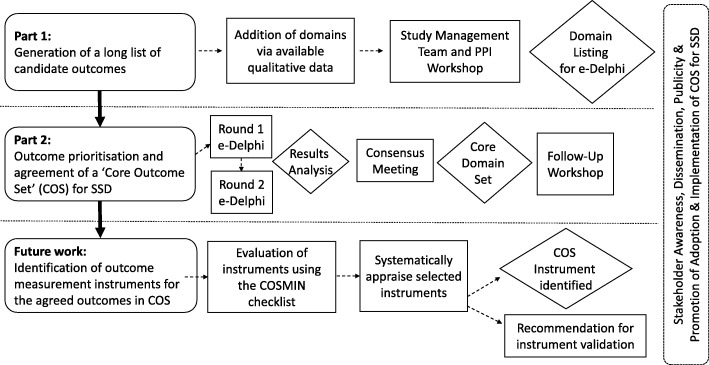
Methods/design: The CROSSSD study adopts an international two-round online modified Delphi survey followed by a stakeholder consensus meeting to identify a patient-centred core outcome domain set for SSD based on what is considered critical and important for assessing whether an intervention for SSD has worked.
Discussion: The resulting core outcome domain set will act as a minimum standard for reporting in future clinical trials and could have further applications in guiding the use of outcome measures in clinical practice. Standardisation will facilitate comparison of research findings.
Keywords: Consensus methods; Core outcome set; Delphi technique; Single-sided deafness.
Conflict of interest statement
PTK declares receiving research grants and support in kind awarded to his institution for research projects in the field of SSD from manufacturers of hearing devices. All other authors declare that they have no competing interests.
Figures
References
-
- van de Heyning P, Tavora-Vieira D, Mertens G, Van Rompaey V, Rajan GP, Muller J, Hempel JM, Leander D, Polterauer D, Marx M, Usami SI, Kitoh R, Miyagawa M, Moteki H, Smilsky K, Baumgartner WD, Keintzel TG, Sprinzl GM, Wolf-Magele A, Arndt S, Wesarg T, Zirn S, Baumann U, Weissgerber T, Rader T, Hagen R, Kurz A, Rak K, Stokroos R, George E, Polo R, Medina MDM, Henkin Y, Hilly O, Ulanovski D, Rajeswaran R, Kameswaran M, Di Gregorio MF, Zernotti ME. Towards a unified testing framework for single-sided deafness studies: a consensus paper. Audiol Neurootol. 2016;21(6):391–398. doi: 10.1159/000455058. - DOI - PMC - PubMed
-
- Daniels RL, Swallow C, Shelton C, Davidson HC, Krejci CS, Harnsberger HR. Causes of unilateral sensorineural hearing loss screened by high-resolution fast spin echo magnetic resonance imaging: review of 1,070 consecutive cases. Otol Neurotol. 2000;21(2):173–180. - PubMed
-
- Staecker H, Nadol JB, Jr, Ojeman R, Ronner S, McKenna MJ. Hearing preservation in acoustic neuroma surgery: middle fossa versus retrosigmoid approach. Otol Neurotol. 2000;21(3):399–404. - PubMed
Publication types
MeSH terms
Grants and funding
LinkOut - more resources
Full Text Sources
Medical
