


Networks and long-range mobility in cities: A study of more than one billion taxi trips in New York City
- PMID: 32132592
- PMCID: PMC7055277
- DOI: 10.1038/s41598-020-60875-w
Networks and long-range mobility in cities: A study of more than one billion taxi trips in New York City
Abstract
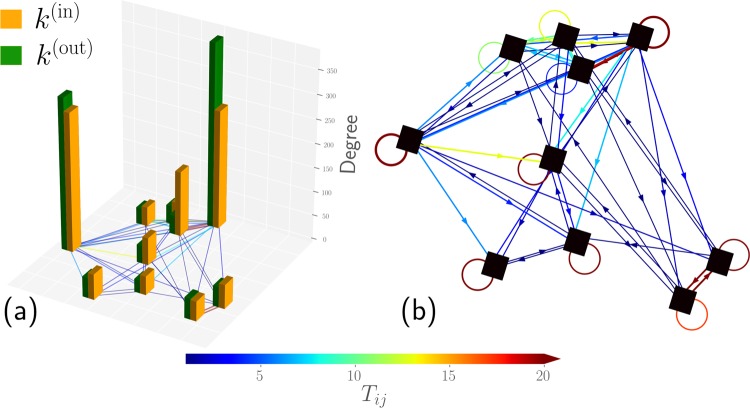
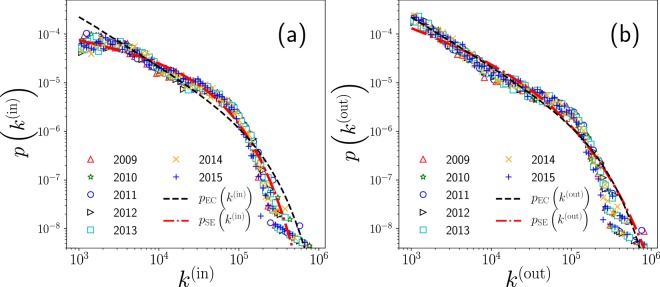
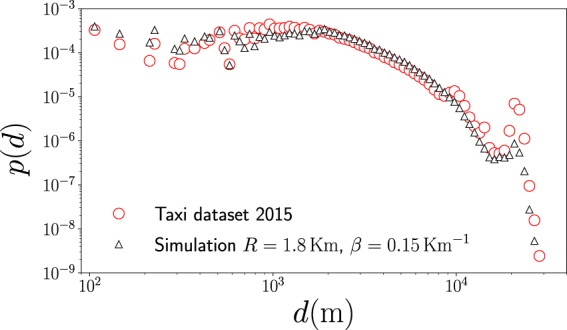
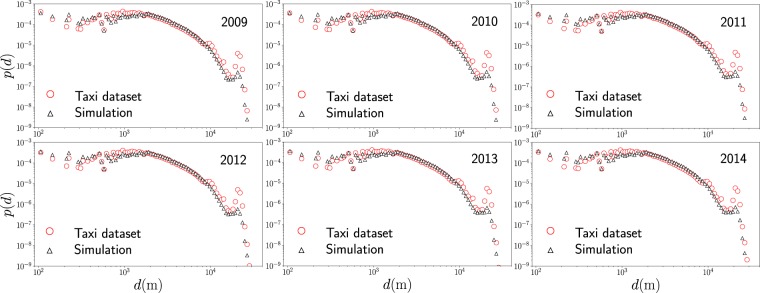
We analyze the massive data set of more than one billion taxi trips in New York City, from January 2009 to December 2015. With these records of seven years, we generate an origin-destination matrix that has information of a vast number of trips. The mobility and flow of taxis can be described as a directed weighted network that connects different zones of high demand for taxis. This network has in and out degrees that follow a stretched exponential and a power law with an exponential cutoff distributions, respectively. Using the origin-destination matrix, we obtain a rank, called "OD rank", analogous to the page rank of Google, that gives the more relevant places in New York City in terms of taxi trips. We introduced a model that captures the local and global dynamics that agrees with the data. Considering the taxi trips as a proxy of human mobility in cities, it might be possible that the long-range mobility found for New York City would be a general feature in other large cities around the world.
Conflict of interest statement
The authors declare no competing interests.
Figures
References
-
- Batty, M. The New Science of Cities (MIT Press, Cambridge, MA, 2013).
-
- Barthélemy, M. The Structure and Dynamics of Cities: Urban Data Analysis and Theoretical Modeling (Cambridge University Press, 2016).
-
- Barbosa H, et al. Human mobility: Models and applications. Phys. Rep. 2018;734:1–74. doi: 10.1016/j.physrep.2018.01.001. - DOI
Publication types
LinkOut - more resources
Full Text Sources
