. 2020 Mar 4;10(1):3981.
doi: 10.1038/s41598-020-60970-y.

Evaluation of the Effect of Ciprofloxacin and Vancomycin on Mechanical Properties of PMMA Cement; a Preliminary Study on Molecular Weight

Affiliations

Evaluation of the Effect of Ciprofloxacin and Vancomycin on Mechanical Properties of PMMA Cement; a Preliminary Study on Molecular Weight

Marzieh Gandomkarzadeh et al. Sci Rep. .

Abstract

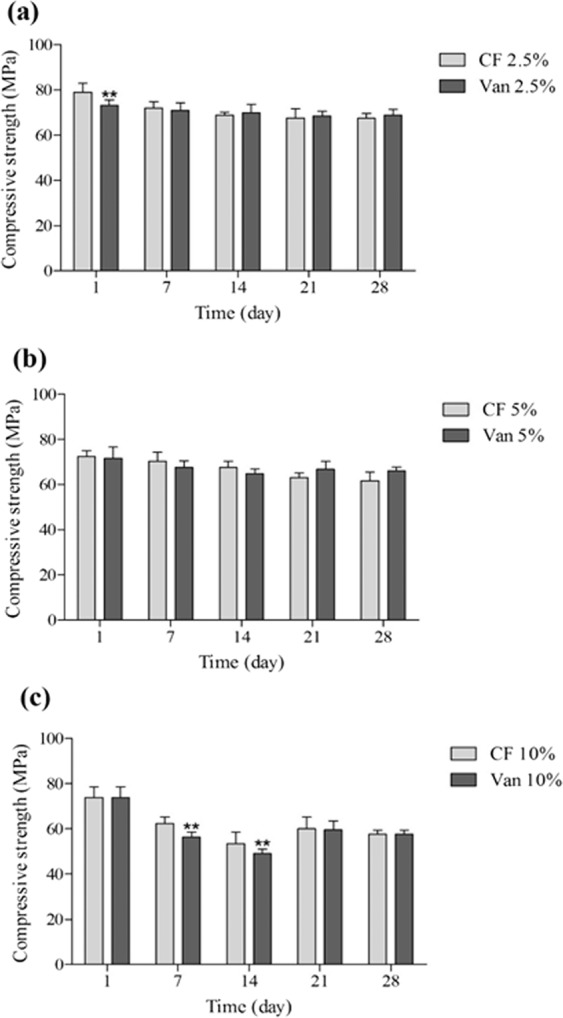
Antibiotic-loaded bone cement (ALBC) is commonly used in joint replacement therapy for prevention and treatment of bone infection and mechanical properties of the cement is still an important issue. The effects of ciprofloxacin and vancomycin was investigated on mechanical characterization of PMMA bone cement. Different properties of cement containing (0, 2.5, 5 and 10% W/W) antibiotics, including compressive and bending properties, microstructural, porosity and density were evaluated. Both antibiotics significantly reduced the density values and mechanical properties (compressive and flexural strength and modulus) in all groups in comparison to control over first two weeks (p < 0.05). This reduction was due to increased porosity upon antibiotic addition (3.05 and 3.67% for ciprofloxacin and vancomycin, respectively) in comparison to control (2.08%) (p < 0.001) and exposure to aqueous medium. Vancomycin as antibiotic with higher molecular weight (MW = 1485) had significant effect on compressive strength reduction of the cement at high amount compared to ciprofloxacin (MW = 367) (P < 0.01), there was no difference between two antibiotics at lower concentrations (P > 0.05). The effect of antibiotic loading is both molecular weight and drug content dependent. The time is also an important parameter and the second week is the probably optimum time to study mechanical behavior of ALBC.


Conflict of interest statement

The authors declare no competing interests.

Figures

Figure 1
Figure 1
The effect of different concentrations of ciprofloxacin (CF) and vancomycin (Van) (0% ----; 2.5% ─; 5% -─-, 10%--─) on the compressive properties of bone cement after ageing in distilled water at 37 ± 1 °C over 28 days (Mean ± SD, n = 5).
Figure 2
Figure 2
Comparison of the effect of different concentrations of ciprofloxacin (CF) and vancomycin (Van) (0% ----; 2.5% ─; 5% -─-, 10%--─) on the bending properties of bone cement after ageing in distilled water at 37 ± 1 °C over 28 days (Mean ± SD, n = 5).
Figure 3
Figure 3
The compression strength of bone cements containing 2.5, 5 and 10% of ciprofloxacin (CF) and vancomycin (Van) for 28 days (MPa, Mean ± SD, n = 5), **P < 0.01; statistically different from ciprofloxacin group.
Figure 4
Figure 4
The microstructures of the fractured surfaces of dry bone cement, (a) cement without antibiotic (control group), (b) cement containing ciprofloxacin and (c) cement containing vancomycin.
Figure 5
Figure 5
The microstructures of the intact and fractured surfaces of bone cement after 14 days of degradation at 37 ± 1 °C in distilled water, (a) cement without antibiotic (control group), (b) cement containing ciprofloxacin and (c) cement containing vancomycin.

References

    1. Amin TJ, Lamping JW, Hendricks KJ, McIff TE. Increasing the Elution of Vancomycin from High-Dose Antibiotic-Loaded Bone Cement: A Novel Preparation Technique. J. Bone Jt. Surg. 2012;94:1946–1951. doi: 10.2106/jbjs.l.00014. - DOI - PubMed
    1. Wenke JC, Owens BD, Svoboda SJ, Brooks DE. Effectiveness of commercially-available antibiotic-impregnated implants. J. Bone Jt. Surg. Br. 2006;88:1102–1104. doi: 10.1302/0301-620X.88B8.17368. - DOI - PubMed
    1. Anagnostakos K, Kelm J. Enhancement of antibiotic elution from acrylic bone cement. J. Biomed. Mater. Res. B Appl. Biomater. 2009;90:467–475. doi: 10.1002/jbm.b.31281. - DOI - PubMed
    1. Frutos Cabanillas P, Díez Peña E, Barrales-Rienda JM, Frutos G. Validation and in vitro characterization of antibiotic-loaded bone cement release. Int. J. Pharm. 2000;209:15–26. doi: 10.1016/S0378-5173(00)00520-2. - DOI - PubMed
    1. Gutowski CJ, Zmistowski BM, Clyde CT, Parvizi J. The economics of using prophylactic antibiotic-loaded bone cement in total knee replacement. Bone Jt. J. 2014;96-B:65–69. doi: 10.1302/0301-620X.96B1.31428. - DOI - PubMed

Publication types