. 2020 Feb 18;11(7):671-686.
doi: 10.18632/oncotarget.27461.

Randomized, double-blind trial of F14512, a polyamine-vectorized anticancer drug, compared with etoposide phosphate, in dogs with naturally occurring lymphoma

Affiliations

Randomized, double-blind trial of F14512, a polyamine-vectorized anticancer drug, compared with etoposide phosphate, in dogs with naturally occurring lymphoma

Pierre Boyé et al. Oncotarget. .

Abstract

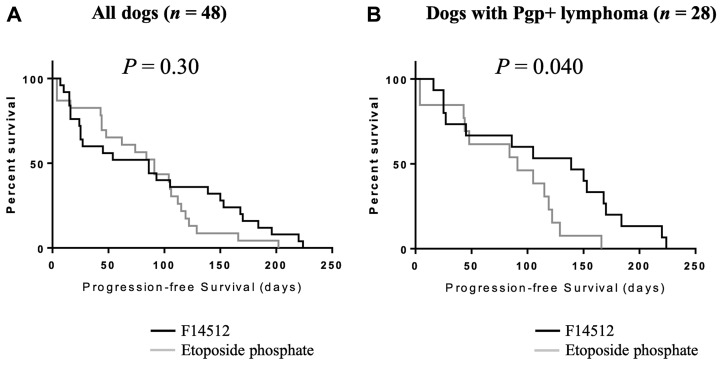
Purpose: F14512 is an epipodophyllotoxin derivative from etoposide, combined with a spermine moiety introduced as a cell delivery vector. The objective of this study was to compare the safety and antitumor activity of F14512 and etoposide phosphate in dogs with spontaneous non-Hodgkin lymphoma (NHL) and to investigate the potential benefit of F14512 in P-glycoprotein (Pgp) overexpressing lymphomas. Experimental Design: Forty-eight client-owned dogs with intermediate to high-grade NHL were enrolled into a randomized, double-blind trial of F14512 versus etoposide phosphate. Endpoints included safety and therapeutic efficacy. Results: Twenty-five dogs were randomized to receive F14512 and 23 dogs to receive etoposide phosphate. All adverse events (AEs) were reversible, and no treatment-related death was reported. Hematologic AEs were more severe with F14512 and gastrointestinal AEs were more frequent with etoposide phosphate. F14512 exhibited similar response rate and progression-free survival (PFS) as etoposide phosphate in the global treated population. Subgroup analysis of dogs with Pgp-overexpressing NHL showed a significant improvement in PFS in dogs treated with F14512 compared with etoposide phosphate. Conclusion: F14512 showed strong therapeutic efficacy against spontaneous NHL and exhibited a clinical benefice in Pgp-overexpressing lymphoma superior to etoposide phosphate. The results clearly justify the evaluation of F14512 in human clinical trials.

Keywords: F14512; P-glycoprotein; etoposide phosphate; non-Hodgkin lymphoma; pet dog model.


Conflict of interest statement

CONFLICTS OF INTEREST The authors declare no potential conflicts of interest.

Figures
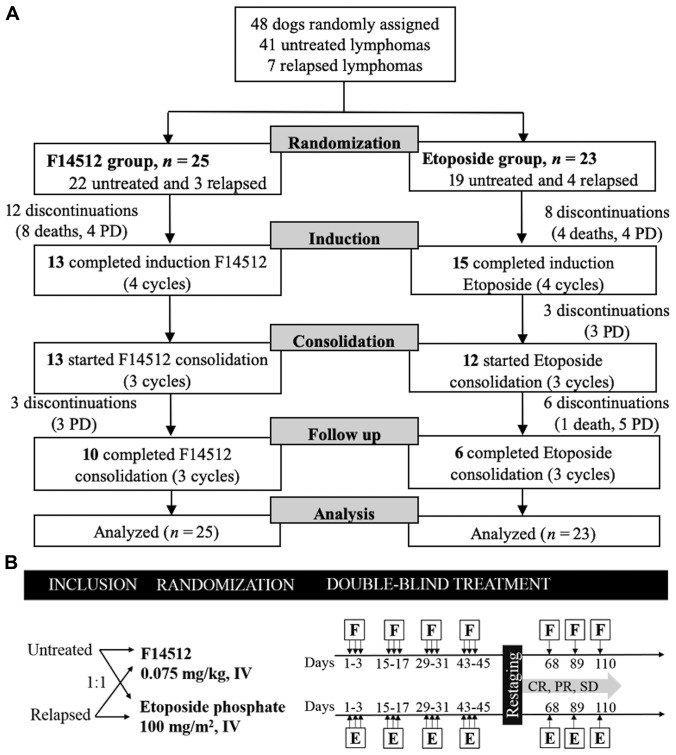
Figure 1
Figure 1. Trial design.
(A) Flow diagram for the trial. Enrollment of 48 dogs randomized to receive F14512 (n = 25) or etoposide phosphate (n = 23). (B) Schematics of study design. Black arrows indicate time of treatment administration. CR: complete response, E: etoposide phosphate, F: F14512, IV: intravenous, PD: progressive disease, PR: partial response, SD: stable disease.
Figure 2
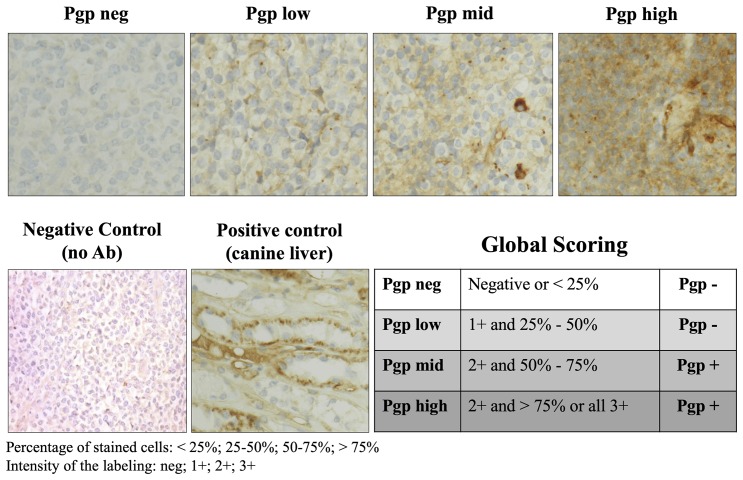
Figure 2. P-glycoprotein expression evaluated by immunohistochemistry in lymph node tumor cells.
Microscopic photographs of lymph node histology stained with a primary mouse anti-human P-glycoprotein clone C494 antibody (ALX-801–003-C100, lab Enzo life sciences). Original magnification ×40. Normal canine liver was used as a positive control for P-glycoprotein analysis. Non-immune serum substituted to C494 on lymph node tissues was used as a negative control. Immunohistochemical score method was then evaluated by a scoring system adapted from Lee and colleagues as follows: negative (neg, less than 25% stained cells), low (more than 25% but less than 50% of the tumor cells are stained with a light staining), moderate (mid, more than 50% but less than 75% of the tumor cells are stained with moderate intensity), high (more than 75% are stained with a moderate to high intensity). Negative and Low Pgp expression was included in the Pgp- group; Mid and High expression was included in the Pgp+ group. Ab: antibody; Pgp: P-glycoprotein.
Figure 3
Figure 3. Kaplan-Meier curves by treatment group for progression-free survival.
(A) The entire cohort, n = 48. (B) Dogs with Pgp-overexpressing lymphoma (Pgp+), n = 28. Log-rank P values are shown
Figure 4
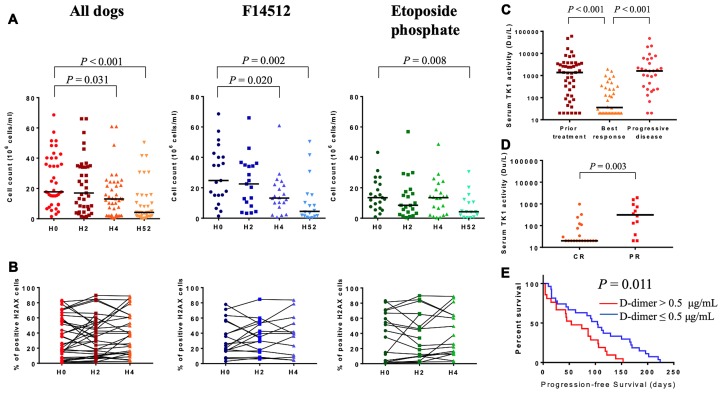
Figure 4. Exploratory biomarkers.
(A) Total surviving cells count measured by flow cytometric analysis at H0, H2, H4 and H52 following treatment initiation. Drug infusion was started at H0. The horizontal bars represent median. (B) Percentage of γ-H2AX expression in surviving cells at H0, H2, H4 following treatment initiation. Groups were compared using Wilcoxon rank test. (C) Serum thymidine kinase 1 activity (Du/L) in dogs prior to treatment initiation (n = 48), at the time of the best clinical response (n = 36) and at the time of progressive disease (n = 30). Minimum detectable activity for this assay: 20 Du/L. The horizontal bars represent median. (D) Serum thymidine kinase 1 activity in dogs with complete (CR, n = 20) and partial (PR, n = 12) response. Minimum detectable activity for this assay: 20 Du/L. The horizontal bars represent median. Levels of sTK1 activity between groups were compared using Wilcoxon rank test. (E) Kaplan-Meier curve in dogs with high (> 0.5 μg/mL, n = 21) or low (≤ 0.5 μg/mL, n = 27) pretreatment D-dimer levels. Log-rank P value is shown.

References

    1. Vail DM, MacEwen EG. Spontaneously occurring tumors of companion animals as models for human cancer. Cancer Invest. 2000; 18:781–792. 10.3109/07357900009012210. - DOI - PubMed
    1. Rowell JL, McCarthy DO, Alvarez CE. Dog models of naturally occurring cancer. Trends Mol Med. 2011; 17:380–388. 10.1016/j.molmed.2011.02.004. - DOI - PMC - PubMed
    1. LeBlanc AK, Breen M, Choyke P, Dewhirst M, Fan TM, Gustafson DL, Helman LJ, Kastan MB, Knapp DW, Levin WJ, London C, Mason N, Mazcko C, et al. Perspectives from man’s best friend: National Academy of Medicine’s Workshop on Comparative Oncology. Sci Transl Med. 2016; 8:324ps5. 10.1126/scitranslmed.aaf0746. - DOI - PMC - PubMed
    1. Ponce F, Marchal T, Magnol JP, Turinelli V, Ledieu D, Bonnefont C, Pastor M, Delignette ML, Fournel-Fleury C. A morphological study of 608 cases of canine malignant lymphoma in France with a focus on comparative similarities between canine and human lymphoma morphology. Vet Pathol. 2010; 47:414–433. 10.1177/0300985810363902. - DOI - PubMed
    1. Seelig DM, Avery AC, Ehrhart EJ, Linden MA. The Comparative Diagnostic Features of Canine and Human Lymphoma. Vet Sci. 2016; 3:11. 10.3390/vetsci3020011. - DOI - PMC - PubMed