


Phase-adjusted estimation of the number of Coronavirus Disease 2019 cases in Wuhan, China
- PMID: 32133152
- PMCID: PMC7039910
- DOI: 10.1038/s41421-020-0148-0
Phase-adjusted estimation of the number of Coronavirus Disease 2019 cases in Wuhan, China
Abstract
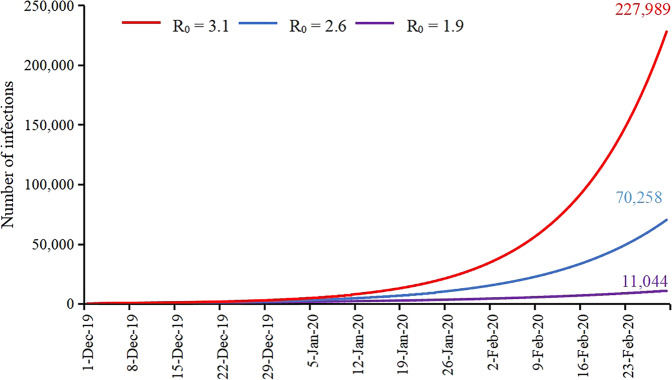
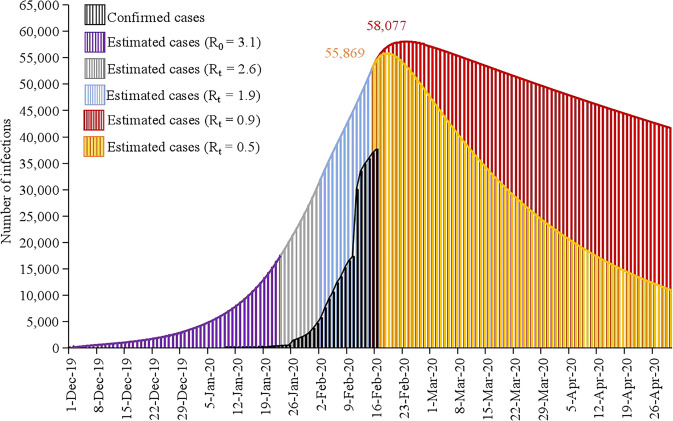
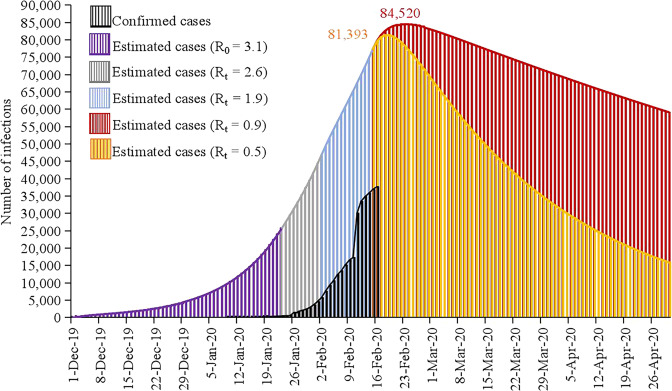
An outbreak of clusters of viral pneumonia due to a novel coronavirus (2019-nCoV/SARS-CoV-2) happened in Wuhan, Hubei Province in China in December 2019. Since the outbreak, several groups reported estimated R0 of Coronavirus Disease 2019 (COVID-19) and generated valuable prediction for the early phase of this outbreak. After implementation of strict prevention and control measures in China, new estimation is needed. An infectious disease dynamics SEIR (Susceptible, Exposed, Infectious, and Removed) model was applied to estimate the epidemic trend in Wuhan, China under two assumptions of Rt . In the first assumption, Rt was assumed to maintain over 1. The estimated number of infections would continue to increase throughout February without any indication of dropping with Rt = 1.9, 2.6, or 3.1. The number of infections would reach 11,044, 70,258, and 227,989, respectively, by 29 February 2020. In the second assumption, Rt was assumed to gradually decrease at different phases from high level of transmission (Rt = 3.1, 2.6, and 1.9) to below 1 (Rt = 0.9 or 0.5) owing to increasingly implemented public health intervention. Several phases were divided by the dates when various levels of prevention and control measures were taken in effect in Wuhan. The estimated number of infections would reach the peak in late February, which is 58,077-84,520 or 55,869-81,393. Whether or not the peak of the number of infections would occur in February 2020 may be an important index for evaluating the sufficiency of the current measures taken in China. Regardless of the occurrence of the peak, the currently strict measures in Wuhan should be continuously implemented and necessary strict public health measures should be applied in other locations in China with high number of COVID-19 cases, in order to reduce Rt to an ideal level and control the infection.
Keywords: Autoimmunity; Immunology.
© The Author(s) 2020.
Conflict of interest statement
Conflict of interestThe authors declare that they have no conflict of interest.
Figures
References
-
- Chan Jasper Fuk-Woo, Yuan Shuofeng, Kok Kin-Hang, To Kelvin Kai-Wang, Chu Hin, Yang Jin, Xing Fanfan, Liu Jieling, Yip Cyril Chik-Yan, Poon Rosana Wing-Shan, Tsoi Hoi-Wah, Lo Simon Kam-Fai, Chan Kwok-Hung, Poon Vincent Kwok-Man, Chan Wan-Mui, Ip Jonathan Daniel, Cai Jian-Piao, Cheng Vincent Chi-Chung, Chen Honglin, Hui Christopher Kim-Ming, Yuen Kwok-Yung. A familial cluster of pneumonia associated with the 2019 novel coronavirus indicating person-to-person transmission: a study of a family cluster. The Lancet. 2020;395(10223):514–523. doi: 10.1016/S0140-6736(20)30154-9. - DOI - PMC - PubMed
-
- World Health Organization. Pneumonia of unknown cause—China. https://www.who.int/csr/don/05-january-2020-pneumonia-of-unkown-cause-ch....
-
- WHO. Novel Coronavirus(2019-nCoV) Situation Report—22. https://www.who.int/docs/default-source/coronaviruse/situation-reports/2....
-
- World Health Organization. Novel Coronavirus—China. https://www.who.int/csr/don/12-january-2020-novel-coronavirus-china/en/.
LinkOut - more resources
Full Text Sources
Other Literature Sources
Miscellaneous
