. 2020 Feb 18:10:41.
doi: 10.3389/fcimb.2020.00041. eCollection 2020.

Tick-Borne Encephalitis Virus Infection Alters the Sialome of Ixodes ricinus Ticks During the Earliest Stages of Feeding

Affiliations

Tick-Borne Encephalitis Virus Infection Alters the Sialome of Ixodes ricinus Ticks During the Earliest Stages of Feeding

Charles E Hart et al. Front Cell Infect Microbiol. .

Abstract

Ticks are hematophagous arthropods that transmit a number of pathogens while feeding. Among these is tick-borne encephalitis virus (TBEV), a flavivirus transmitted by Ixodes ricinus ticks in the temperate zone of Europe. The infection results in febrile illness progressing to encephalitis and meningitis with a possibility of fatality or long-term neurological sequelae. The composition of tick saliva plays an essential role in the initial virus transmission during tick feeding. Ticks secrete a diverse range of salivary proteins to modulate the host response, such as lipocalins to control the itch and inflammatory response, and both proteases and protease inhibitors to prevent blood coagulation. Here, the effect of viral infection of adult females of Ixodes ricinus was studied with the goal of determining how the virus alters the tick sialome to modulate host tissue response at the site of infection. Uninfected ticks or those infected with TBEV were fed on mice and removed and dissected one- and 3-h post-attachment. RNA from the salivary glands of these ticks, as well as from unfed ticks, was extracted and subjected to next-generation sequencing to determine the expression of key secreted proteins at each timepoint. Genes showing statistically significant up- or down-regulation between infected and control ticks were selected and compared to published literature to ascertain their function. From this, the effect of tick viral infection on the modulation of the tick-host interface was determined. Infected ticks were found to differentially express a number of uncategorized genes, proteases, Kunitz-type serine protease inhibitors, cytotoxins, and lipocalins at different timepoints. These virus-induced changes to the tick sialome may play a significant role in facilitating virus transmission during the early stages of tick feeding.

Keywords: immunomodulation; tick feeding; tick sialome; tick-borne encephalitis virus; vector-skin interface.


Figures

Figure 1
Figure 1
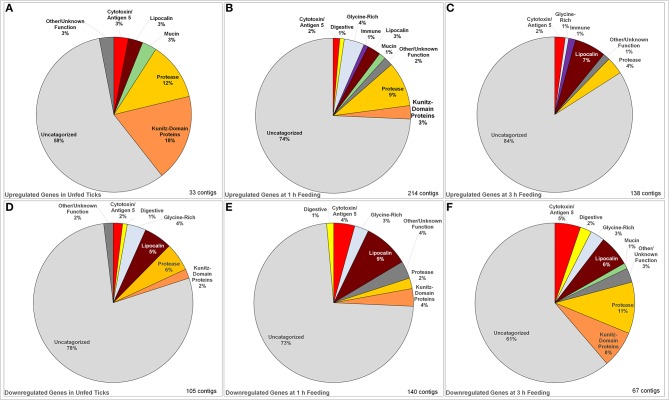
Identified categories of saliva-associated genes in Ixodes ricinus ticks upregulated and downregulated in response to tick infection with TBEV. Upregulation was observed in unfed ticks (A), ticks after 1 h of feeding (B), and ticks after 3 h of feeding (C) showing an overall increase in the number of genes upregulated. The dominant change in upregulation is in uncategorized genes, with the proportion of proteases and serine protease inhibitors decreasing with feeding while upregulation of lipocalins increase. Downregulation was also observed in unfed ticks (D) as well as those at 1 h (E) and 3 h (F) of feeding. In downregulated genes, the proportion of uncharacterized genes decreased while the downregulation of proteases, lipocalins, serine protease inhibitors, and cytotoxins became dominant.
Figure 2
Figure 2
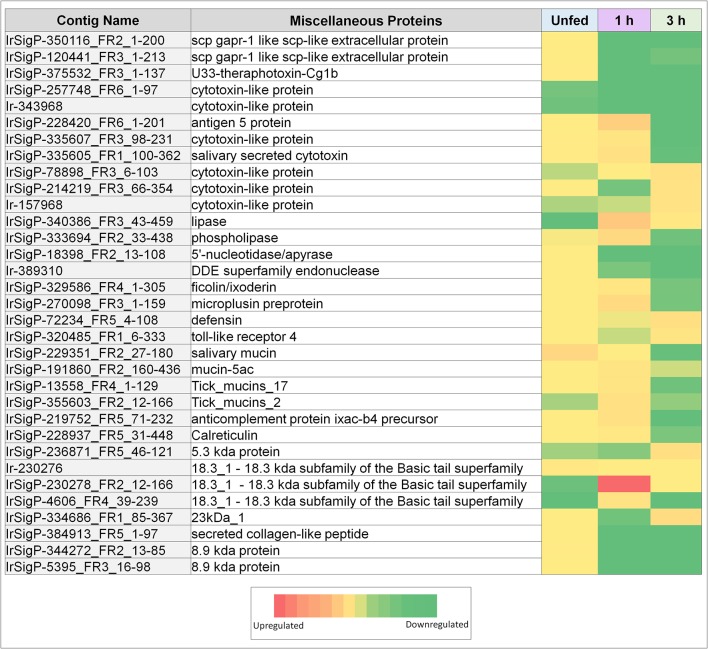
Heatmaps of several categories of genes identified in salivary glands of Ixodes ricinus ticks as up or down regulated in response to TBEV infection, including miscellaneous genes (cytotoxins, anti-microbial genes, and mucins). Regulation is generally most influenced at a single timepoint, often as the inverse of the pattern seen in other timepoints. Expression in each category is also not consistent between proteins, indicating that expression of each individual gene is not equivalent, and under complex regulatory control.
Figure 3
Figure 3
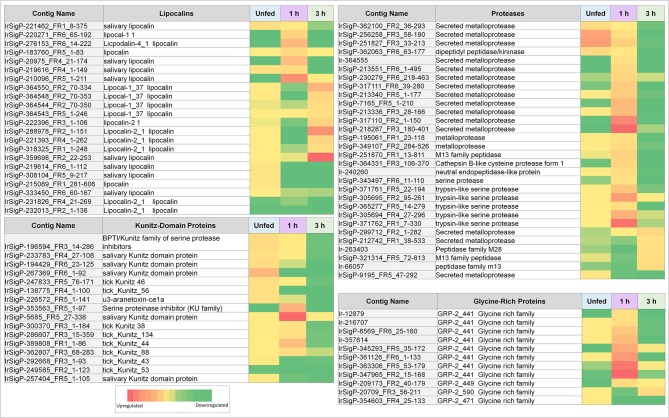
Heatmaps of several categories of genes identified in salivary glands of Ixodes ricinus ticks as up or down regulated in response to TBEV infection, including lipocalins, proteases, and protease inhibitors (largely Kunitz-type). Regulation is generally most influenced at a single timepoint, often as the inverse of the pattern seen in other timepoints. Expression in each category is also not consistent between proteins, indicating that expression of each individual gene is not equivalent and under complex regulatory control.

Similar articles

Cited by

References

    1. Ali A., Parizi L. F., Guizzo M. G., Tirloni L., Seixas A., Vaz I. S., Jr., et al. . (2015). Immunoprotective potential of a Rhipicephalus (Boophilus) microplus metalloprotease. Vet. Parasitol. 207, 107–114. 10.1016/j.vetpar.2014.11.007 - DOI - PubMed
    1. Ali A., Triloni L., Isezaki M., Seixas A., Konnai S., Ohashi K., et al. . (2014). Reprolysin metalloproteases from Ixodes persculatus, Rhipicephalus sanguineus and Rhipicephalus microplus ticks. Exp. Appl. Acarol. 63, 559–578. 10.1007/s10493-014-9796-9 - DOI - PubMed
    1. Andreotti R., Cunha R. C., Soares M. A., Guerrero F. D., Leite F. P. L., de Leon A. A. P. (2012). Protective immunity against tick infestation in cattle vaccinated with recombinant typsin inhibitor of Rhipicephalus microplus. Vaccine 30, 6678–6685. 10.1016/j.vaccine.2012.08.066 - DOI - PubMed
    1. Assumpção T. C., Ma D., Mizurini D. M., Kini R. M., Ribeiro J. M. C., Kotsyfakis M., et al. . (2015). In vitro mode of action and anti-thrombotic activity of boophilin, a multifunctional Kunitz protease inhibitor from the midgut of a tick vector of babesiosis, Rhipicephalus microplus. PLoS Negl. Trop. Dis. 10:e0004298. 10.1371/journal.pntd.0004298 - DOI - PMC - PubMed
    1. Barnard A. C., Nijhof A. M., Gaspar A. R. M., Neitz A. W. H., Jongejan F., Maritz-Olivier C. (2012). Expression profiling, gene silencing and transcriptional networking of metzincin metalloproteases in the cattle tick. Vet. Parasitol. 186, 403–414. 10.1016/j.vetpar.2011.11.026 - DOI - PubMed

Publication types