. 2019:1:27.
doi: 10.1186/s42490-019-0027-7. Epub 2019 Oct 29.

In vitro tissue-engineered adipose constructs for modeling disease

Affiliations

In vitro tissue-engineered adipose constructs for modeling disease

Connor S Murphy et al. BMC Biomed Eng. 2019.

Abstract

Background: Adipose tissue is a vital tissue in mammals that functions to insulate our bodies, regulate our internal thermostat, protect our organs, store energy (and burn energy, in the case of beige and brown fat), and provide endocrine signals to other organs in the body. Tissue engineering of adipose and other soft tissues may prove essential for people who have lost this tissue from trauma or disease.

Main text: In this review, we discuss the applications of tissue-engineered adipose tissue specifically for disease modeling applications. We provide a basic background to adipose depots and describe three-dimensional (3D) in vitro adipose models for obesity, diabetes, and cancer research applications.

Conclusions: The approaches to engineering 3D adipose models are diverse in terms of scaffold type (hydrogel-based, silk-based and scaffold-free), species of origin (H. sapiens and M. musculus) and cell types used, which allows researchers to choose a model that best fits their application, whether it is optimization of adipocyte differentiation or studying the interaction of adipocytes and other cell types like endothelial cells. In vitro 3D adipose tissue models support discoveries into the mechanisms of adipose-related diseases and thus support the development of novel anti-cancer or anti-obesity/diabetes therapies.

Keywords: 3D culture; In vitro models; adipocytes; cancer; fat; obesity; tissue engineering; tissue-engineered adipose tissue; type 2 diabetes.


Conflict of interest statement

The Reagan laboratory was also supported by Union Chemique Belge, but that contractual funding had no effect on the content within this review article. The Liaw lab (senior author of Boucher et al. 2018) did not receive funding from Union Chemique Belge or other funding sources that would warrant the declaration of a competing interest.

Figures
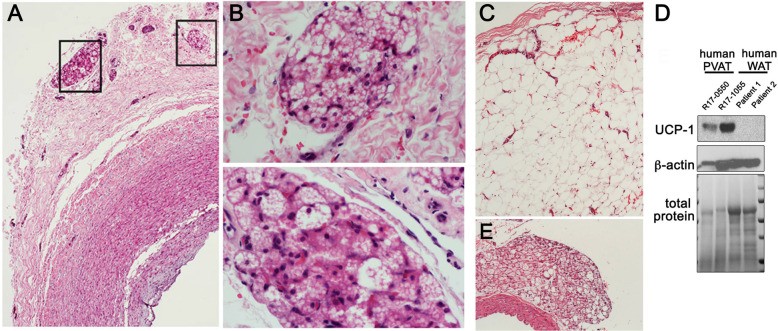
Fig. 1
Fig. 1
Human aortic PVAT has features of thermogenic adipose tissue. a Shown is a carotid artery with surrounding adventitia and PVAT from a 1-month old human donor. b Note the pockets of brown-like adipose tissue (boxed), that are morphologically indistinguishable from brown adipose tissue. c Human PVAT surrounding aorta was collected from an adult during open-heart surgery, and morphologically resembles WAT. However, compared to subcutaneous human WAT, human aortic PVAT, even from patients with cardiovascular disease, express the thermogenic adipocyte marker UCP-1. d Western immunoblot of human PVAT and subcutaneous WAT for the indicated proteins. R17–0550 and R17–1055 represent samples from two different patients. Reprinted by permission from RightsLink: Springer Nature, Cardiovascular Drugs and Therapy, Boucher et al. 2018. e Mouse PVAT from the thoracic aorta is shown for comparison, and has a brown fat-like thermogenic phenotype and protein profile
Fig. 2
Fig. 2
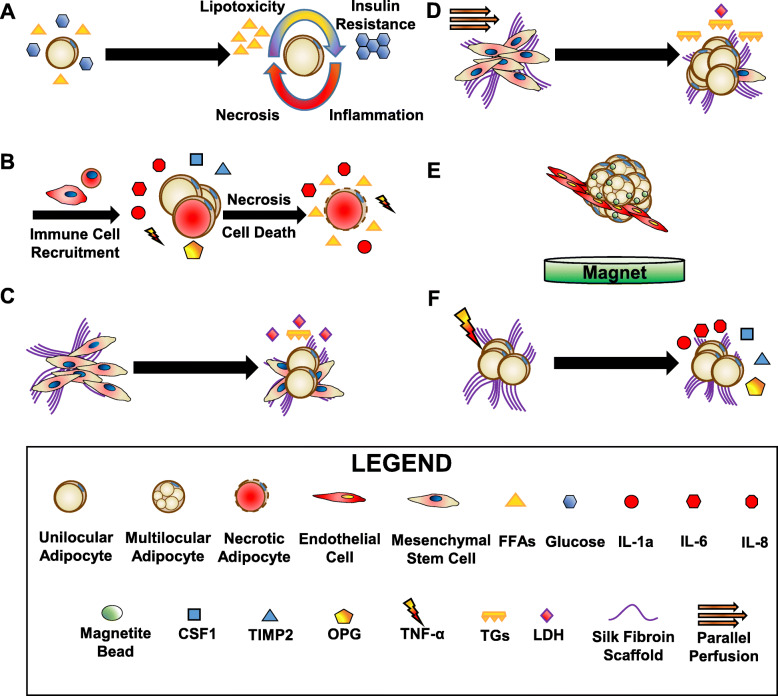
Overview of the effects of obesity on adipocytes and 3D tissue-engineered adipose models of obesity. a During obesity, excess calories (whether from free fatty acids (FFAs) or glucose) cause adipocytes to become hypertrophic. The increase in FFAs causes activation of oxidative and endoplasmic reticulum (ER) stress and subsequent secretion of cytokines and adipokines. Oxidative and ER stress cause insulin resistance by negatively regulating insulin signaling. As inflammation and adipocyte size increase, oxygen is unable to penetrate the adipose tissue causing hypoxia, necrosis and eventually cell death. b Hypertrophic adipocytes secrete chemokines (C-C motif chemokine ligand 2 (CCL2), CCL8, CCL5, colony stimulating factor 1 (CSF1)) and cytokines that attract immune cells, mainly macrophages. Adipose tissue macrophages can secrete anti-inflammatory factors (interleukin-10 (IL-10) and IL-1) and pro-inflammatory factors (tumor necrosis factor α, (TNF-α), IL-6 and IL-1β). Inflammation can cause necrosis and cell death, further releasing pro-inflammatory molecules like cytokines and excess lipids, perpetuating the cycle of chronic low-grade inflammation. c and d Bellas et al. 2013 and Abbott et al. 2015 both demonstrated the benefits of perfusion (d, yellow-orange arrows) compared to static culture (c) for human mesenchymal stem cell (hMSC)-derived adipocytes differentiated on silk fibroin scaffolds (e.g. increased differentiation, triacylglycerols (TGs), and viable culture time, and decreased the damage-associated protein, lactate dehydrogenase (LDH)). e Daquinag et al. 2013 co-cultured 3 T3-L1 preadipocytes with the endothelial cell line bEND.3 embedded with magnetite nanoparticles. f Abbott et al. 2016 obtained adipocyte-derived stem cells from lipoaspirates and seeded and differentiated these cells on silk scaffolds. These cultures secreted factors found in both obesity (IL1-α, osteoprotegerin (OPG), and tissue inhibitor of metalloproteinases 2 (TIMP2)) and type 2 diabetes mellitus (IL-6 and IL-8)
Fig. 3
Fig. 3
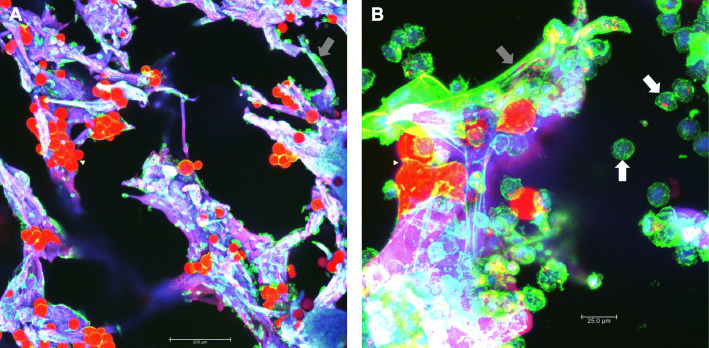
Example of tissue-engineered bone marrow adipose tissue. Silk scaffolds were used as a platform to make 3D, tissue-engineered bone marrow adipose tissue (BMAT). a Mouse BMAT was differentiated from male, 10-month-old KaLwRij mouse-derived bone marrow mesenchymal stem cells (BM-MSCs). Briefly, BM-MSCs were seeded onto scaffolds and cultured for 6 days, then put into adipogenic media for 10 days, put into a maintenance media for 1 week, and finally imaged. Scale bar = 200 μm. b Mouse-derived BM-MSCs were treated as above up until adipogenesis then the mouse myeloma cell line, 5TGM1s, were co-culture with the differentiated adipocytes for 1 week in maintenance media. Scale bar = 25.0 μm. Samples were stained Oil Red O (red) and phalloidin/actin (green). The scaffolds are autofluorescent in all channels and thus appear purple. Imaging was performed with a confocal microscope using maximum projections of Z-stacked images. Many adipocytes are visible (red, white arrowheads), along with many undifferentiated stromal cells (grey arrows). Rounded green myeloma cells are seen throughout the scaffold (white arrows)

References

    1. Mullard A. Parsing clinical success rates. Nat Publ Gr. 2016;15:447. doi: 10.1038/nrd.2016.136. - DOI - PubMed
    1. Dimasi JA, Grabowski HG, Hansen RW. Innovation in the pharmaceutical industry : new estimates of R & D costs. J Health Econ. 2016;47:20–33. doi: 10.1016/j.jhealeco.2016.01.012. - DOI - PubMed
    1. Lee J, Cuddihy MJ, Kotov NA. Three-dimensional cell culture matrices : state of the art. Tissue Eng Part B Rev. 2008;14. 10.1089/teb.2007.0150. - PubMed
    1. Fairfield H, Falank C, Farrell M, Vary C, Boucher JM, Driscoll H, et al. Development of a 3D bone marrow adipose tissue model. Bone. 2019;118:77–88. doi: 10.1016/j.bone.2018.01.023. - DOI - PMC - PubMed
    1. Sitarski AM, Fairfield H, Falank C, Reagan MR. 3D tissue engineered in vitro models of Cancer in bone. ACS Biomater Sci Eng. 2017;2:324–336. doi: 10.1021/acsbiomaterials.7b00097. - DOI - PMC - PubMed

LinkOut - more resources