


Cold aggravates abnormal excitability of motor axons in oxaliplatin-treated patients
- PMID: 32133655
- PMCID: PMC7318596
- DOI: 10.1002/mus.26852
Cold aggravates abnormal excitability of motor axons in oxaliplatin-treated patients
Abstract
Introduction: Cold allodynia is often seen in the acute phase of oxaliplatin treatment, but the underlying pathophysiology remains unclear.
Methods: Patients scheduled for adjuvant oxaliplatin for colorectal cancer were examined with quantitative sensory testing and nerve excitability tests at baseline and after the second or third oxaliplatin cycle at different skin temperatures.
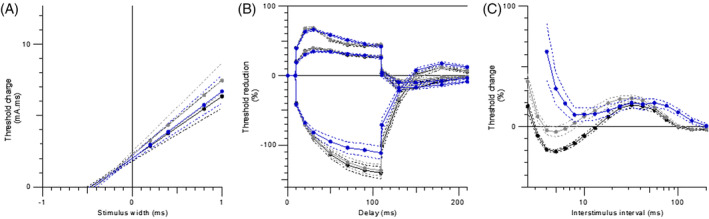
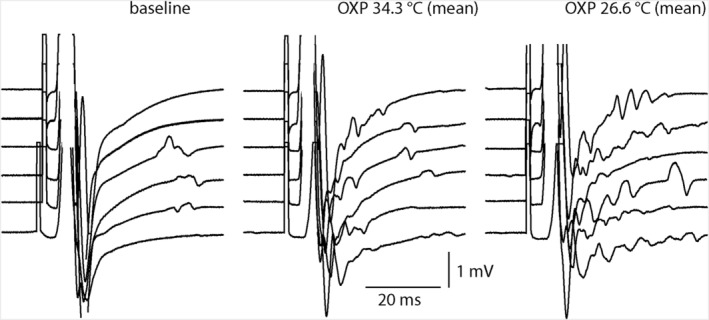
Results: Seven patients were eligible for examination. All patients felt evoked pain and tingling when touching something cold after oxaliplatin infusion. Oxaliplatin decreased motor nerve superexcitability (P < .001), increased relative refractory period (P = .011), and caused neuromyotonia-like after-activity. Cooling exacerbated these changes and prolonged the accommodation half-time.
Discussion: The findings suggest that a combined effect of oxaliplatin and cooling facilitates nerve excitability changes and neuromyotonia-like after-activity in peripheral nerve axons. A possible mechanism is the slowing in gating of voltage-dependent fast sodium and slow potassium channels, which results in symptoms of cold allodynia.
Keywords: allodynia; nerve excitability testing; neuropathy; oxaliplatin toxicity; potassium channel dysfunction; sodium channel dysfunction.
© 2020 The Authors. Muscle & Nerve published by Wiley Periodicals, Inc.
Conflict of interest statement
The authors declare no potential conflicts of interest.
Figures
References
-
- Grothey A. Oxaliplatin‐safety profile: neurotoxicity. Semin Oncol. 2003;30:5‐13. - PubMed
-
- Attal N, Bouhassira D, Gautron M, et al. Thermal hyperalgesia as a marker of oxaliplatin neurotoxicity: a prospective quantified sensory assessment study. Pain. 2009;144:245‐252. - PubMed
-
- Cersosimo RJ. Oxaliplatin‐associated neuropathy: a review. Ann Pharmacother. 2005;39:128‐135. - PubMed
-
- Heide R, Bostock H, Ventzel L, et al. Axonal excitability changes and acute symptoms of oxaliplatin treatment: in vivo evidence for slowed sodium channel inactivation. Clin Neurophysiol. 2018;129:694‐706. - PubMed
Publication types
MeSH terms
Substances
LinkOut - more resources
Full Text Sources
