Synthetic Methods Driven by the Photoactivity of Electron Donor-Acceptor Complexes
- PMID: 32134647
- PMCID: PMC7099579
- DOI: 10.1021/jacs.0c01416
Synthetic Methods Driven by the Photoactivity of Electron Donor-Acceptor Complexes
Abstract
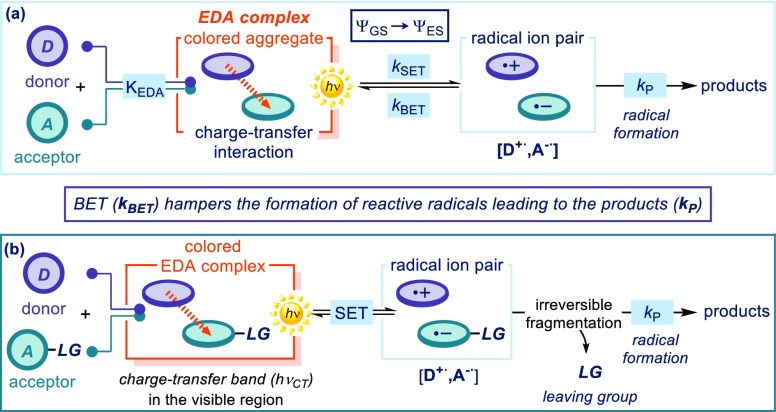
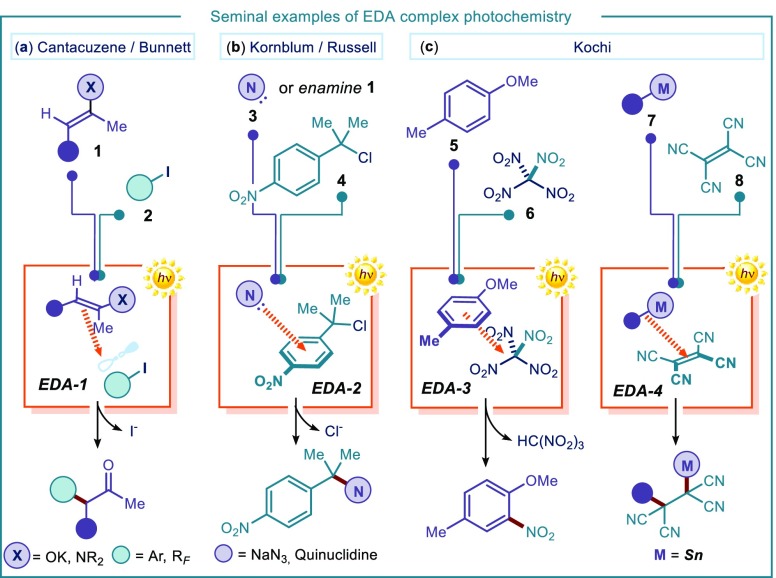
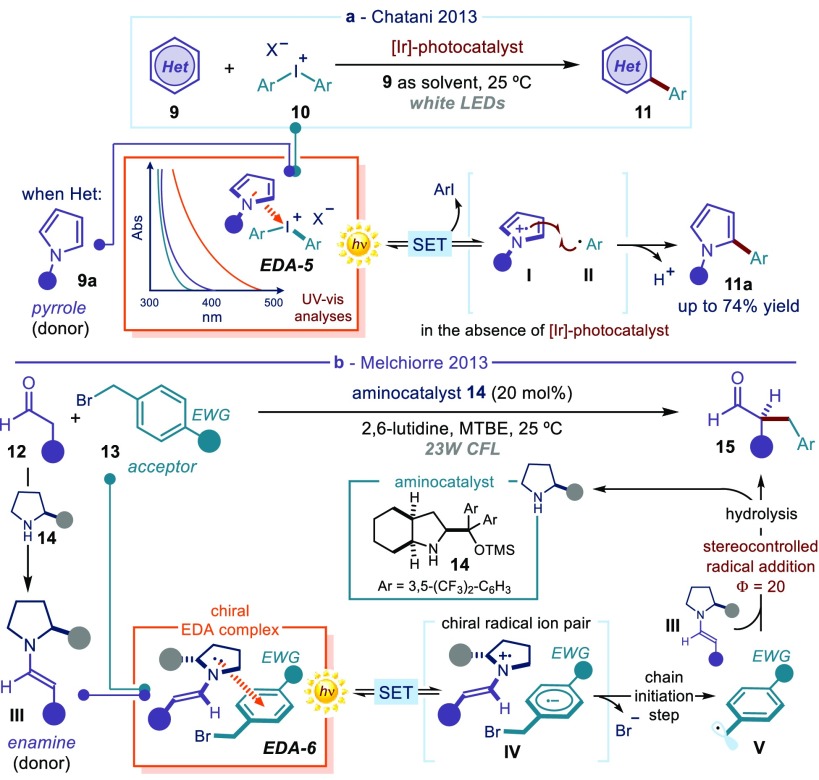
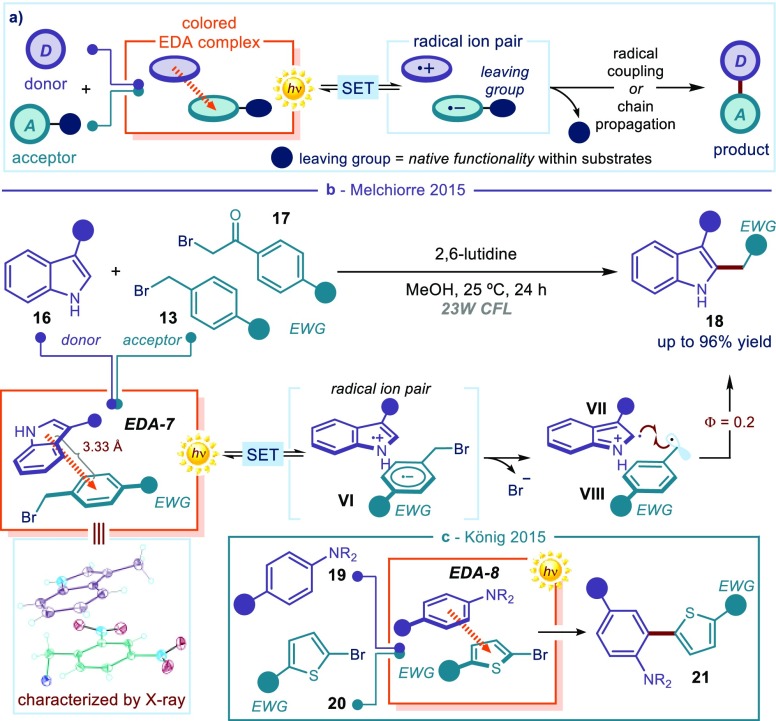
The association of an electron-rich substrate with an electron-accepting molecule can generate a new molecular aggregate in the ground state, called an electron donor-acceptor (EDA) complex. Even when the two precursors do not absorb visible light, the resulting EDA complex often does. In 1952, Mulliken proposed a quantum-mechanical theory to rationalize the formation of such colored EDA complexes. However, and besides a few pioneering studies in the 20th century, it is only in the past few years that the EDA complex photochemistry has been recognized as a powerful strategy for expanding the potential of visible-light-driven radical synthetic chemistry. Here, we explain why this photochemical synthetic approach was overlooked for so long. We critically discuss the historical context, scientific reasons, serendipitous observations, and landmark discoveries that were essential for progress in the field. We also outline future directions and identify the key advances that are needed to fully exploit the potential of the EDA complex photochemistry.
Conflict of interest statement
The authors declare no competing financial interest.
Figures
References
-
- Ciamician G. The Photochemistry of the Future. Science 1912, 36, 385–394. 10.1126/science.36.926.385. - DOI - PubMed
- Ciamician G. Actions Chimiques de la Lumière. Bull. Soc. Chim. Fr. 1908, 3–4, i-xxvii.
- Paternò E. Sintesi in Chimica Organica per Mezzo della Luce. Nota I. Introduzione. Gazz. Chim. Ital. 1914, 44, 31.
-
- Photochemistry and Photophysics; Balzani V., Ceroni P., Juris A., Eds.; Wiley-VCH, 2014.
- Modern Molecular Photochemistry of Organic Molecules; Turro N. J., Ramamurthy V., Scaiano J. C., Eds.; University Science Books: Sausalito, CA, 2010.
-
- Shaw M. H.; Twilton J.; MacMillan D. W. C. Photoredox Catalysis in Organic Chemistry. J. Org. Chem. 2016, 81, 6898–6926. 10.1021/acs.joc.6b01449. - DOI - PMC - PubMed
- Romero N.; Nicewicz D. Organic Photoredox Catalysis. Chem. Rev. 2016, 116, 10075–10166. 10.1021/acs.chemrev.6b00057. - DOI - PubMed
- Marzo L.; Pagire S. K.; Reiser O.; König B. Visible-Light Photocatalysis: Does It Make a Difference in Organic Synthesis?. Angew. Chem., Int. Ed. 2018, 57, 10034–10072. 10.1002/anie.201709766. - DOI - PubMed
- Buzzetti L.; Crisenza G. E. M.; Melchiorre P. Mechanistic Studies in Photocatalysis. Angew. Chem., Int. Ed. 2019, 58, 3730–3747. 10.1002/anie.201809984. - DOI - PubMed
-
- Encyclopedia of Radicals in Chemistry, Biology and Materials; Chatgilialoglu C., Studer A., Eds.; John Wiley & Sons, 2012.
- Yan M.; Lo J. C.; Edwards J. T.; Baran P. S. Radicals: Reactive Intermediates with Translational Potential. J. Am. Chem. Soc. 2016, 138, 12692–12714. 10.1021/jacs.6b08856. - DOI - PMC - PubMed
LinkOut - more resources
Full Text Sources
Miscellaneous