


Training load and match-play demands in basketball based on competition level: A systematic review
- PMID: 32134965
- PMCID: PMC7058381
- DOI: 10.1371/journal.pone.0229212
Training load and match-play demands in basketball based on competition level: A systematic review
Abstract
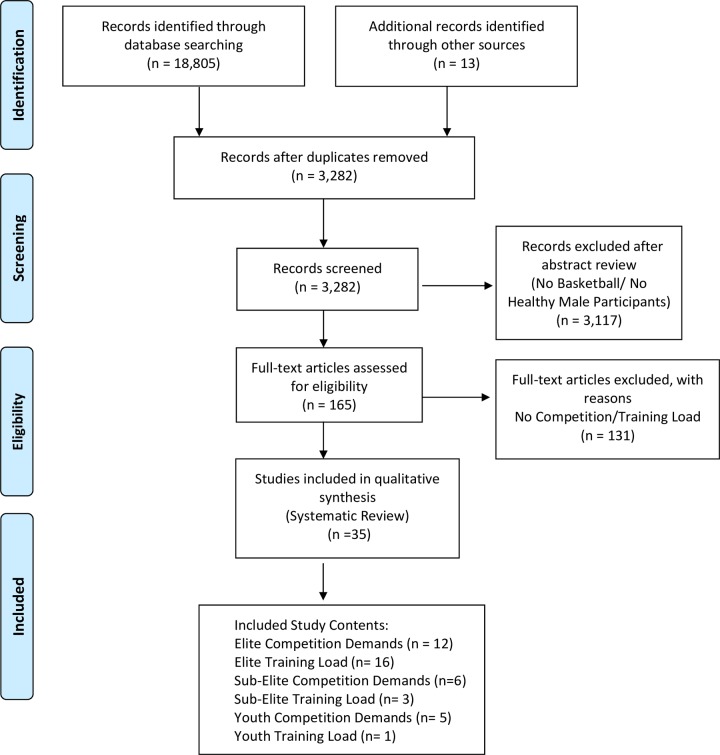
Basketball is a court-based team-sport that requires a broad array of demands (physiological, mechanical, technical, tactical) in training and competition which makes it important for practitioners to understand the stress imposed on the basketball player during practice and match-play. Therefore, the main aim of the present systematic review is to investigate the training and match-play demands of basketball in elite, sub-elite, and youth competition. A search of five electronic databases (PubMed, SportDiscus, Web of Science, SCOPUS, and Cochrane) was conducted until December 20th, 2019. Articles were included if the study: (i) was published in English; (ii) contained internal or external load variables from basketball training and/or competition; and (iii) reported physiological or metabolic demands of competition or practice. Additionally, studies were classified according to the type of study participants into elite (20), sub-elite (9), and youth (6). A total of 35 articles were included in the systematic review. Results indicate that higher-level players seem to be more efficient while moving on-court. When compared to sub-elite and youth, elite players cover less distance at lower average velocities and with lower maximal and average heart rate during competition. However, elite-level players have a greater bandwidth to express higher velocity movements. From the present systematic review, it seems that additional investigation on this topic is warranted before a "clear picture" can be drawn concerning the acceleration and deceleration demands of training and competition. It is necessary to accurately and systematically assess competition demands to provide appropriate training strategies that resemble match-play.
Conflict of interest statement
The authors have declared that no competing interests exist.
Figures
References
-
- Schelling X, Torres-Ronda L, et al. An integrative approach to Strength and Neuromuscular Training for Basketball. J Strength Cond Res. 2016; 38(3): 72–80.
-
- Svilar L, Jukić I, Castellano J, et al. Load monitoring system in top-level basketball team. Kinesiology. 2018; 50(1): 25–33.
-
- Scanlan A, Dascombe B, Reaburn P, et al. A comparison of the activity demands of elite and sub-elite Australian men’s basketball competition. J Sport Sci. 2011; 29(11): 1153–1160. - PubMed
