


Breast cancer risk, worry, and anxiety: Effect on patient perceptions of false-positive screening results
- PMID: 32135458
- PMCID: PMC7375679
- DOI: 10.1016/j.breast.2020.02.004
Breast cancer risk, worry, and anxiety: Effect on patient perceptions of false-positive screening results
Abstract
Objective: The impact of mammography screening recall on quality-of-life (QOL) has been studied in women at average risk for breast cancer, but it is unknown whether these effects differ by breast cancer risk level. We used a vignette-based survey to evaluate how women across the spectrum of breast cancer risk perceive the experience of screening recall.
Methods: Women participating in mammography or breast MRI screening were recruited to complete a vignette-based survey. Using a numerical rating scale (0-100), women rated QOL for hypothetical scenarios of screening recall, both before and after benign results were known. Lifetime breast cancer risk was calculated using Gail and BRCAPRO risk models. Risk perception, trait anxiety, and breast cancer worry were assessed using validated instruments.
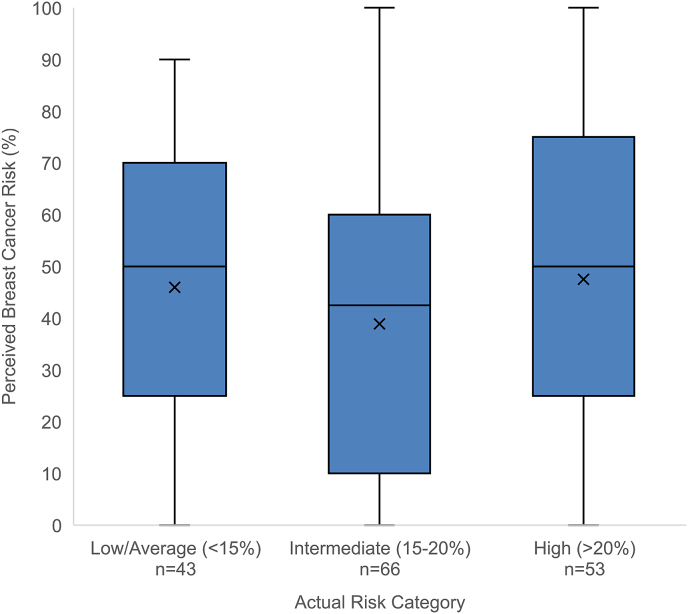
Results: The final study cohort included 162 women at low (n = 43, 26%), intermediate (n = 66, 41%), and high-risk (n = 53, 33%). Actual breast cancer risk was not a predictor of QOL for any of the presented scenarios. Across all risk levels, QOL ratings were significantly lower for the period during diagnostic uncertainty compared to after benign results were known (p < 0.05). In multivariable regression analyses, breast cancer worry was a significant predictor of decreased QoL for all screening scenarios while awaiting results, including scenarios with non-invasive imaging alone or with biopsy. High trait anxiety and family history predicted lower QOL scores after receipt of benign test results (p < 0.05).
Conclusions: Women with high trait anxiety and family history may particularly benefit from discussions about the risk of recall when choosing a screening regimen.
Copyright © 2020 The Authors. Published by Elsevier Ltd.. All rights reserved.
Conflict of interest statement
Declaration of competing interest JML and KPL receive research support from GE Healthcare. GSG was previously a consultant for GE Healthcare until 2018.
Figures


References
-
- Nelson H.D., Fu R., Cantor A., Pappas M., Daeges M., Humphrey L. Effectiveness of breast cancer screening: systematic review and meta-analysis to update the 2009 U.S. Preventive services task force recommendation. Ann Intern Med. 2016;164(4):244–255. - PubMed
-
- Komenaka I.K., Ditkoff B.A., Joseph K.A. The development of interval breast malignancies in patients with BRCA mutations. Cancer. 2004;100(10):2079–2083. - PubMed
-
- van Zelst J.C.M., Mus R.D.M., Woldringh G. Surveillance of women with the BRCA1 or BRCA2 mutation by using biannual automated breast US, MR imaging, and mammography. Radiology. 2017;285(2):376–388. - PubMed
-
- Saslow D., Boetes C., Burke W. American Cancer Society guidelines for breast screening with MRI as an adjunct to mammography. CA A Cancer J Clin. 2007;57(2):75–89. - PubMed
