


Incidence and time trends of sarcoma (2000-2013): results from the French network of cancer registries (FRANCIM)
- PMID: 32138705
- PMCID: PMC7059296
- DOI: 10.1186/s12885-020-6683-0
Incidence and time trends of sarcoma (2000-2013): results from the French network of cancer registries (FRANCIM)
Abstract
Background: The exhaustive collection of new sarcoma cases and their second histologic review offer a unique opportunity to study their incidence and time trends in France according to the major subtypes.
Methods: Data were collected from population-based cancer registries covering 22% of the French population. Crude and world age-standardized incidence rates (ASR) were estimated according to anatomic, histological and genetic groups, age and sex over the 2010-2013 period.
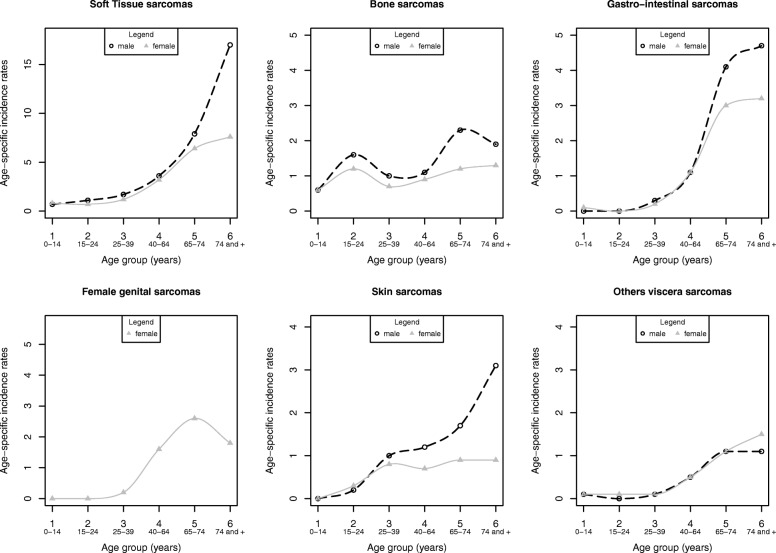
Results: Time trends in incidence were calculated by the annual percent change over the 2000-2013 period. During the most recent period (2010-2013), 3942 patients with sarcoma were included. The ASR of soft-tissue and bone sarcomas, and gastro-intestinal stromal tumors (GIST) were 2.1, 1.0 and 0.6, respectively. For the four most frequent histological subtypes (unclassified, leiomyosarcoma, GIST and liposarcoma), the ASR ranged from 0.4 to 0.7. ASRs were 1.9 for complex genomic and 1.3 for recurrent translocation sarcomas. The time-trend analysis showed a significant increase of sarcoma incidence rate between 2000 and 2005, which stabilized thereafter. Incidence rates increased for four histological subtypes (GIST, chondrosarcoma, myxofibrosarcoma, solitary fibrous tumors) and decreased for three (leiomyosarcomas, Kaposi sarcoma and fibrosarcoma).
Conclusion: To our knowledge, this study is the first to investigate sarcoma incidence based on a systematic pathological review of these cancers and on the updated sarcoma classifications. Due to the paucity of literature on sarcomas, future studies using data from population-based cancer registries should consider a standardized inclusion criterion presented in our study to better describe and compare data between countries.
Keywords: Cancer registry; France; Incidence; Sarcoma; Trends in incidence.
Conflict of interest statement
The authors declare that they have no competing interests.
Figures
References
-
- Fletcher CDM, Bridge JA, Hogendoorn PCW, Mertens F. WHO classification of Tumours of soft tissue and bone. 4. Lyon: IARC Press; 2013.
-
- Lurkin A, Ducimetiere F, Vince DR, et al. Epidemiological evaluation of concordance between initial diagnosis and central pathology review in a comprehensive and prospective series of sarcoma patients in the Rhone-Alpes region. BMC Cancer. 2010;10:150. doi: 10.1186/1471-2407-10-150. - DOI - PMC - PubMed
MeSH terms
Grants and funding
LinkOut - more resources
Full Text Sources
Medical
