


The Early Childhood Irritability-Related Impairment Interview (E-CRI): A Novel Method for Assessing Young Children's Developmentally Impairing Irritability
- PMID: 32138939
- PMCID: PMC10127521
- DOI: 10.1016/j.beth.2019.07.008
The Early Childhood Irritability-Related Impairment Interview (E-CRI): A Novel Method for Assessing Young Children's Developmentally Impairing Irritability
Erratum in
-
Corrigendum to 'The Early Childhood Irritability-Related Impairment Interview (E-CRI): A Novel Method for Assessing Young Children's Developmentally Impairing Irritability' [Behavior Therapy 51(2) (2020) 294-309].Behav Ther. 2020 Jul;51(4):670-673. doi: 10.1016/j.beth.2020.03.005. Epub 2020 May 19. Behav Ther. 2020. PMID: 32586438 No abstract available.
Abstract
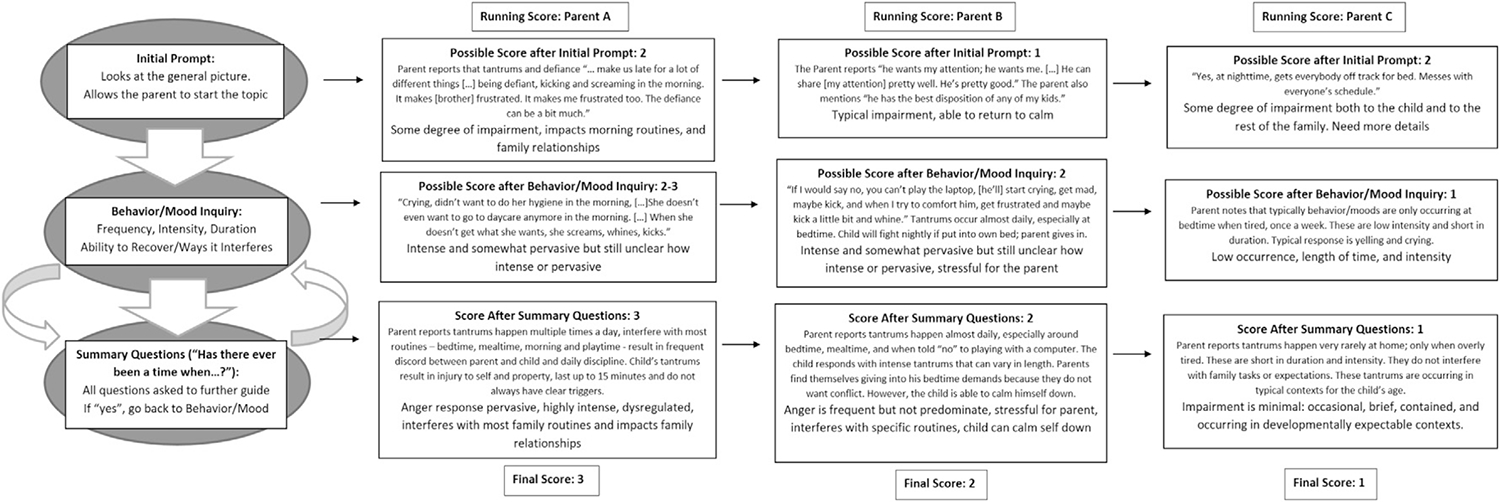
Irritability is a substrate of more than one dozen clinical syndromes. Thus, identifying when it is atypical and interfering with functioning is crucial to the prevention of mental disorder in the earliest phase of the clinical sequence. Advances in developmentally based measurement of irritability have enabled differentiation of normative irritable mood and tantrums from indicators of concern, beginning in infancy. However, developmentally sensitive assessments of irritability-related impairment are lacking. We introduce the Early Childhood Irritability-Related Impairment Interview (E-CRI), which assesses impairment associated with irritable mood and tantrums across contexts. Reliability and validity are established across two independent samples varied by developmental period: the Emotional Growth preschool sample (EmoGrow; N = 151, M = 4.82 years) and the When to Worry infant/toddler sample (W2W; N = 330, M = 14 months). We generated a well-fitting two-factor E-CRI model, with tantrum- and irritable mood-related impairment factors. The E-CRI exhibited good interrater, test-retest, and longitudinal reliability. Construct and clinical validity were also demonstrated. In both samples, E-CRI factors showed association to internalizing and externalizing problems, and to caregiver-reported concern in W2W. Tantrum-related impairment demonstrated stronger and more consistent explanatory value across outcomes, while mood-related impairment added explanatory utility for internalizing problems. The E-CRI also showed incremental utility beyond variance explained by the Family Life Impairment Scale (FLIS) survey indicator of developmental impairment. The E-CRI holds promise as an indicator of impairment to inform identification of typical versus atypical patterns reflecting early emerging irritability-related syndromes in the initial phase of the clinical sequence.
Keywords: developmental psychopathology; early childhood; irritability.
Copyright © 2019. Published by Elsevier Ltd.
Conflict of interest statement
Conflict of Interest Statement The authors declare that there are no conflicts of interest.
Figures
References
-
- Achenbach T, & Rescorla L (2000). Manual for the ASEBA preschool forms and profiles: An integrated system of multiinformant assessment. Burlington: University of Vermont, Department of Psychiatry.
-
- Althoff R, Chaarani B, Kan KJ, Mackey S, Spechler P, Orr C, & Garavan H (2017). Neural correlates of adolescent irritability and its comorbidity. Biological Psychiatry, 81(10). 10.1016/j.biopsych.2017.02.051 - DOI
-
- Angold A, & Costello E (2000). A review of the issues relevant to the creation of a measure of disability in children based on the World Health Organization’s International Classification of Functioning and Disability (ICIDH-2). Geneva, Switzerland: World Health Organization.
Publication types
MeSH terms
Grants and funding
LinkOut - more resources
Full Text Sources
Medical
