


Computationally Derived Image Signature of Stromal Morphology Is Prognostic of Prostate Cancer Recurrence Following Prostatectomy in African American Patients
- PMID: 32139401
- PMCID: PMC7165025
- DOI: 10.1158/1078-0432.CCR-19-2659
Computationally Derived Image Signature of Stromal Morphology Is Prognostic of Prostate Cancer Recurrence Following Prostatectomy in African American Patients
Abstract
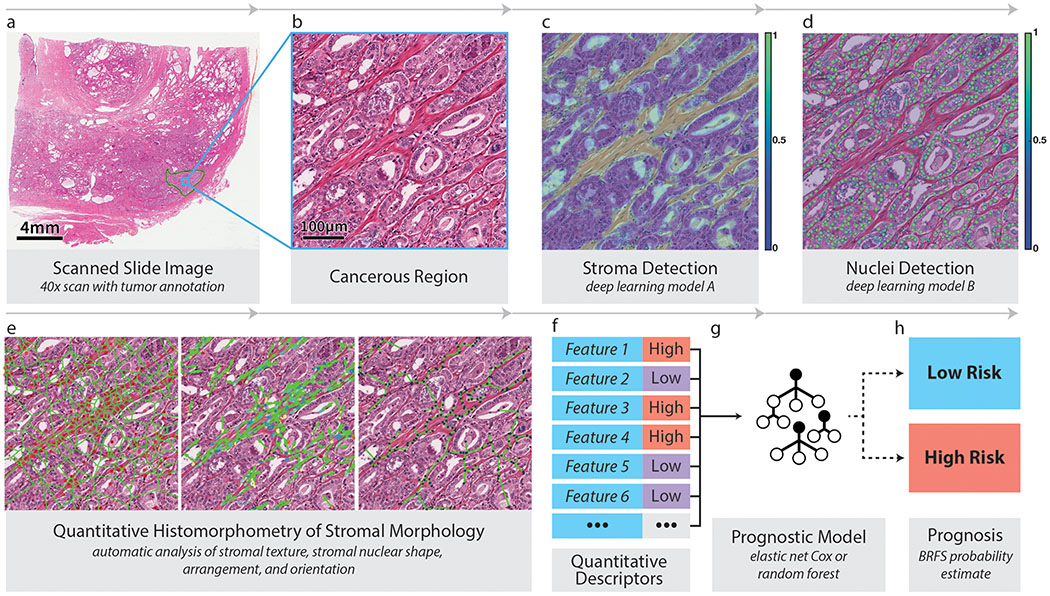
Purpose: Between 30%-40% of patients with prostate cancer experience disease recurrence following radical prostatectomy. Existing clinical models for recurrence risk prediction do not account for population-based variation in the tumor phenotype, despite recent evidence suggesting the presence of a unique, more aggressive prostate cancer phenotype in African American (AA) patients. We investigated the capacity of digitally measured, population-specific phenotypes of the intratumoral stroma to create improved models for prediction of recurrence following radical prostatectomy.
Experimental design: This study included 334 radical prostatectomy patients subdivided into training (VT, n = 127), validation 1 (V1, n = 62), and validation 2 (V2, n = 145). Hematoxylin and eosin-stained slides from resected prostates were digitized, and 242 quantitative descriptors of the intratumoral stroma were calculated using a computational algorithm. Machine learning and elastic net Cox regression models were constructed using VT to predict biochemical recurrence-free survival based on these features. Performance of these models was assessed using V1 and V2, both overall and in population-specific cohorts.
Results: An AA-specific, automated stromal signature, AAstro, was prognostic of recurrence risk in both independent validation datasets [V1,AA: AUC = 0.87, HR = 4.71 (95% confidence interval (CI), 1.65-13.4), P = 0.003; V2,AA: AUC = 0.77, HR = 5.7 (95% CI, 1.48-21.90), P = 0.01]. AAstro outperformed clinical standard Kattan and CAPRA-S nomograms, and the underlying stromal descriptors were strongly associated with IHC measurements of specific tumor biomarker expression levels.
Conclusions: Our results suggest that considering population-specific information and stromal morphology has the potential to substantially improve accuracy of prognosis and risk stratification in AA patients with prostate cancer.
©2020 American Association for Cancer Research.
Figures


References
-
- Siegel RL, Miller KD, Jemal A. Cancer statistics, 2019. CA Cancer J Clin. 2019;69:7–34. - PubMed
-
- Burkhardt JH, Litwin MS, Rose CM, Correa RJ, Sunshine JH, Hogan C, et al. Comparing the costs of radiation therapy and radical prostatectomy for the initial treatment of early-stage prostate cancer. J Clin Oncol. 2002;20:2869–75. - PubMed
-
- Zincke H, Oesterling JE, Blute ML, Bergstralh EJ, Myers RP, Barrett DM. Long-term (15 years) results after radical prostatectomy for clinically localized (stage T2c or lower) prostate cancer. J Urol. 1994;152:1850–7. - PubMed
-
- Freedland SJ, Humphreys EB, Mangold LA, Eisenberger M, Dorey FJ, Walsh PC, et al. Risk of prostate cancer-specific mortality following biochemical recurrence after radical prostatectomy. JAMA. 2005;294:433–9. - PubMed
-
- Freedland SJ, Rumble RB, Finelli A, Chen RC, Slovin S, Stein MN, et al. Adjuvant and Salvage Radiotherapy After Prostatectomy: American Society of Clinical Oncology Clinical Practice Guideline Endorsement. J Clin Orthod. American Society of Clinical Oncology; 2014;32:3892–8. - PubMed
Publication types
MeSH terms
Substances
Grants and funding
LinkOut - more resources
Full Text Sources
Medical
