Cycle-related Diarrhea and Dysmenorrhea are Independent Predictors of Peritoneal Endometriosis, Cycle-related Dyschezia is an Independent Predictor of Rectal Involvement
- PMID: 32139920
- PMCID: PMC7056393
- DOI: 10.1055/a-1033-9588
Cycle-related Diarrhea and Dysmenorrhea are Independent Predictors of Peritoneal Endometriosis, Cycle-related Dyschezia is an Independent Predictor of Rectal Involvement
Abstract
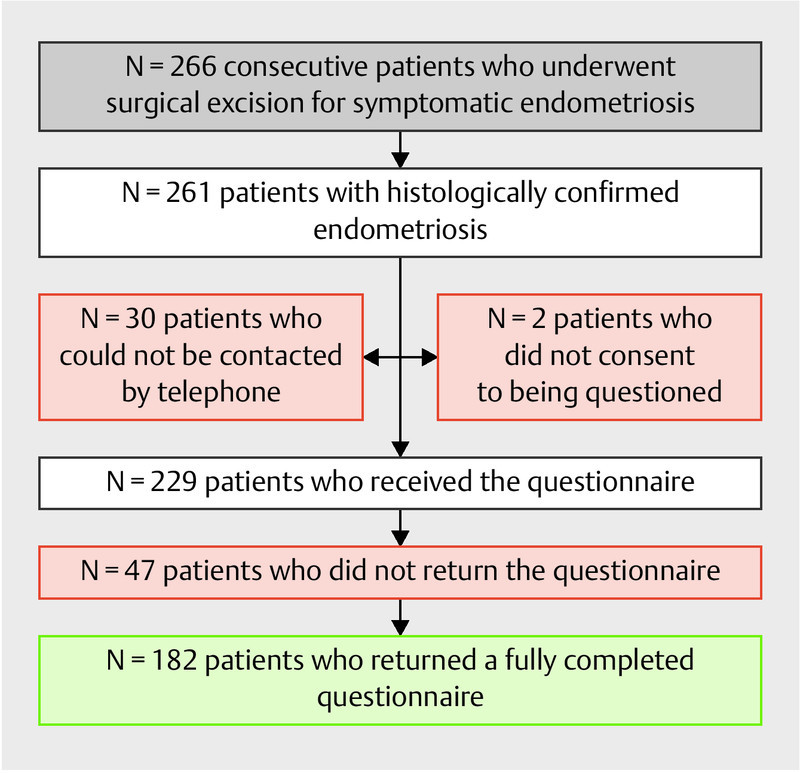
Introduction The clinical presentation of endometriosis is extremely varied. Because endometriosis symptoms may overlap with symptoms caused by gastroenterological disorders, this can lead to misdiagnosis and a considerable delay in arriving at the correct diagnosis. The aim was to evaluate the type and duration of endometriosis-related symptoms and to identify predictors for patterns of involvement depending on symptoms. Material and Method The data of 266 consecutive patients who were operated on in the Endometriosis Center between 1/2016 and 12/2017 after receiving a histologically verified diagnosis of endometriosis were recorded. In addition to recording the clinical parameters, a questionnaire was distributed to the patients, who were asked about their medical history. Infertile patients were grouped together as Group 1 and compared to non-infertile patients (Group 2). Results The response rate for returned questionnaires was 79.47% (182/229). 41.8% of patients reported that they were infertile and 91.8% reported pelvic pain. In more than ⅓ of cases in both groups, more than 10 years passed between the initial symptoms and the final diagnosis (39.4 vs. 37.5%). On average, patients consulted 2.72 (± 1.58) resp. 3.08 (± 1.72) doctors before they presented to a hospital or were referred for laparoscopic diagnostic workup (p = 0.162). Cycle-related diarrhea (odds ratio 2.707; 95% CI: 1.063 - 6.895, p = 0.037) and dysmenorrhea (odds ratio 2.278; 95% CI: 1.193 - 4.348, p = 0.013) were associated with involvement of the pelvic peritoneum, cycle-related dyschezia was associated with rectal involvement by a factor of 4.6 in binary regression analysis (odds ratio 4.659; 95% CI: 1.132 - 19.186; p = 0.033). Conclusion Cycle-related diarrhea and dysmenorrhea increase the risk probability of peritoneal endometriosis. Dyschezia increases the risk probability of rectal endometriosis.
Keywords: dyschezia; dysmenorrhea; endometriosis.
Conflict of interest statement
Conflict of Interest/Interessenkonflikt The authors declare that they have no conflict of interest./Die Autorinnen/Autoren geben an, dass kein Interessenkonflikt besteht.
Figures
References
-
- Schweppe K W. Differentialdiagnose und Behandlungsstrategien bei Endometriose: Was tun – wann? Journal für Fertilität und Reproduktion. 2003;13:8–12.
-
- Goldstein D P, deCholnoky C, Emans S J. Laparoscopy in the diagnosis and management of pelvic pain in adolescents. J Reprod Med. 1980;24:251–256. - PubMed
-
- Eskenazi B, Warner M L. Epidemiology of endometriosis. Obstet Gynecol Clin North Am. 1997;24:235–258. - PubMed
-
- Schweppe K W. [Endometriosis–a disease that has no lobby] Zentralbl Gynakol. 2003;125:233. - PubMed
-
- Child T J, Tan S L. Endometriosis: aetiology, pathogenesis and treatment. Drugs. 2001;61:1735–1750. - PubMed
LinkOut - more resources
Full Text Sources