


A Fluorescent and Colorimetric Chemosensor for Hg2+ Based on Rhodamine 6G With a Two-Step Reaction Mechanism
- PMID: 32140458
- PMCID: PMC7042397
- DOI: 10.3389/fchem.2020.00014
A Fluorescent and Colorimetric Chemosensor for Hg2+ Based on Rhodamine 6G With a Two-Step Reaction Mechanism
Abstract
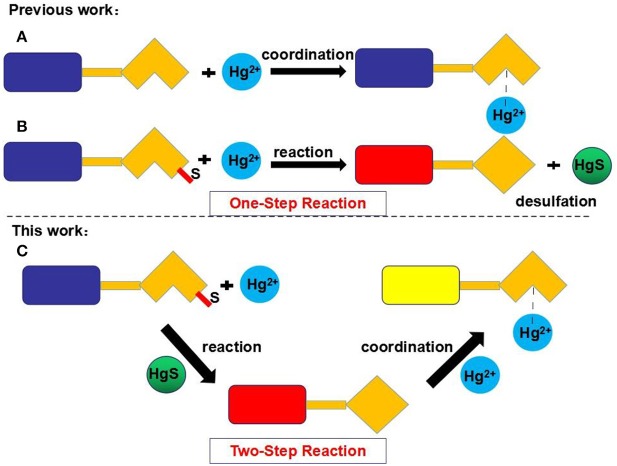
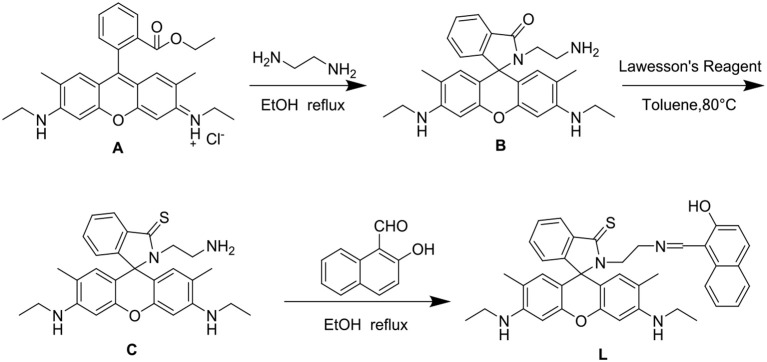
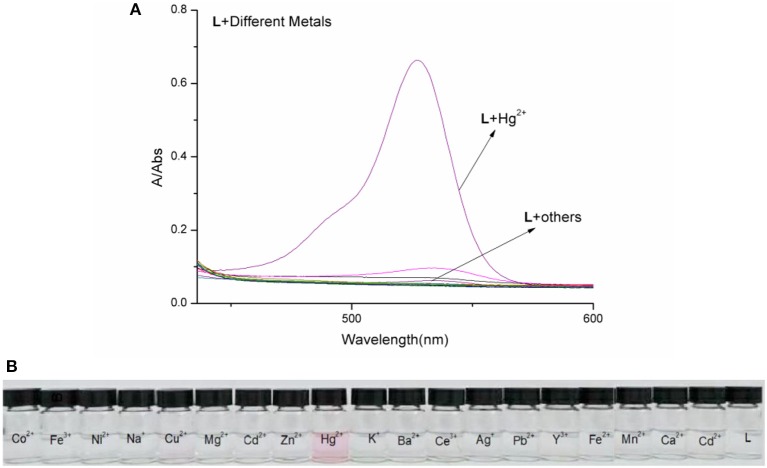
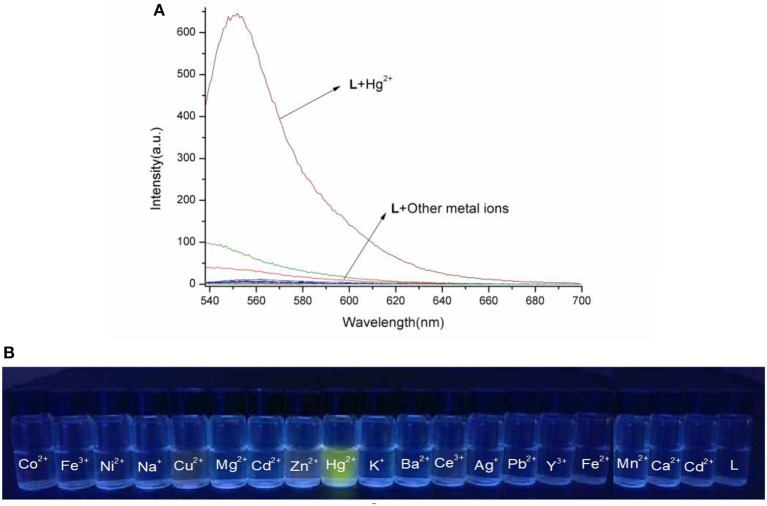
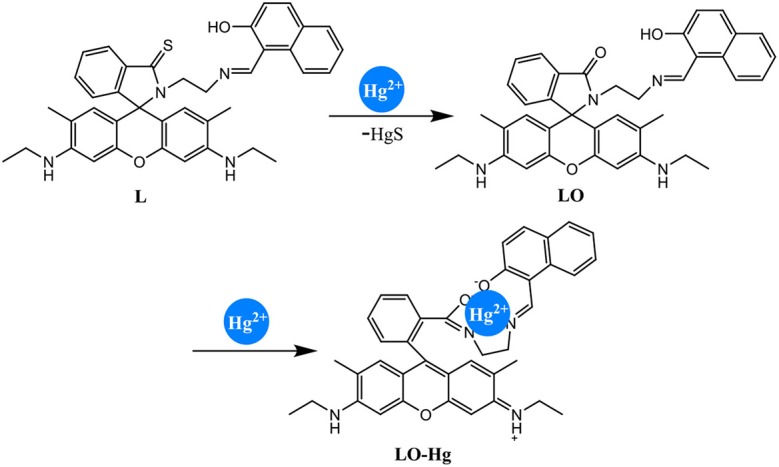
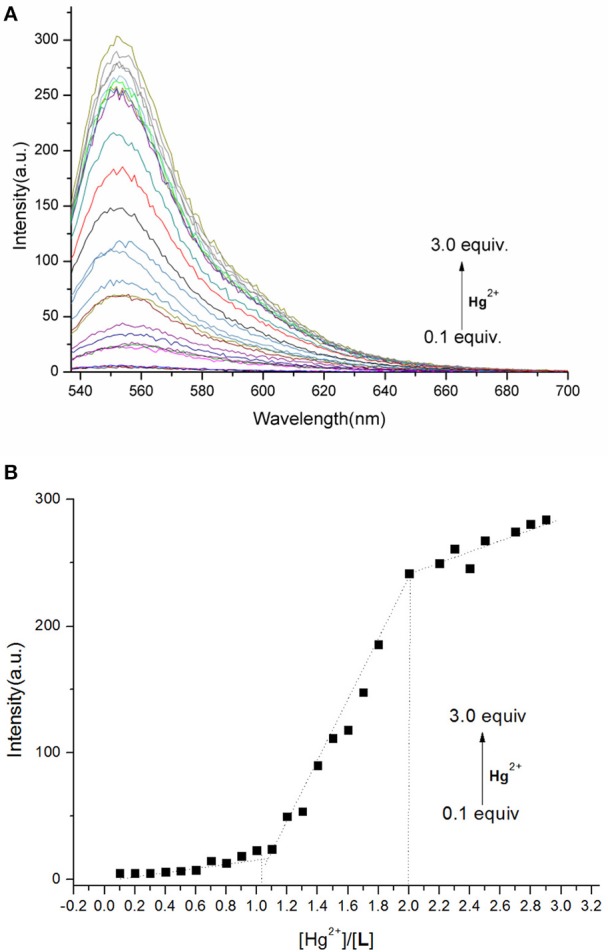
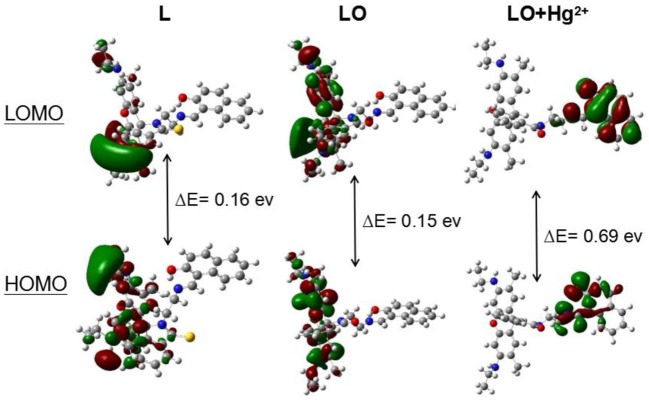
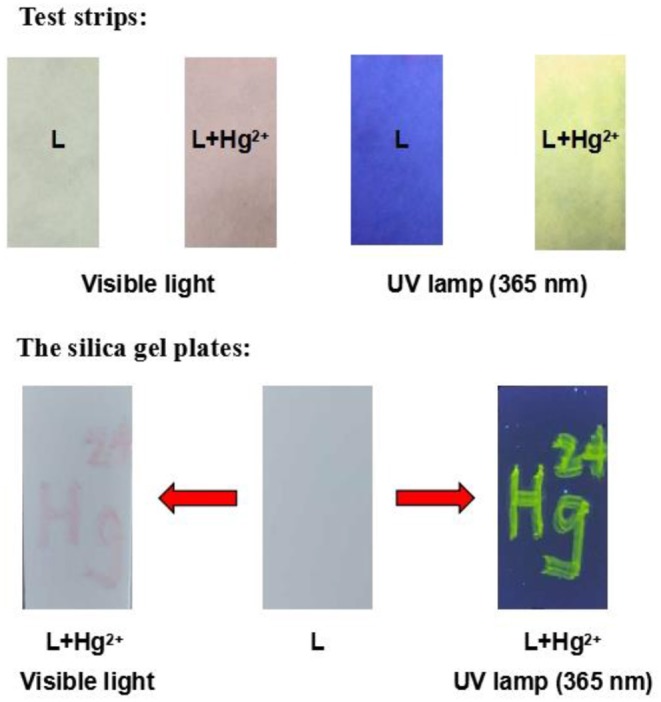
A fluorescent and colorimetric chemosensor L based on rhodamine 6G was designed, synthesized, and characterized. Based on a two-step reaction, the chemosensor L effectively recognized Hg2+. The interaction between the chemosensor and Hg2+ was confirmed by ultraviolet-visible spectrophotometry, fluorescence spectroscopy, electrospray ionization-mass spectrometry, Fourier-transform infrared spectroscopy, and frontier molecular orbital calculations. The chemosensor L was also incorporated into test strips and silica gel plates, which demonstrated good selectivity and high sensitivity for Hg2+.
Keywords: Hg2+; chemosensor; rhodamine 6G; silica gel plates; test strips.
Copyright © 2020 Bai, Wang, Zhang, Wang, Qiao, Wei, Zhang, Chen and Yang.
Figures
References
-
- Alibert A., Vaiano P., Caporale A., Consales M., Ruvo M., Cusano A. (2017). Fluorescent chemosensors for Hg2+ detection in aqueous environment. Sens. Actuators B Chem. 247, 727–735. 10.1016/j.snb.2017.03.026 - DOI
-
- Bai C. B., Fan H. Y., Qiao R., Wang S. N., Wei B., Meng Q., et al. (2019). Synthesis of methionine methyl ester-modified coumarin as the fluorescent-colorimetric chemosensor for selective detection Cu2+ with application in molecular logic gate. Spectrochim. Acta. A 216, 45–51. 10.1016/j.saa.2019.03.016 - DOI - PubMed
-
- Bai C. B., Qiao R., Liao J. X., Xiong W. Z., Zhang J., Chen S. S., et al. (2018). A highly selective and reversible fluorescence “off-on-off” chemosensor for Hg2+ based on rhodamine-6G dyes derivative and its application as a molecular logic gate. Spectrochim. Acta. A 202, 252–259. 10.1016/j.saa.2018.05.050 - DOI - PubMed
LinkOut - more resources
Full Text Sources
