


Racial Non-equivalence of Socioeconomic Status and Self-rated Health among African Americans and Whites
- PMID: 32140544
- PMCID: PMC7049651
- DOI: 10.1016/j.ssmph.2020.100561
Racial Non-equivalence of Socioeconomic Status and Self-rated Health among African Americans and Whites
Abstract
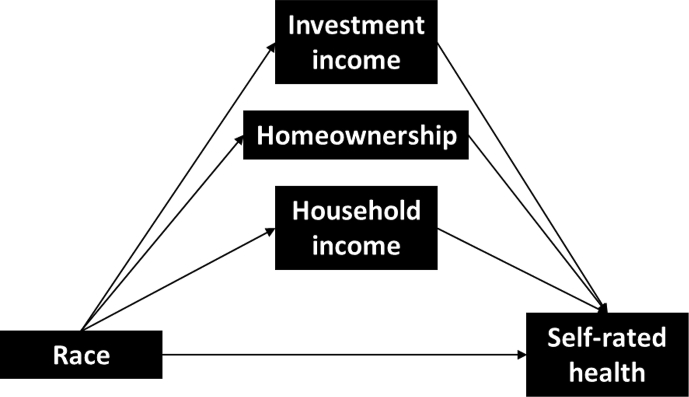
Racial health inequities are not fully explained by socioeconomic status (SES) measures like education, income and wealth. The largest inequities are observed among African American and white college graduates suggesting that African Americans do not receive the same health benefits of education. African Americans do not receive the same income and wealth returns of college education as their white counterparts indicating a racial non-equivalence of SES that may affect health inequities. The aim of this study is to determine whether racial non-equivalence of SES mediates race inequities in self-rated health by education and sex. Using data from the 2007-2016 National Health and Nutrition Examination Survey in the United States, the mediation of the associations between race and self-rated health through household income ≥400% federal poverty line, homeownership, and investment income were assessed among college graduates and non-college graduates by sex. Indirect associations were observed among college graduate women (odds = 0.08, standard error (s.e.) = 0.03), and non-college graduate men (odds = 0.14, s.e. = 0.02) and women (odds = 0.06, s.e. = 0.02). Direct associations between race and self-rated health remained after accounting for household income and wealth indicators suggesting that race differences in income and wealth partially mediate racial inequities in self-rated health. This study demonstrates that the racial non-equivalence of SES has implications for health inequities, but the magnitude of indirect associations varied by sex. Other factors like discrimination, health pessimism and segregation should be considered in light of the racial non-equivalence of SES and racial inequities in self-rated health.
© 2020 The Authors.
Conflict of interest statement
Caryn Bell, Tina Sacks, Courtney Thomas Tobin, and Roland Thorpe, Jr. have no conflicts of interest.
Figures
References
-
- Adler N.E., Newman K. Socioeconomic disparities in health: Pathways and policies. Health Affairs. 2002;21:60–76. - PubMed
-
- Adler N.E., Stewart J. Health disparities across the lifespan: Meaning, methods, and mechanisms. Biology of Disadvantage: Socioeconomic Status and Health. 2010;1186:5–23. - PubMed
-
- Bailey Z.D., Krieger N., Agenor M., Graves J., Linos N., Bassett M.T. Structural racism and health inequities in the USA: Evidence and interventions. Lancet. 2017;389:1453–1463. - PubMed
Grants and funding
LinkOut - more resources
Full Text Sources
