


Revisiting the cytotoxicity of quantum dots: an in-depth overview
- PMID: 32140918
- PMCID: PMC7311601
- DOI: 10.1007/s12551-020-00653-0
Revisiting the cytotoxicity of quantum dots: an in-depth overview
Abstract
Recently, medical research has been shifting its focus to nanomedicine and nanotherapeutics in the pursuit of drug development research. Quantum dots (QDs) are a critical class of nanomaterials due to their unique properties, which include optical, electronic, and engineered biocompatibility in physiological environments. These properties have made QDs an attractive biomedical resource such that they have found application as both in vitro labeling and in vivo theranostic (therapy-diagnostic) agents. Considerable research has been conducted exploring the suitability of QDs in theranostic applications, but the cytotoxicity of QDs remains an obstacle. Several types of QDs have been investigated over the past decades, which may be suitable for use in biomedical applications if the barrier of cytotoxicity can be resolved. This review attempts to report and analyze the cytotoxicity of the major QDs along with relevant related aspects.
Keywords: Biocompatibility; Biomedical applications; Cytotoxicity; Quantum dots; Theranostic agents.
Figures
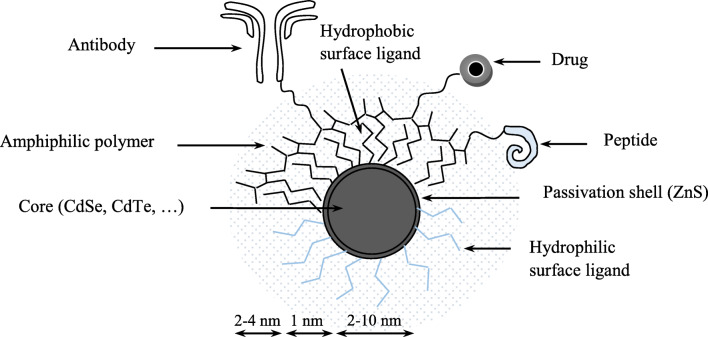
References
-
- Aldana J, Wang YA, Peng X. Photochemical instability of CdSe nanocrystals coated by hydrophilic thiols. J Am Chem Soc. 2001;123:8844–8850. - PubMed
-
- Allocca M, Mattera L, Bauduin A, Miedziak B, Moros M, De Trizio L, Tortiglione C. An integrated multilevel analysis profiling biosafety and toxicity induced by indium-and cadmium-based quantum dots in vivo. Environ Sci Technol. 2019;53:3938–3947. - PubMed
-
- Amelia M, Lincheneau C, Silvi S, Credi A. Electrochemical properties of CdSe and CdTe quantum dots. Chem Soc Rev. 2012;41:5728–5743. - PubMed
-
- Bera D, Qian L, Tseng TK, Holloway PH. Quantum dots and their multimodal applications: a review. Materials. 2010;3:2260–2345.
-
- Bozrova SV, Baryshnikova MA, Sokolova ZA, Nabiev IR, Sukhanova AV (2018) In vitro cytotoxicity of CdSe/ZnS quantum dots and their interaction with biological systems. KnE Energy:58–63
Publication types
LinkOut - more resources
Full Text Sources
Miscellaneous
