. 2020 Nov;50(11):3844-3856.
doi: 10.1007/s10803-020-04438-y.

Sleep Problems and Trajectories of Restricted and Repetitive Behaviors in Children with Neurodevelopmental Disabilities

Affiliations

Sleep Problems and Trajectories of Restricted and Repetitive Behaviors in Children with Neurodevelopmental Disabilities

Katherine E MacDuffie et al. J Autism Dev Disord. 2020 Nov.

Abstract

Sleep problems are prevalent in children with neurodevelopmental disabilities and are associated with the expression of restricted and repetitive behaviors (RRBs). Children (n = 57) with autism spectrum disorder (ASD, n = 38) or developmental delay (DD, n = 19) participated in multiple assessments of intellectual ability, ASD symptoms, and RRBs (3 timepoints for ASD, 2 for DD). Sleep problems assessed at age 4 via parent report were associated with trajectories of higher-order RRBs (sameness/ritualistic/compulsive behaviors) from age 2-6 in the ASD group, and from age 2-4 in the DD group, even after controlling for intellectual ability, social-affective symptoms, and anxiety. Trajectories of stereotyped/restricted behaviors were unrelated to sleep problems. Sleep problems were associated with trajectories of higher-order (but not lower-order) RRBs in a transdiagnostic sample.

Keywords: Anxiety; Autism spectrum disorder; Developmental delay; Neurodevelopmental disability; Repetitive behaviors; Restricted behaviors; Sleep.


Conflict of interest statement

Conflict of interest

Drs. MacDuffie, Munson, Greenson, Ward and Estes report no potential conflicts of interest.

Figures
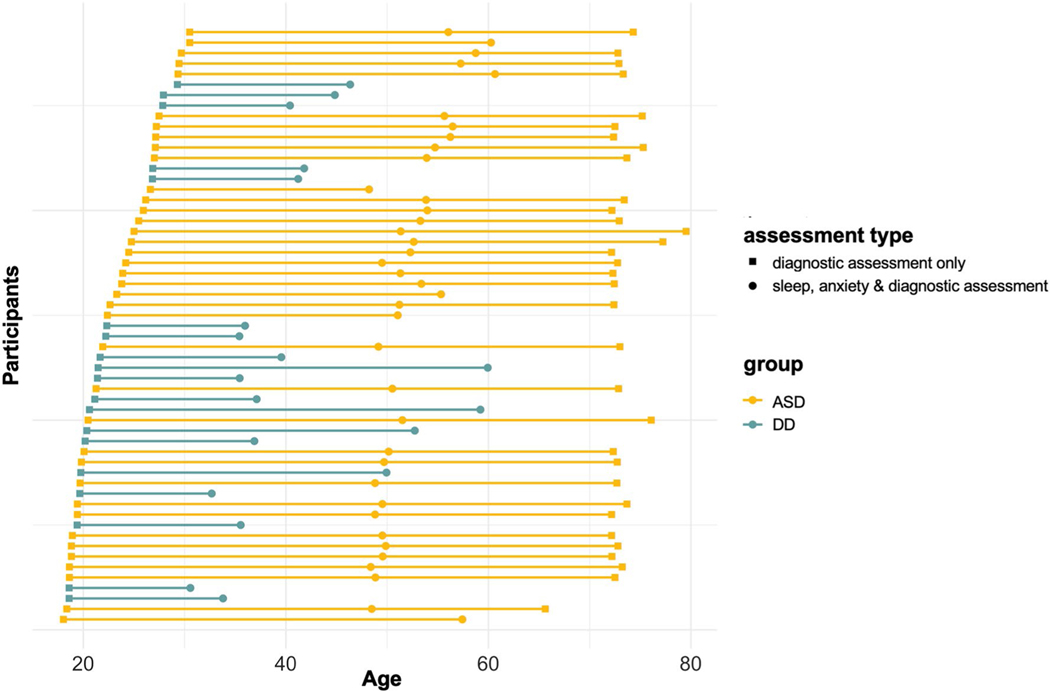
Fig. 1
Fig. 1
Age distribution. The distribution of participant ages at each assessment shown by group (ASD vs. DD). ASD symptoms and intellectual ability were assessed in both groups at every timepoint. Sleep and anxiety were assessed at the T2 only
Fig. 2
Fig. 2
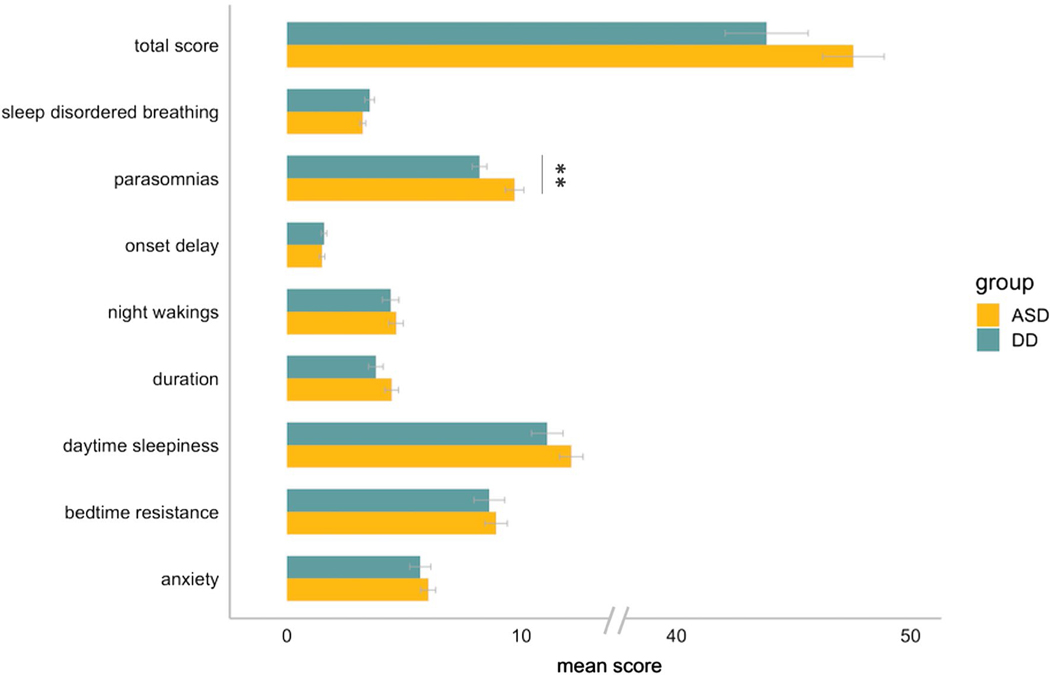
CSHQ subscale scores. Average scores across each CSHQ subscale by group (ASD vs. DD). For visualization purposes, average subscale scores were computed so that scores on subscales containing different numbers of items could be more easily compared. Error bars depict standard error of the mean. Asterix denotes significant group difference (p < .01)
Fig. 3
Fig. 3
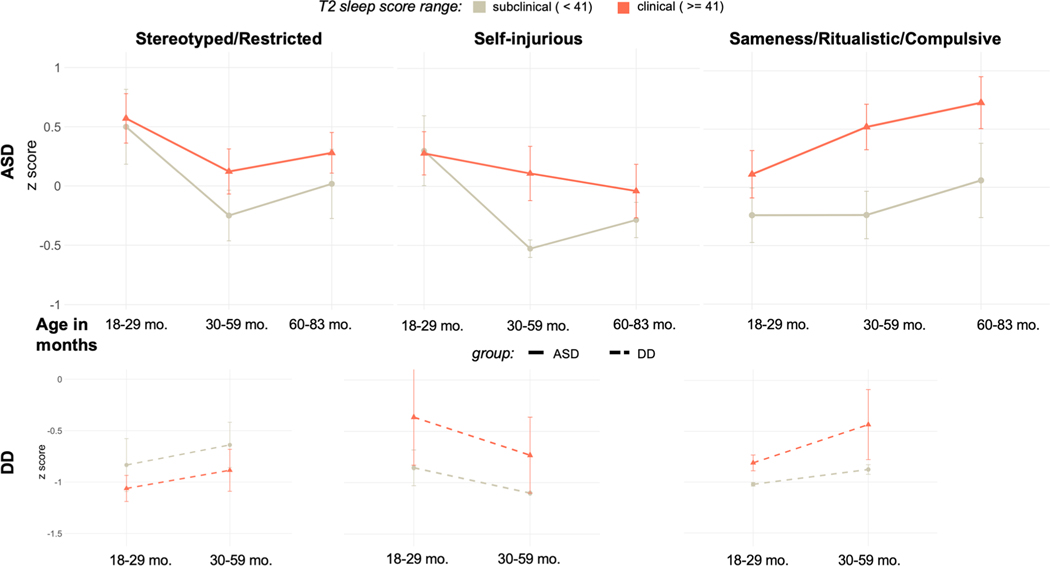
RRBs over time. RRB count score for each subtype over time (the horizontal axis depicts age ranges in months). For visualization purposes, participants were split into groups based on the established clinical threshold for the CSHQ (ASD: 10 subclinical, 28 clinical; DD: 9 subclinical, 10 clinical) and mean Z scores were plotted for each group at each timepoint. Note that this has been done for visualization only; LMM analyses in the text treated both age and T2 sleep problems as continuous variables
Fig. 4
Fig. 4
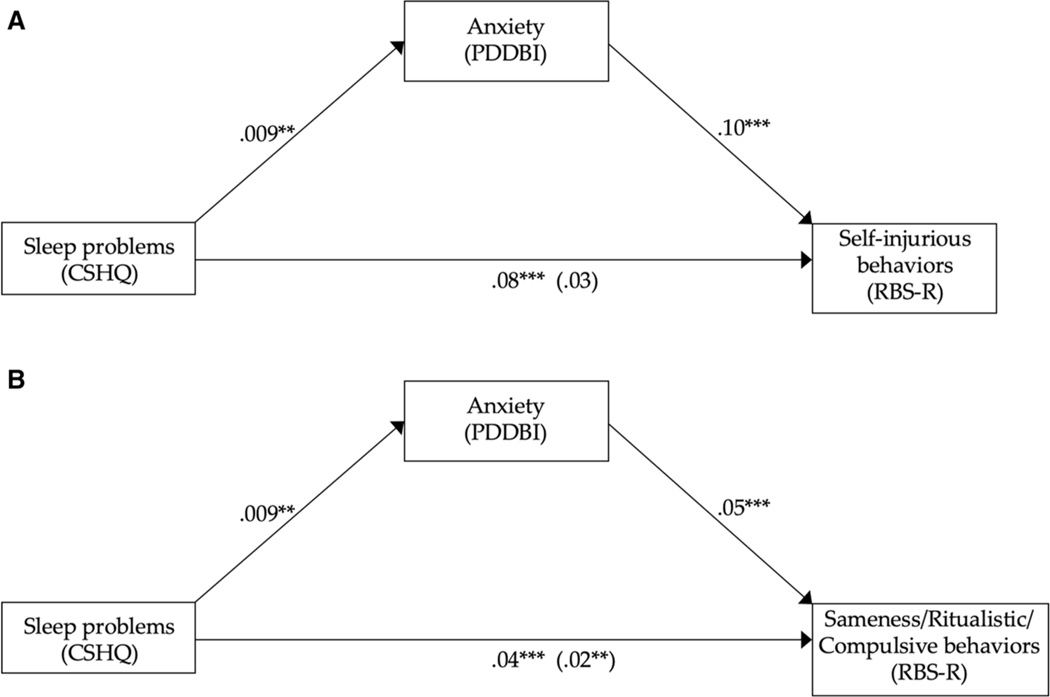
Exploratory mediation analysis. Regression coefficients for the relationship between sleep problems and a self-injurious behaviors or b sameness/ ritualistic/compulsive behaviors, mediated by anxiety, in the ASD group at age 4. The regression coefficient between sleep problems and RRB subtype, controlling for anxiety, is in parenthesis. Anxiety mediated the relationship between sleep problems and self-injurious behaviors (a), but not sameness/ ritualistic/compulsive behaviors (b). *p < .05, **p < .01, ***p < .001

References

    1. Abel EA, Schwichtenberg AJ, Brodhead MT, & Christ SL (2018). Sleep and challenging behaviors in the context of intensive behavioral intervention for children with autism. Journal of Autism and Developmental Disorders, 48(11), 3871–3884. 10.1007/s10803-018-3648-0. - DOI - PMC - PubMed
    1. Alfano CA, Ginsburg GS, & Kingery JN (2007). Sleep-related problems among children and adolescents with anxiety disorders. Journal of the American Academy of Child & Adolescent Psychiatry, 46(2), 224–232. 10.1097/01.chi.0000242233.06011.8e. - DOI - PubMed
    1. Astill RG, Van der Heijden KB, & van IJzendoorn MH, & Van Someren, E. J. W., (2012). Sleep, cognition, and behavioral problems in school-age children: A century of research metaanalyzed. Psychological Bulletin, 138(6), 1109–1138. 10.1037/a0028204. - DOI - PubMed
    1. Baron RM, & Kenny DA (1986). The moderator-mediator variable distinction in social psychological research: Conceptual, strategic, and statistical considerations. Journal of Personality and Social Psychology, 51(6), 1173–1182. - PubMed
    1. Bates D, Mächler M, Bolker BM, & Walker SC (2015). Fitting linear mixed-effects models using lme4. Journal of Statistical Software. 10.18637/jss.v067.i01. - DOI

MeSH terms