Review
. 2020 Jun;9(6):674-685.
doi: 10.1002/sctm.19-0338. Epub 2020 Mar 6.

Genome-edited adult stem cells: Next-generation advanced therapy medicinal products

Affiliations
Review

Genome-edited adult stem cells: Next-generation advanced therapy medicinal products

Karim Benabdellah et al. Stem Cells Transl Med. 2020 Jun.

Abstract

Over recent decades, gene therapy, which has enabled the treatment of several incurable diseases, has undergone a veritable revolution. Cell therapy has also seen major advances in the treatment of various diseases, particularly through the use of adult stem cells (ASCs). The combination of gene and cell therapy (GCT) has opened up new opportunities to improve advanced therapy medicinal products for the treatment of several diseases. Despite the considerable potential of GCT, the use of retroviral vectors has major limitations with regard to oncogene transactivation and the lack of physiological expression. Recently, gene therapists have focused on genome editing (GE) technologies as an alternative strategy. In this review, we discuss the potential benefits of using GE technologies to improve GCT approaches based on ASCs. We will begin with a brief summary of different GE platforms and techniques and will then focus on key therapeutic approaches that have been successfully used to treat diseases in animal models. Finally, we discuss whether ASC GE could become a real alternative to retroviral vectors in a GCT setting.

Keywords: CRISPR; adult stem cells; electroporation; gene delivery systems in vivo or in vitro; gene therapy; hematopoietic stem cells (HSCs); mesenchymal stem cells (MSCs); pluripotent hemopoietic stem cells.


Conflict of interest statement

The authors declared no potential conflicts of interest.

Figures
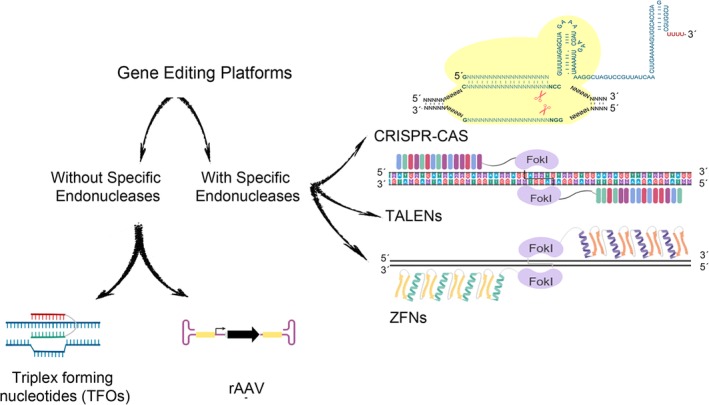
Figure 1
Figure 1
Current genome editing technology platforms can be divided into two main groups: specific endonuclease (SEN)‐based (right) and nuclease‐independent (left) platforms. The three main types of SEN‐based genome editing platforms are the transcription activator‐like effector nuclease (TALEN), zinc finger nuclease (ZFN), and clustered regularly interspaced short palindromic repeat (CRISPR)/CRISPR‐associated protein 9 (Cas9) systems. The principal SEN‐free gene editing platforms use recombinant adeno‐associated virus (rAAV) vectors and triplex‐forming oligonucleotides (TFOs)
Figure 2
Figure 2
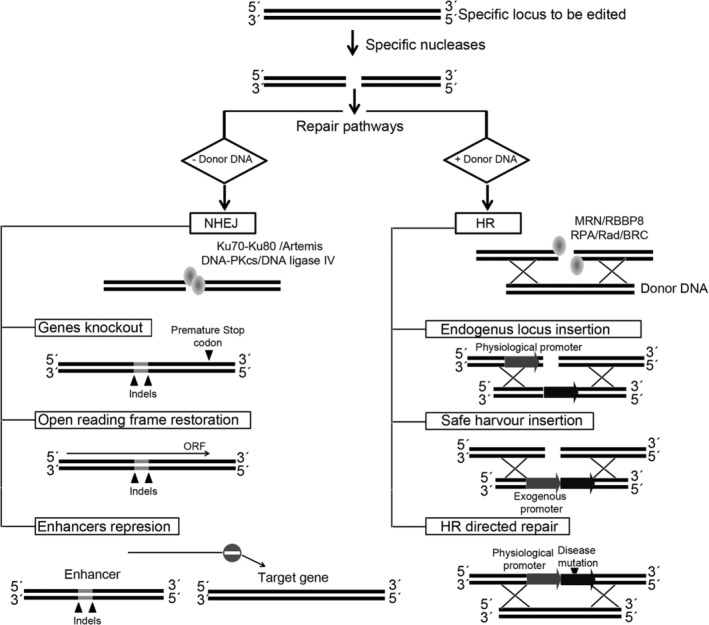
Genome editing strategies based on the activity of specific nucleases (SENs). Once SENs generate a double strand break in the target locus (top), the cell triggers two main repair pathways depending on the availability of homologous DNA and cell type. Non‐homologous end joining (NHEJ, left) preferentially occurs on G1 phase and quiescence cells, whereas homologous recombination (HR, right) generally requires cell division and takes place in the S phase of the cell cycle. In the NHEJ pathway, the donor or template DNA are not available and, after SEN cleavage, the binding of the proteins Ku70‐Ku80 protects the DNA ends against excessive resection and promotes DNA repair by recruiting the Artemis, DNA‐dependent protein kinase catalytic subunit (DNA‐PKcs) and DNA ligase IV complex. This repair pathway introduces short DNA insertions or deletions (indels) into the target site and facilitates different GE approaches: (a) generation of knockout genes by eliminating the ATG or by changing the open reading frame, thus generating premature stop codons, (b) repair of the correct open reading frame on mutated genes, or (c) elimination/alteration of enhancers/promoter regions. In contrast to NHEJ, in the HR pathway, the cell uses a donor DNA to fix DNA breaks introduced by SENs. HR repair is initiated by the combined action of the MRE11‐RAD50‐NBS1 (MRN) complex and RBBP8 generating single strand DNA where replication protein A (RPA), in association with Rad and BRC proteins bind and promote HR by invading the homologous template. By providing abundant homologous DNA donors, the HR pathway can also be used for different GE strategies: (a) insertion of a cDNA sequence under the regulation of a specific locus in order to provide locus‐specific, physiological expression of the particular cDNA. (b) Insertion of an expression cassette (promoter and cDNA) into a safe location (harbor). (c) Alternatively, HR can be used for HR‐directed repair (HRDR) of disease‐causing mutations (precise gene editing) by providing DNA donor harboring the corrected DNA sequences
Figure 3
Figure 3
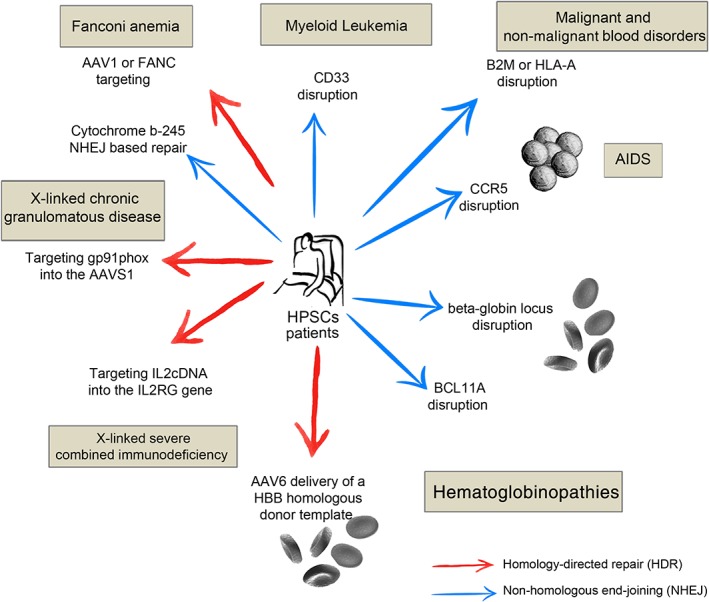
Diagram showing potential clinical HPSCs genome editing applications using either NHEJ‐ or HR‐based approaches (blue and red arrows, respectively). The target conditions are indicated in gray boxes, and each arrow points to the locus targeted in each case
Figure 4
Figure 4
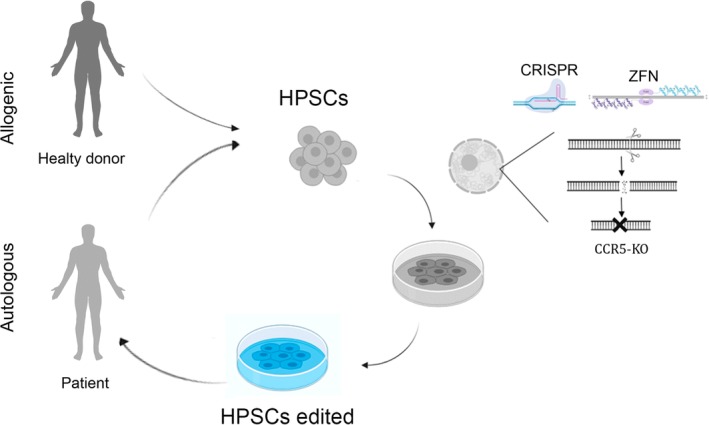
Diagram showing the principal steps in a clinical trial using autologous as compared to allogenic HSPCs. HPSCs were harvested from patients and healthy donors and cultivated in vitro. Once an optimal number of cells with the appropriate phenotype were obtained, they were subjected to gene editing and then infused back into the patient who was treated with the appropriate conditioning regimen
Figure 5
Figure 5
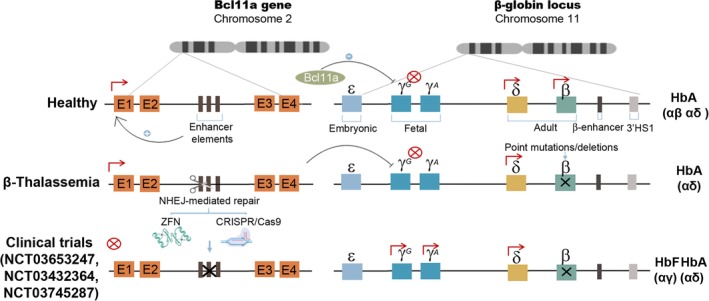
NHEJ GE strategies for treating β‐thalassemic and sickle cell disease (SCD) patients. Schematic representation of the β‐globin cluster in healthy individuals (top drawing). Only adult globins, δ‐globin and β‐globin, are expressed in healthy adult individuals. The Bcl11a gene is expressed thanks to the erythroid‐specific enhancer and blocks fetal globin (γG and γA) expression. In β‐thalassemia and SCD patients (middle drawing), mutations in the β‐globin gene abrogate its normal expression, preventing the generation of the predominant adult hemoglobin form (αβ). Three different clinical trials are currently on‐going to investigate the feasibility of eliminating the erythroid‐specific enhancer of the Bcl11a gene on HSPCs (Bottom drawing) using ZFNs (NCT03432364 and NCT03745287) or CRISPR/Cas9 (NCT03653247). By disrupting Bcl11a gene expression in erythroid cells, the fetal γ‐globin will be expressed in adults forming fetal hemoglobin (αγ) which should restore normal function

References

    1. Naldini L. Ex vivo gene transfer and correction for cell‐based therapies. Nat Rev Genet. 2011;12(5):301‐315. - PubMed
    1. Doss MX, Sachinidis A. Current challenges of iPSC‐based disease modeling and therapeutic implications. Cell. 2019;8(5):E403 10.3390/cells8050403. - DOI - PMC - PubMed
    1. Montel‐Hagen A, Crooks GM. From pluripotent stem cells to T cells. Exp Hematol. 2019;71:24‐31. - PubMed
    1. Haake K, Ackermann M, Lachmann N. Concise review: towards the clinical translation of induced pluripotent stem cell‐derived blood cells‐ready for take‐off. Stem Cells Translational Medicine. 2019;8(4):332‐339. - PMC - PubMed
    1. Shi Y, Inoue H, Wu JC, Yamanaka S. Induced pluripotent stem cell technology: a decade of progress. Nat Rev Drug Discov. 2017;16(2):115‐130. - PMC - PubMed

Publication types