


Prenatal, Early-Life, and Childhood Exposure to Air Pollution and Lung Function: The ALSPAC Cohort
- PMID: 32142356
- PMCID: PMC7328307
- DOI: 10.1164/rccm.201902-0286OC
Prenatal, Early-Life, and Childhood Exposure to Air Pollution and Lung Function: The ALSPAC Cohort
Abstract
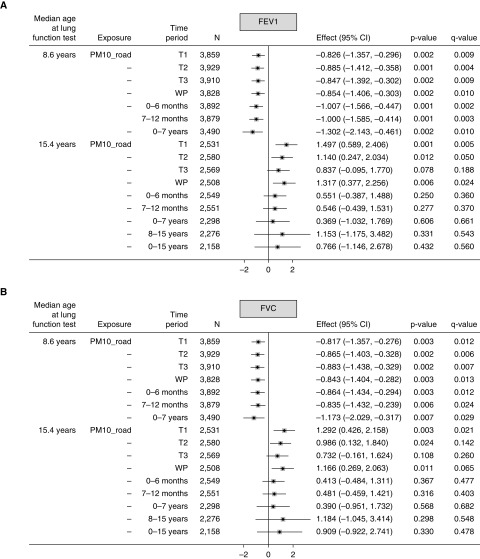
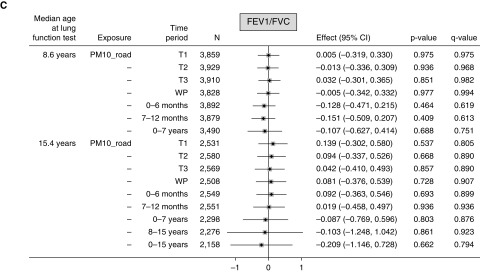
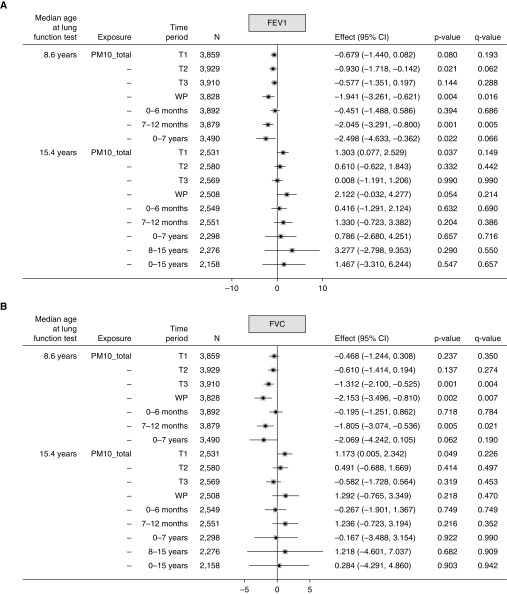
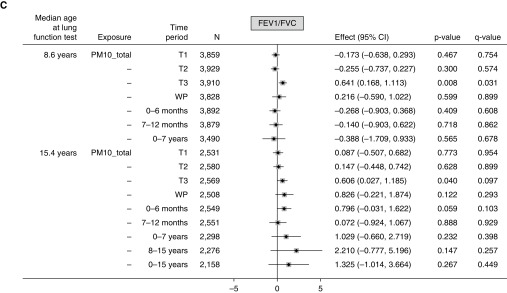
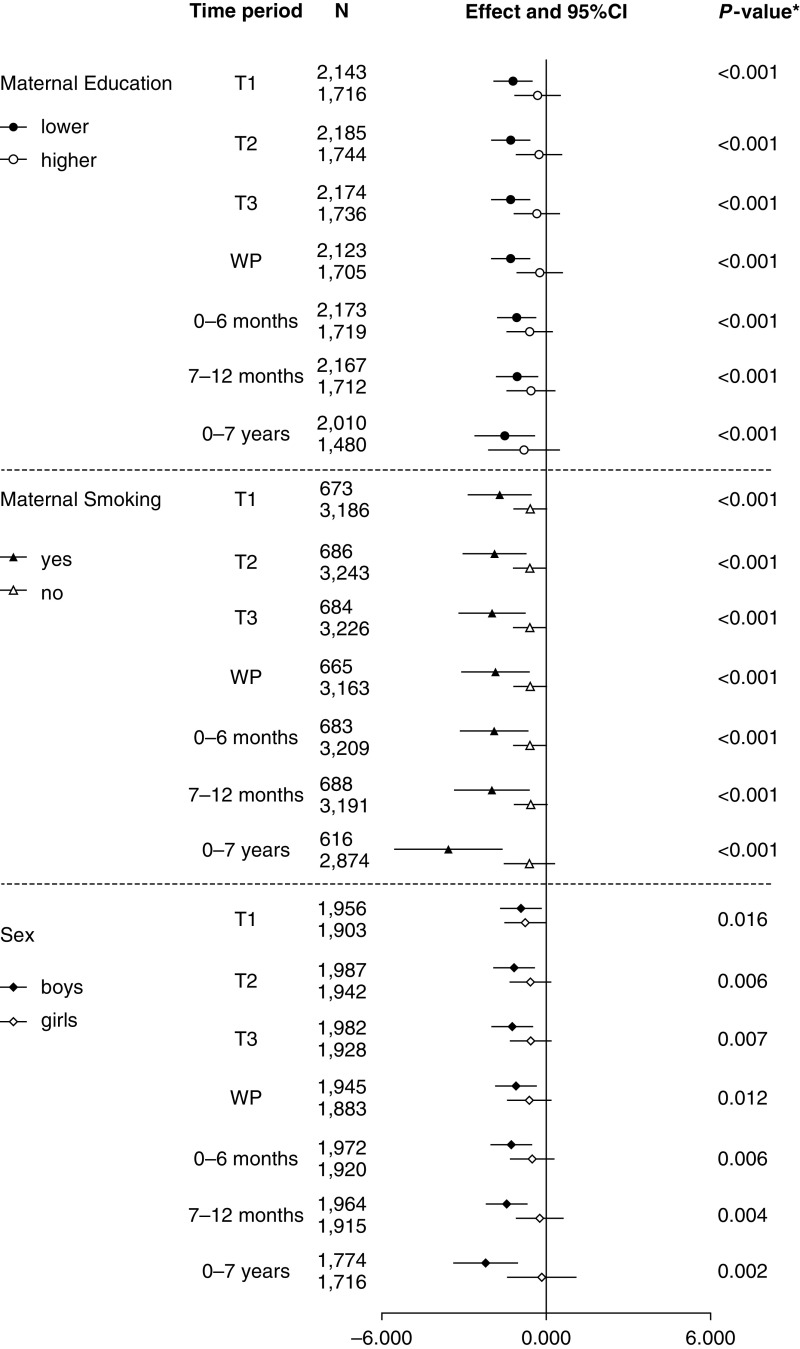
Rationale: Exposure to air pollution during intrauterine development and through childhood may have lasting effects on respiratory health.Objectives: To investigate lung function at ages 8 and 15 years in relation to air pollution exposures during pregnancy, infancy, and childhood in a UK population-based birth cohort.Methods: Individual exposures to source-specific particulate matter ≤10 μm in aerodynamic diameter (PM10) during each trimester, 0-6 months, 7-12 months (1990-1993), and up to age 15 years (1991-2008) were examined in relation to FEV1% predicted and FVC% predicted at ages 8 (n = 5,276) and 15 (n = 3,446) years using linear regression models adjusted for potential confounders. A profile regression model was used to identify sensitive time periods.Measurements and Main Results: We did not find clear evidence of a sensitive exposure period for PM10 from road traffic. At age 8 years, 1 μg/m3 higher exposure during the first trimester was associated with lower FEV1% predicted (-0.826; 95% confidence interval [CI], -1.357 to -0.296) and FVC% predicted (-0.817; 95% CI, -1.357 to -0.276), but similar associations were seen for exposures for other trimesters, 0-6 months, 7-12 months, and 0-7 years. Associations were stronger among boys, as well as children whose mother had a lower education level or smoked during pregnancy. For PM10 from all sources, the third trimester was associated with lower FVC% predicted (-1.312; 95% CI, -2.100 to -0.525). At age 15 years, no adverse associations with lung function were seen.Conclusions: Exposure to road-traffic PM10 during pregnancy may result in small but significant reductions in lung function at age 8 years.
Keywords: ALSPAC; air pollution; children; respiratory health; traffic.
Figures
Comment in
-
Prenatal Air Pollution and Child Lung Function: The Impossible Search for a Vulnerable Trimester.Am J Respir Crit Care Med. 2020 Jul 1;202(1):15-16. doi: 10.1164/rccm.202003-0764ED. Am J Respir Crit Care Med. 2020. PMID: 32271613 Free PMC article. No abstract available.
References
-
- Belgrave DCM, Granell R, Turner SW, Curtin JA, Buchan IE, Le Souëf PN, et al. Lung function trajectories from pre-school age to adulthood and their associations with early life factors: a retrospective analysis of three population-based birth cohort studies. Lancet Respir Med. 2018;6:526–534. - PubMed
-
- Bui DS, Lodge CJ, Burgess JA, Lowe AJ, Perret J, Bui MQ, et al. Childhood predictors of lung function trajectories and future COPD risk: a prospective cohort study from the first to the sixth decade of life. Lancet Respir Med. 2018;6:535–544. - PubMed
-
- Royal College of Physicians. Every breath we take: the lifelong impact of air pollution, report of a working party. London: Report of a working party, RCP; 2016 [published 2016 Feb 23; accessed 2020 Apr 20]. Available from: https://www.rcplondon.ac.uk/projects/outputs/every-breath-we-take-lifelo....
-
- Lange P, Celli B, Agustí A, Boje Jensen G, Divo M, Faner R, et al. Lung-function trajectories leading to chronic obstructive pulmonary disease. N Engl J Med. 2015;373:111–122. - PubMed
-
- Gauderman WJ, Vora H, McConnell R, Berhane K, Gilliland F, Thomas D, et al. Effect of exposure to traffic on lung development from 10 to 18 years of age: a cohort study. Lancet. 2007;369:571–577. - PubMed
Publication types
MeSH terms
Substances
Grants and funding
LinkOut - more resources
Full Text Sources
Medical
