


Risk factors for bronchiolitis hospitalization in infants: A French nationwide retrospective cohort study over four consecutive seasons (2009-2013)
- PMID: 32142528
- PMCID: PMC7059917
- DOI: 10.1371/journal.pone.0229766
Risk factors for bronchiolitis hospitalization in infants: A French nationwide retrospective cohort study over four consecutive seasons (2009-2013)
Abstract
Objectives: Large studies are needed to update risk factors of bronchiolitis hospitalization. We performed a nationwide analysis of hospitalization rates for bronchiolitis over four consecutive bronchiolitis seasons to identify underlying medical disorders at risk of bronchiolitis hospitalization and assess their frequency.
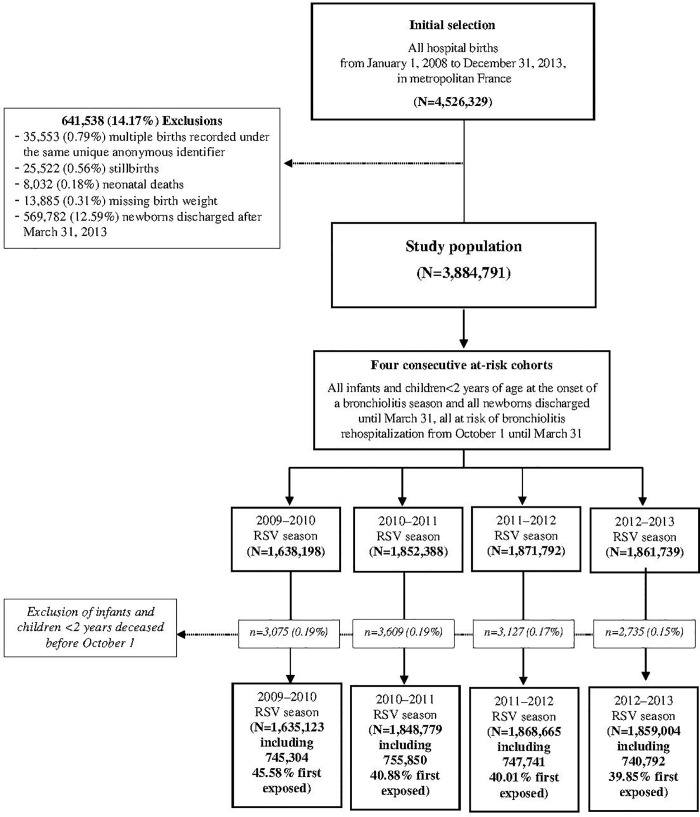
Methods: Data were retrieved from the French National Hospital Discharge database. Of all infants discharged alive from maternity wards from January 2008 to December 2013 in France (N = 3,884,791), we identified four consecutive cohorts at risk of bronchiolitis during the seasons of 2009-2010 to 2012-2013. The main outcome was bronchiolitis hospitalization during a season. Individual risk factors were collected.
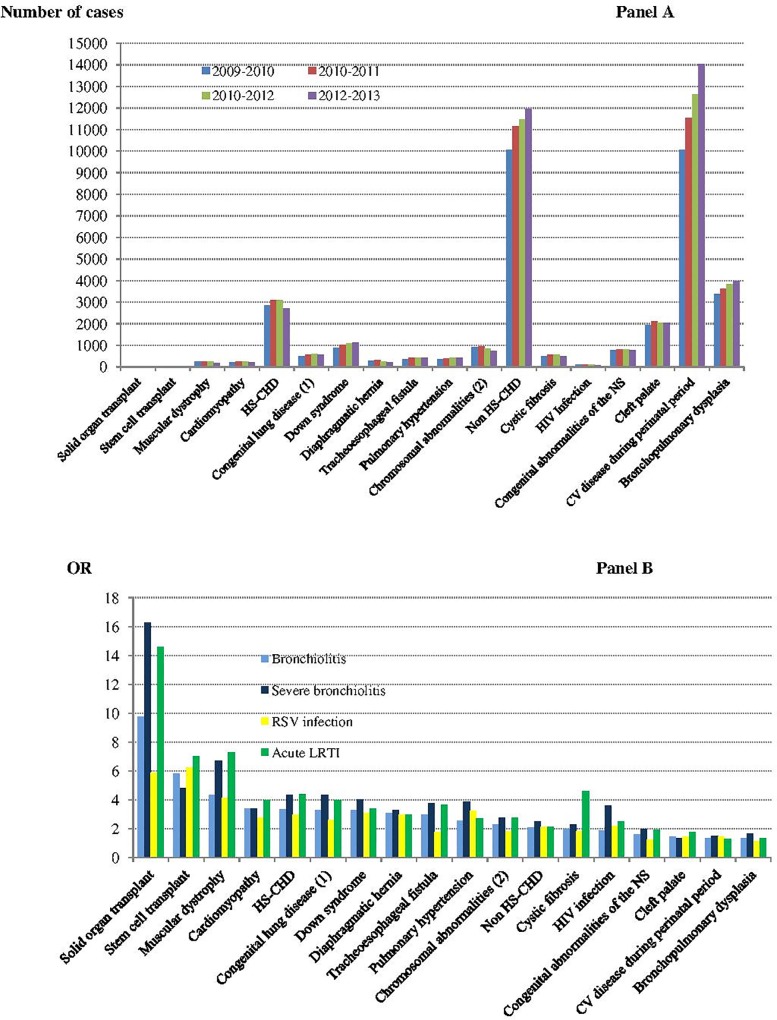
Results: Among infants, 6.0% were preterm and 2.0% had ≥1 chronic condition including 0.2% bronchopulmonary dysplasia (BPD) and 0.2% hemodynamically significant congenital heart disease (HS-CHD). Bronchiolitis hospitalization rates varied between seasons (min: 1.26% in 2010-2011; max: 1.48% in 2012-2013; p<0.001). Except omphalocele, the following conditions were associated with an increased risk for bronchiolitis hospitalization: solid organ (9.052; 95% CI, 4.664-17.567) and stem cell transplants (6.012; 95% CI, 3.441-10.503), muscular dystrophy (4.002; 95% CI, 3.1095-5.152), cardiomyopathy (3.407; 95% CI, 2.613-4.442), HS-CHD (3.404; 95% CI, 3.153-3.675), congenital lung disease and/or bronchial abnormalities, Down syndrome, congenital tracheoesophageal fistula, diaphragmatic hernia, pulmonary hypertension, chromosomal abnormalities other than Down syndrome, hemodynamically non-significant CHD, congenital abnormalities of nervous system, cystic fibrosis, cleft palate, cardiovascular disease occurring during perinatal period, and BPD.
Conclusion: Besides prematurity, BPD, and HS-CHD, eighteen underlying conditions were associated with a significant increased risk for bronchiolitis hospitalization in a nationwide population.
Conflict of interest statement
I have read the journal's policy and the authors of this manuscript have the following competing interests: Prof Brigitte Fauroux, Prof Jean-Michel Hascoët, Dr Jean-François Magny, Prof Jean-Christophe Rozé and Prof Elie Saliba have received compensation as neonatology board members of AbbVie France. Prof Pierre-Henri Jarreau has received personal fees for a course to Chiesi staff and participation in an observational study and invitations for congresses from Chiesi France. He has also received compensation as a neonatology board member of AbbVie France. Dr Michaël Schwarzinger is employee of Translational Health Economics Network (THEN), Paris, France, which received research grants from Abbvie France as well as Gilead, Merck and Co, and Novartis, outside and unrelated to the submitted work. This does not alter our adherence to PLOS ONE policies on sharing data and materials. There are no patents, products in development, or marketed products to declare.
Figures
References
-
- Shi T, McAllister DA, O’Brien KL, Simoes EAF, Madhi SA, Gessner BD, et al. Global, regional, and national disease burden estimates of acute lower respiratory infections due to respiratory syncytial virus in young children in 2015: a systematic review and modeling study. Lancet. 2017;390:946–58. 10.1016/S0140-6736(17)30938-8 - DOI - PMC - PubMed
-
- Figueras–Aloy J, Manzoni P, Paes B, Simoes EAF, Bont L, Checchia PA et al. Defining the risk and associated morbidity and mortality of severe respiratory syncytial virus infection among preterm infants without chronic lung disease or congenital heart disease. Infect Dis Ther. 2016;5:417–52. 10.1007/s40121-016-0130-1 - DOI - PMC - PubMed
Publication types
MeSH terms
LinkOut - more resources
Full Text Sources
