. 2020 Mar 4;21(5):1758.
doi: 10.3390/ijms21051758.

Biocomplexity and Fractality in the Search of Biomarkers of Aging and Pathology: Mitochondrial DNA Profiling of Parkinson's Disease

Affiliations

Biocomplexity and Fractality in the Search of Biomarkers of Aging and Pathology: Mitochondrial DNA Profiling of Parkinson's Disease

Annamaria Zaia et al. Int J Mol Sci. .

Abstract

Increasing evidence implicates mitochondrial dysfunction in the etiology of Parkinson's disease (PD). Mitochondrial DNA (mtDNA) mutations are considered a possible cause and this mechanism might be shared with the aging process and with other age-related neurodegenerative disorders such as Alzheimer's disease (AD). We have recently proposed a computerized method for mutated mtDNA characterization able to discriminate between AD and aging. The present study deals with mtDNA mutation-based profiling of PD. Peripheral blood mtDNA sequences from late-onset PD patients and age-matched controls were analyzed and compared to the revised Cambridge Reference Sequence (rCRS). The chaos game representation (CGR) method, modified to visualize heteroplasmic mutations, was used to display fractal properties of mtDNA sequences and fractal lacunarity analysis was applied to quantitatively characterize PD based on mtDNA mutations. Parameter β, from the hyperbola model function of our lacunarity method, was statistically different between PD and control groups when comparing mtDNA sequence frames corresponding to GenBank np 5713-9713. Our original method, based on CGR and lacunarity analysis, represents a useful tool to analyze mtDNA mutations. Lacunarity parameter β is able to characterize individual mutation profile of mitochondrial genome and could represent a promising index to discriminate between PD and aging.

Keywords: Parkinson’s disease; aging; biocomplexity; chaos game representation; fractal lacunarity; mtDNA.


Conflict of interest statement

The authors declare no conflict of interest.

Figures
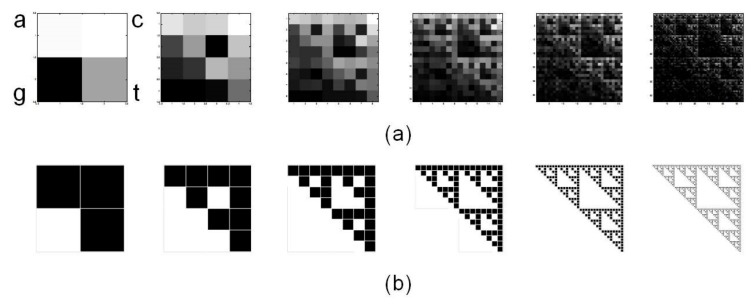
Figure 1
Figure 1
Chaos Game Representation (CGR) of human mtDNA. (a) CGR matrices for L=1 to L=6 of whole revised Cambridge Reference Sequence, rCRS, display self-similarity, a property peculiar to fractals, resembling (b) the triangle of Sierpinski, an ideal fractal built through repeated iterations starting from a square.
Figure 2
Figure 2
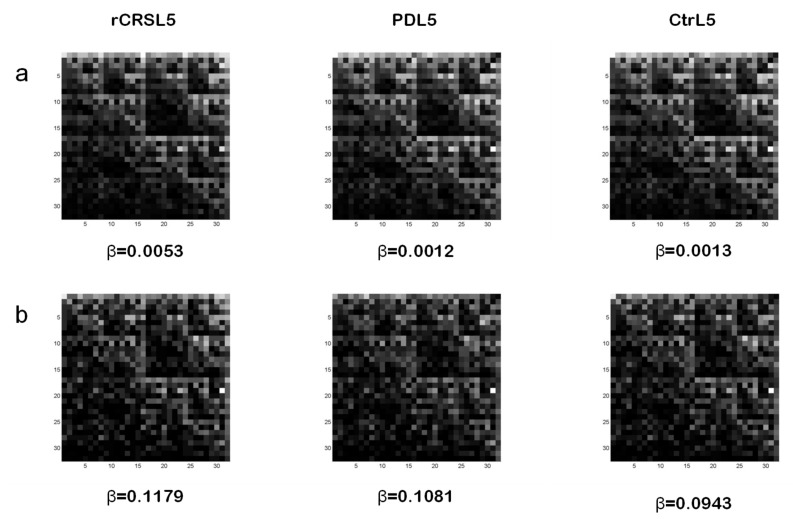
Examples of CGR images of whole mtDNA sequences (a) and related GenBank np 5713-9713 frames (b) from different subjects. Lacunarity parameter β value for CGR matrices 32x32 (L=5) generated from mtDNA of rCRS (left), a PD patient (middle), and a control (right) is reported. CGR: Chaos Game Representation; rCRS: revised Cambridge Reference Sequence; PD: Parkinson’s Disease.
Figure 3
Figure 3
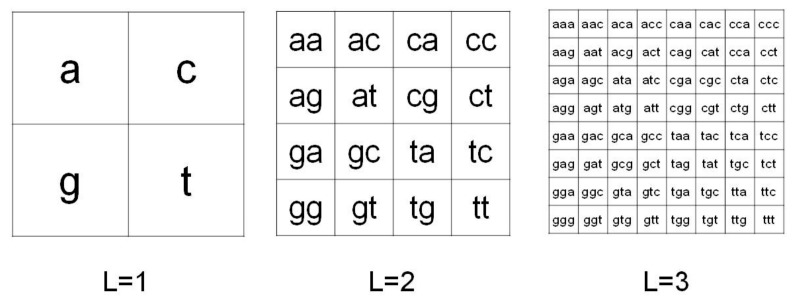
Chaos Game Representation method. CGR organization in matrices 2Lx2L for L=1,2,3 in the case of four-symbol alphabet {a,c,g,t}.
Figure 4
Figure 4
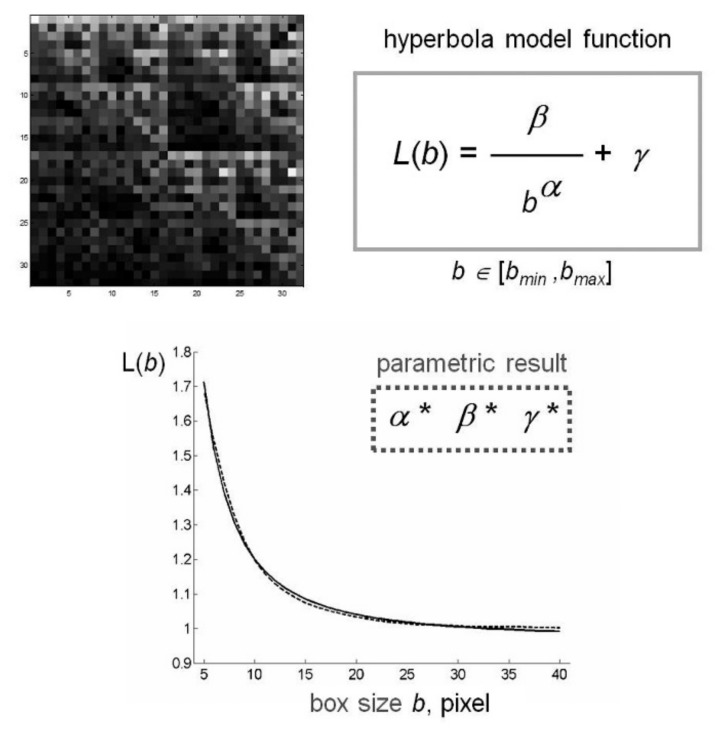
Schematic representation of fractal lacunarity analysis. (Top left) rCRS mtDNA image generated by CGR matrix for L=5 is a 32x32 square. The plot (bottom) represents the result of GBA application (dotted line), for bmin=3, as fitted by hyperbola function (solid line) used to calculate the triplet of parameters α, β, γ. CGR: Chaos Game Representation; rCRS: revised Cambridge Reference Sequence; GBA: Gliding Box Algorithm.

References

    1. de Rijk M.C., Breteler M.M., Graveland G.A., Ott A., Grobbee D.E., van der Meche F.G.A., Hofman A. Prevalence of Parkinson’s disease in the elderly: The rotterdam study. Neurology. 1995;45:2143–2146. doi: 10.1212/WNL.45.12.2143. - DOI - PubMed
    1. Polymeropoulos M.H., Lavedan C., Leroy E., Ide S.E., Dehejia A., Dutra A., Pike B., Root H., Rubenstein J., Boyer R., et al. Mutation in the alpha-synuclein gene identified in families with Parkinson’s disease. Science. 1997;276:2045–2047. doi: 10.1126/science.276.5321.2045. - DOI - PubMed
    1. Kitada T., Asakawa S., Hattori N., Matsumine H., Yamamura Y., Minoshima S., Yokochi M., Mizuno Y., Shimizu N. Mutations in the parkin gene cause autosomal recessive juvenile parkinsonism. Nature. 1998;392:605–608. doi: 10.1038/33416. - DOI - PubMed
    1. Lai B.C.L., Marion S.A., Teschke K., Tsui J.K.C. Occupational and environmental risk factors for Parkinson’s disease. Parkinsonism Relat. Disord. 2002;8:297–309. doi: 10.1016/S1353-8020(01)00054-2. - DOI - PubMed
    1. Gorell J.M., Johnson C.C., Rybicki B.A., Peterson E.L., Kortsha G.X., Brown G.G., Richardson R.J. Occupational exposures to metals as risk factors for Parkinson’s disease. Neurology. 1997;48:650–658. doi: 10.1212/WNL.48.3.650. - DOI - PubMed