


Effect of postextubation high-flow nasal cannula therapy on lung recruitment and overdistension in high-risk patient
- PMID: 32143664
- PMCID: PMC7060646
- DOI: 10.1186/s13054-020-2809-7
Effect of postextubation high-flow nasal cannula therapy on lung recruitment and overdistension in high-risk patient
Abstract
Background: Postextubation high-flow nasal cannula (HFNC) is used as a support therapy in high-risk patients in ICU. This study aimed to determine the effects of HFNC therapy on lung recruitment and overdistension assessed by electrical impedance tomography (EIT).
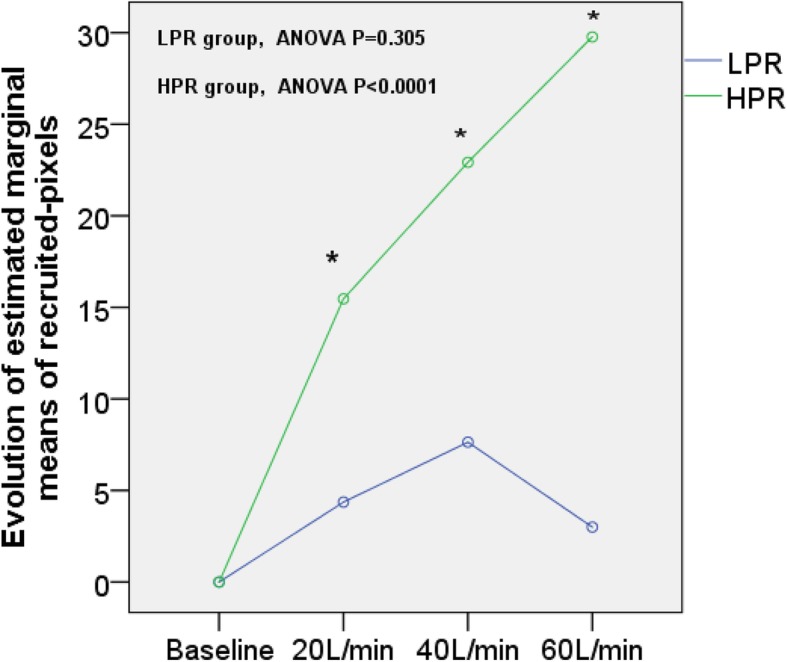
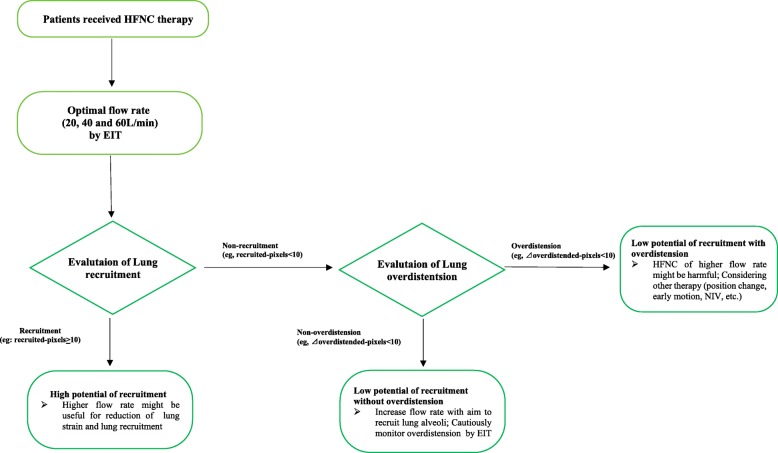
Methods: Twenty-four patients who received HFNC within 24 h after extubation were prospectively enrolled in this study. EIT was used to monitor regional lung ventilation distributions at baseline (conventional oxygen therapy) and three flow rate levels of HFNC therapy (20, 40, and 60 L/min). Change of end-expiratory lung impedance (ΔEELI), regional recruitment (recruited-pixels) and overdistension (overdistended-pixels), and lung strain change were determined by EIT. EIT images were equally divided into four ventral-to-dorsal horizontal regions of interest (ROIs 1, 2, 3, and 4). "Overdistension-by HFNC" due to HFNC is defined as an increase of overdistened-pixels > 10 than baseline. Patients were divided into two groups: (1) high potential of recruitment (HPR), recruited-pixels > 10 pixels at 60 L/min than baseline, and (2) low potential of recruitment (LPR), recruited-pixels < 10 pixels at 60 L/min than baseline.
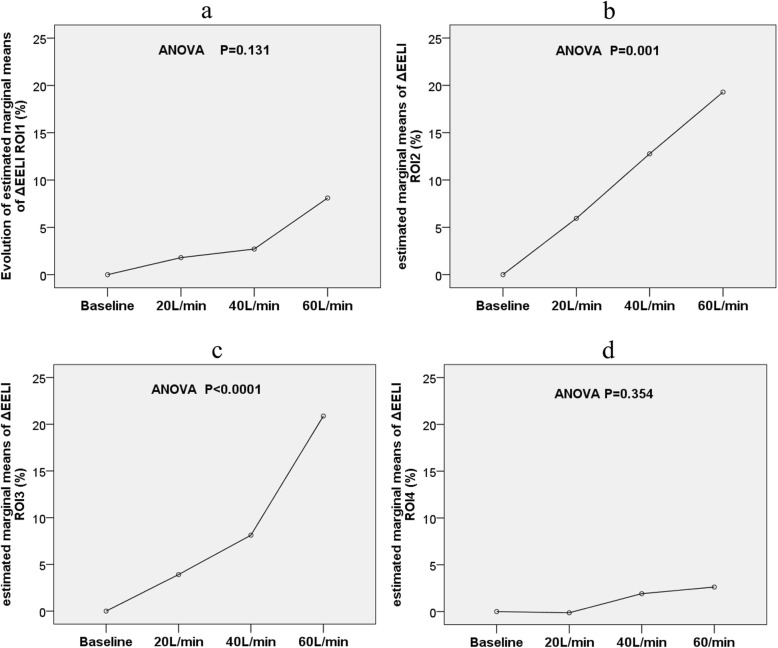
Results: When the flow rate gradually increased from baseline to 60 L/min, a significant and consistent increasing trend of global ΔEELI (%) (p < 0.0001), recruited-pixels (p < 0.001), and overdistended-pixels (p = 0.101) was observed. Moreover, the increase of ΔEELI was mainly distributed in ROI2 (p = 0.001) and ROI3 (p < 0.0001). The HPR group (13/24 patients) had significantly higher recruited-pixels than the LPR group (11/24 patients) at 20, 40, and 60 L/min. There were no significant differences in PaO2/FiO2, ΔEELI (%), and overdistention pixels between the two groups. The HPR group had 13 patients in which no one had "overdistension-by HFNC", and the LPR group had 11 patients in which 4 patients had "overdistension-by HFNC" (0/13 vs. 4/11, p = 0.017).
Conclusions: Using EIT could identify diverse effects of HFNC on lung regional ventilation in postextubation situations. Further study is required to validate using "HFNC effect" based on lung recruitment and overdistension by EIT in clinical practice.
Trial registration: The study was retrospectively registered at www.clinicaltrials.gov (no. NCT04245241).
Keywords: Electrical impedance tomography; High-flow nasal cannula; Lung overdistension; Lung recruitment.
Conflict of interest statement
Zhanqi Zhao receives a consulting fee from Dräger Medical. All other authors declare that they have no competing interests.
Figures
Comment in
-
Is the effect of a high-flow nasal cannula after extubation evaluated by electrical impedance tomography applicable to clinical practice?Crit Care. 2020 Apr 28;24(1):184. doi: 10.1186/s13054-020-02899-2. Crit Care. 2020. PMID: 32345349 Free PMC article. No abstract available.
References
-
- Hernandez G, Vaquero C, Gonzalez P, Subira C, Frutos-Vivar F, Rialp G, Laborda C, Colinas L, Cuena R, Fernandez R. Effect of postextubation high-flow nasal cannula vs conventional oxygen therapy on reintubation in low-risk patients: a randomized clinical trial. JAMA. 2016;315(13):1354–1361. doi: 10.1001/jama.2016.2711. - DOI - PubMed
-
- Mauri T, Alban L, Turrini C, Cambiaghi B, Carlesso E, Taccone P, Bottino N, Lissoni A, Spadaro S, Volta CA, et al. Optimum support by high-flow nasal cannula in acute hypoxemic respiratory failure: effects of increasing flow rates. Intensive Care Med. 2017;43(10):1453–1463. doi: 10.1007/s00134-017-4890-1. - DOI - PubMed
MeSH terms
Substances
Associated data
LinkOut - more resources
Full Text Sources
Medical
