. 2020 May 5;86(10):e00305-20.
doi: 10.1128/AEM.00305-20. Print 2020 May 5.

Genetic Influences of the Microbiota on the Life Span of Drosophila melanogaster

Affiliations

Genetic Influences of the Microbiota on the Life Span of Drosophila melanogaster

Melinda K Matthews et al. Appl Environ Microbiol. .

Abstract

To better understand how associated microorganisms ("microbiota") influence organismal aging, we focused on the model organism Drosophila melanogaster We conducted a metagenome-wide association (MGWA) as a screen to identify bacterial genes associated with variation in the D. melanogaster life span. The results of the MGWA predicted that bacterial cysteine and methionine metabolism genes influence fruit fly longevity. A mutant analysis, in which flies were inoculated with Escherichia coli strains bearing mutations in various methionine cycle genes, confirmed a role for some methionine cycle genes in extending or shortening fruit fly life span. Initially, we predicted these genes might influence longevity by mimicking or opposing methionine restriction, an established mechanism for life span extension in fruit flies. However, follow-up transcriptome sequencing (RNA-seq) and metabolomic experiments were generally inconsistent with this conclusion and instead implicated glucose and vitamin B6 metabolism in these influences. We then tested if bacteria could influence life span through methionine restriction using a different set of bacterial strains. Flies reared with a bacterial strain that ectopically expressed bacterial transsulfuration genes and lowered the methionine content of the fly diet also extended female D. melanogaster life span. Taken together, the microbial influences shown here overlap with established host genetic mechanisms for aging and therefore suggest overlapping roles for host and microbial metabolism genes in organismal aging.IMPORTANCE Associated microorganisms ("microbiota") are intimately connected to the behavior and physiology of their animal hosts, and defining the mechanisms of these interactions is an urgent imperative. This study focuses on how microorganisms influence the life span of a model host, the fruit fly Drosophila melanogaster First, we performed a screen that suggested a strong influence of bacterial methionine metabolism on host life span. Follow-up analyses of gene expression and metabolite abundance identified stronger roles for vitamin B6 and glucose than methionine metabolism among the tested mutants, possibly suggesting a more limited role for bacterial methionine metabolism genes in host life span effects. In a parallel set of experiments, we created a distinct bacterial strain that expressed life span-extending methionine metabolism genes and showed that this strain can extend fly life span. Therefore, this work identifies specific bacterial genes that influence host life span, including in ways that are consistent with the expectations of methionine restriction.

Keywords: Acetobacter; Drosophila melanogaster; Lactobacillus; MGWA; glucose; life span; metagenome-wide association; methionine restriction; microbiota; vitamin B6.


Figures

FIG 1
FIG 1
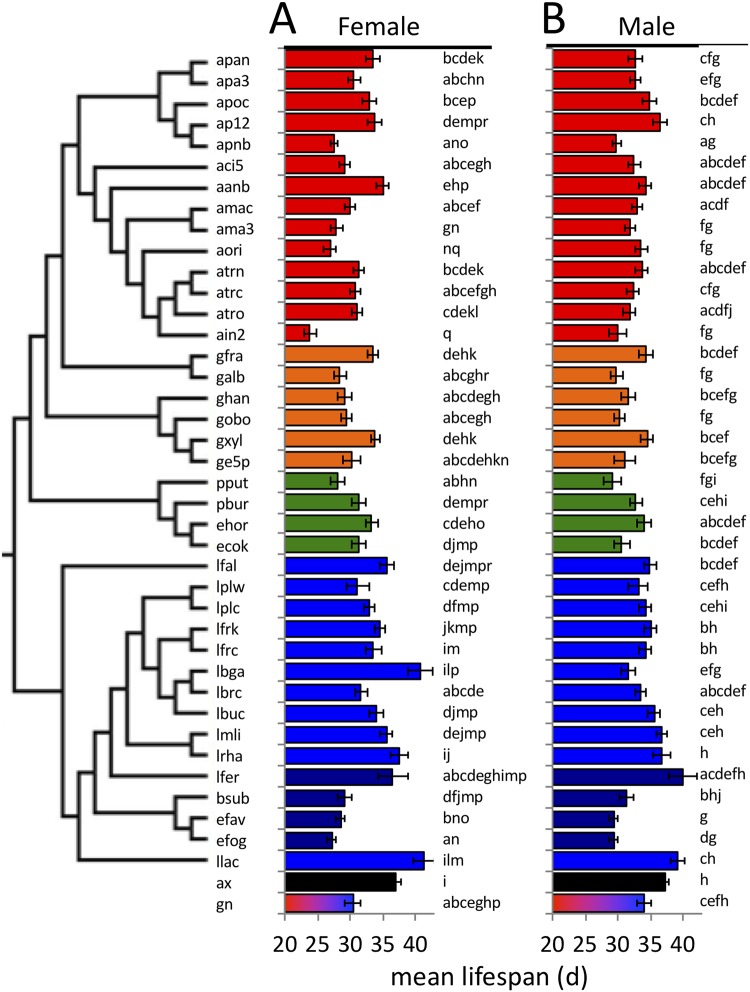
Bacteria influence the mean life spans of female and male flies. The mean life spans of flies reared in monoassociation with a panel of bacterial isolates is presented (total n = 13,350; n for each treatment is shown in Table S1A in the supplemental material). Four-character strain designations are listed in Table 1, and the phylogenetic relationship between the strains, based on 16S sequences, is shown in the tree at left. Coloring represents Acetobacter (red), non-Acetobacter Acetobacteraceae (orange), Gammaproteobacteria (green), Lactobacillus (blue), non-Lactobacillus Firmicutes (purple), bacterium free (ax; black), and 4-species gnotobiotic (gn; multicolored, containing strains atrc, apoc, lbrc, and lplc). Different lowercase letters by the bars represent statistically significant differences between treatments. d, days.
FIG 2
FIG 2
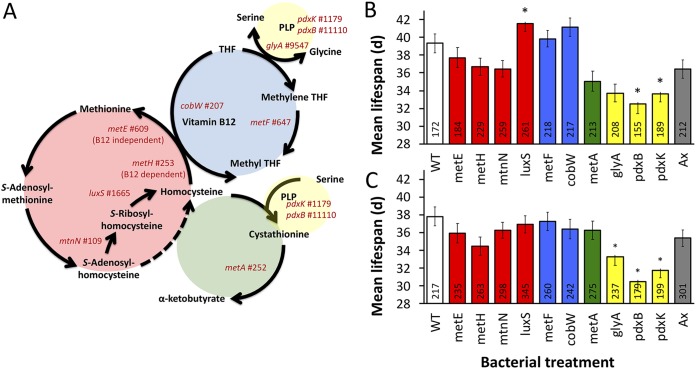
Methionine metabolism mutants and D. melanogaster life span. (A) Diagram of central methionine metabolism (red), vitamin B12-dependent conversion of homocysteine to methionine (blue), transsulfuration (green), and vitamin B6, pyridoxal phosphate (PLP) (yellow). Gene names that were tested with E. coli mutants, together with their rank in the MGWA, are presented. Average life spans of male (B) and female (C) D. melanogaster monoassociated with E. coli mutant strains (WT, wild-type E. coli; Ax, bacterium-free). Colors of the bars correspond to colors shown in panel A. Numbers inside the bars report the number of flies tested per treatment. *, P < 0.05 versus WT bacteria, determined by a Cox mixed-effects survival model.
FIG 3
FIG 3
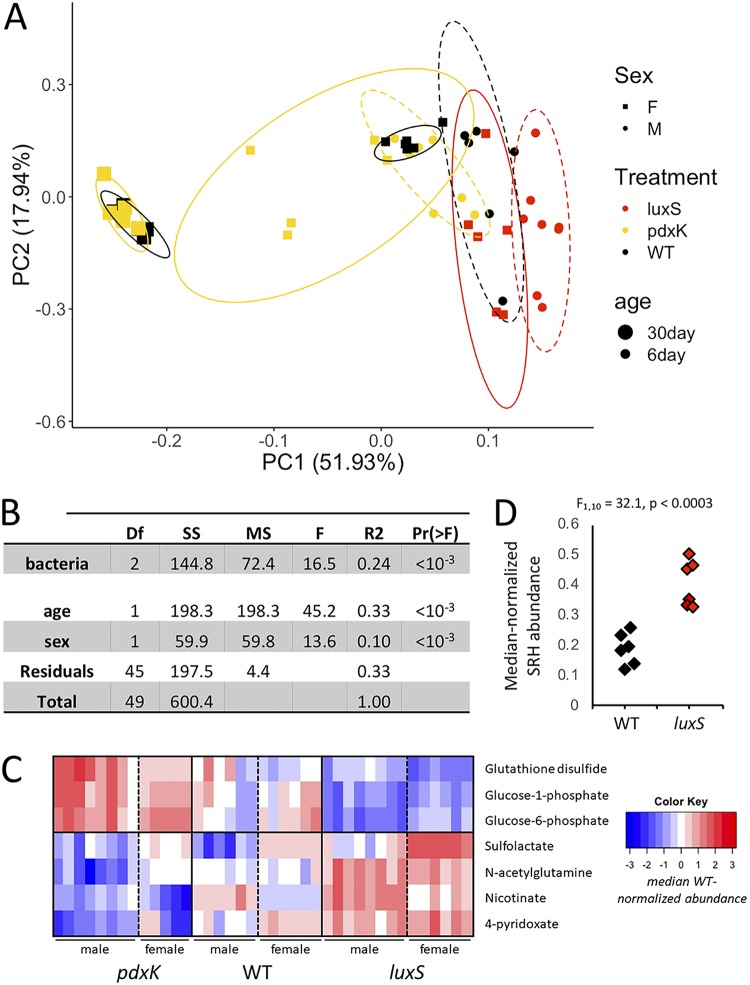
Metabolomics of aging flies and diets exposed to E. coli mutants. (A) Principal-component analysis (PCA) plot showing the clustering of samples from flies inoculated with mutant bacteria (luxS and pdxK) in an analysis of global metabolomes (∼100 metabolites). (B) PERMANOVA table showing significant variations in the metabolome with bacterial treatment and with age and sex of the flies. Df, degrees of freedom; SS, sum of squares; MS, mean squares; F, F value; R2, R2; Pr(>F), P value. (C) Heat map showing the differences in specific metabolite levels between flies bearing mutant (luxS and pdxK) and wild-type bacteria (WT). (D) Differences in the abundance of S-ribosyl homocysteine (SRH) in fly diets exposed to flies and either wild-type (WT) or luxS mutant bacteria.
FIG 4
FIG 4
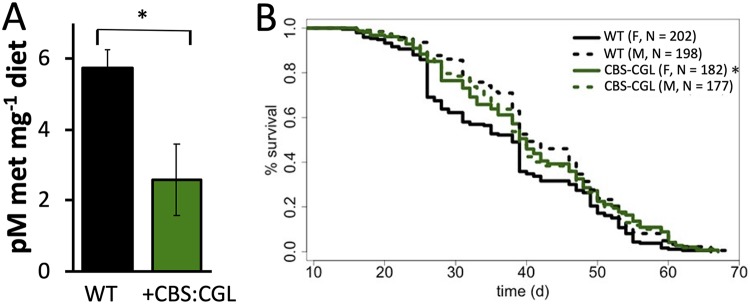
The influence of transsulfuration gene-expressing Acetobacter on fly life span and methionine content. (A) The influence of CBS::CGL-expressing bacteria on dietary methionine content; n = 6 readings per treatment. *, P < 0.05. (B) Mean life spans of female (F) and male (M) flies bearing wild-type (WT) or CBS::CGL-expressing bacteria (+CGS-CGL). *, P < 0.05 versus female flies bearing wild-type (WT) bacteria.

References

    1. Zhao L, Zhao Y, Liu R, Zheng X, Zhang M, Guo H, Zhang H, Ren F. 2017. The transcription factor DAF-16 is essential for increased longevity in C. elegans exposed to Bifidobacterium longum BB68. Sci Rep 7:7408. doi:10.1038/s41598-017-07974-3. - DOI - PMC - PubMed
    1. Smolentseva O, Gusarov I, Gautier L, Shamovsky I, DeFrancesco AS, Losick R, Nudler E. 2017. Mechanism of biofilm-mediated stress resistance and lifespan extension in C. elegans. Sci Rep 7:7137. doi:10.1038/s41598-017-07222-8. - DOI - PMC - PubMed
    1. Khanna A, Kumar J, Vargas MA, Barrett L, Katewa S, Li P, McCloskey T, Sharma A, Naude N, Nelson C, Brem R, Killilea DW, Mooney SD, Gill M, Kapahi P. 2016. A genome-wide screen of bacterial mutants that enhance dauer formation in C. elegans. Sci Rep 6:38764. doi:10.1038/srep38764. - DOI - PMC - PubMed
    1. Kwon G, Lee J, Lim YH. 2016. Dairy Propionibacterium extends the mean lifespan of Caenorhabditis elegans via activation of the innate immune system. Sci Rep 6:31713. doi:10.1038/srep31713. - DOI - PMC - PubMed
    1. Gruber J, Kennedy BK. 2017. Microbiome and longevity: gut microbes send signals to host mitochondria. Cell 169:1168–1169. doi:10.1016/j.cell.2017.05.048. - DOI - PubMed

Publication types

LinkOut - more resources