The lymph node at a glance - how spatial organization optimizes the immune response
- PMID: 32144196
- PMCID: PMC7063836
- DOI: 10.1242/jcs.241828
The lymph node at a glance - how spatial organization optimizes the immune response
Abstract
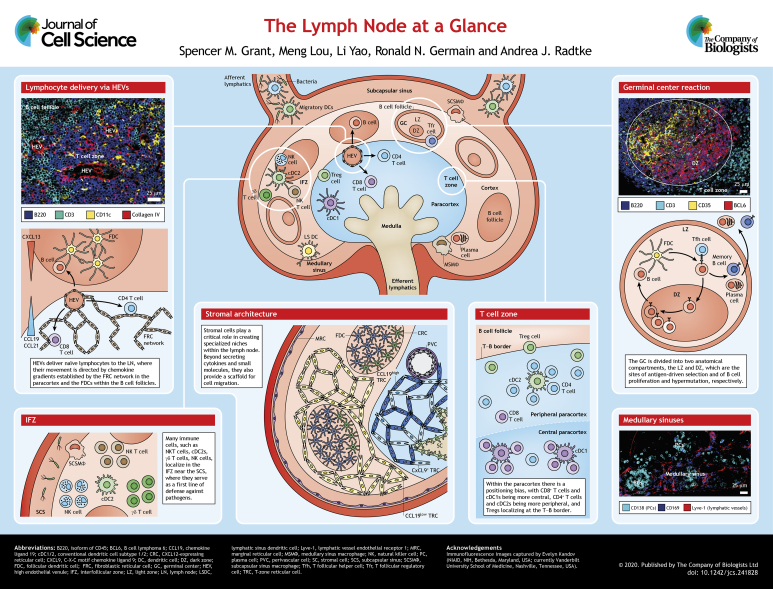
A hallmark of the mammalian immune system is its ability to respond efficiently to foreign antigens without eliciting an inappropriate response to self-antigens. Furthermore, a robust immune response requires the coordination of a diverse range of cells present at low frequencies within the host. This problem is solved, in part, by concentrating antigens, antigen-presenting cells and antigen-responsive cells in lymph nodes (LNs). Beyond housing these cell types in one location, LNs are highly organized structures consisting of pre-positioned cells within well-defined microanatomical niches. In this Cell Science at a Glance article and accompanying poster, we outline the key cellular populations and components of the LN microenvironment that are present at steady state and chronicle the dynamic changes in these elements following an immune response. This review highlights the LN as a staging ground for both innate and adaptive immune responses, while providing an elegant example of how structure informs function.
Keywords: Adaptive immunity; Immunology; Innate immunity; Lymph node.
© 2020. Published by The Company of Biologists Ltd.
Conflict of interest statement
Competing interestsThe authors declare no competing or financial interests.
References
-
- Aichele P., Zinke J., Grode L., Schwendener R. A., Kaufmann S. H. E. and Seiler P. (2003). Macrophages of the splenic marginal zone are essential for trapping of blood-borne particulate antigen but dispensable for induction of specific T-cell responses. J. Immunol. 171, 1148-1155. 10.4049/jimmunol.171.3.1148 - DOI - PubMed
Publication types
MeSH terms
Substances
LinkOut - more resources
Full Text Sources