


Mechanisms and pathophysiological significance of sterile inflammation during acetaminophen hepatotoxicity
- PMID: 32145352
- PMCID: PMC7098420
- DOI: 10.1016/j.fct.2020.111240
Mechanisms and pathophysiological significance of sterile inflammation during acetaminophen hepatotoxicity
Abstract
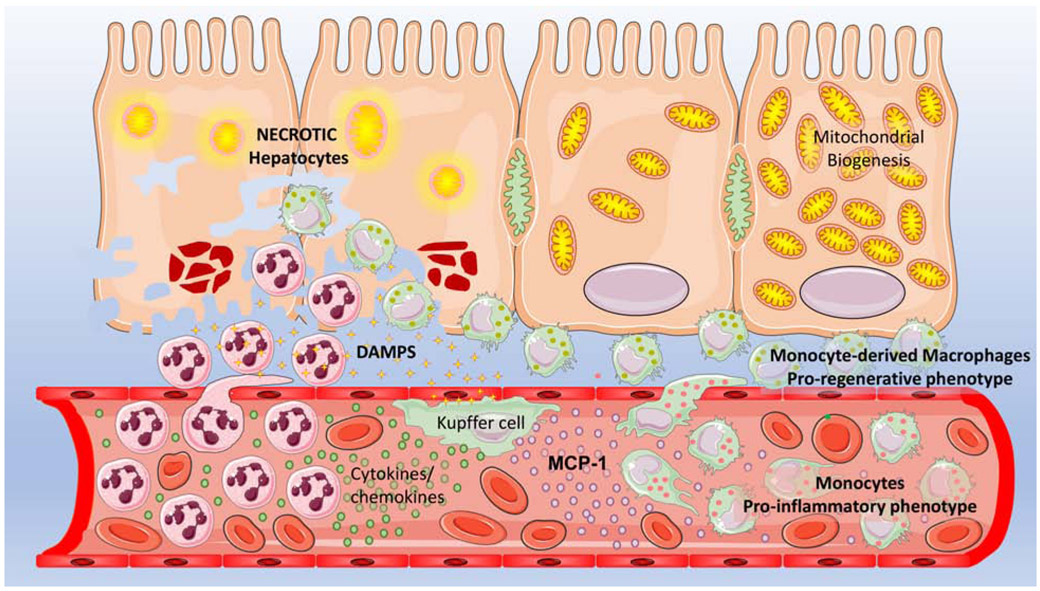
Acetaminophen (APAP) is a widely used analgesic drug, which can cause severe liver injury after an overdose. The intracellular signaling mechanisms of APAP-induced cell death such as reactive metabolite formation, mitochondrial dysfunction and nuclear DNA fragmentation have been extensively studied. Hepatocyte necrosis releases damage-associated molecular patterns (DAMPs) which activate cytokine and chemokine formation in macrophages. These signals activate and recruit neutrophils, monocytes and other leukocytes into the liver. While this sterile inflammatory response removes necrotic cell debris and promotes tissue repair, the capability of leukocytes to also cause tissue injury makes this a controversial topic. This review summarizes the literature on the role of various DAMPs, cytokines and chemokines, and the pathophysiological function of Kupffer cells, neutrophils, monocytes and monocyte-derived macrophages, and NK and NKT cells during APAP hepatotoxicity. Careful evaluation of results and experimental designs of studies dealing with the inflammatory response after APAP toxicity provide very limited evidence for aggravation of liver injury but support of the hypothesis that these leukocytes promote tissue repair. In addition, many cytokines and chemokines modulate tissue injury by affecting the intracellular signaling events of cell death rather than toxicity of leukocytes. Reasons for the controversial results in this area are also discussed.
Keywords: Acetaminophen-induced liver injury; Inflammasome; Innate immune response; Macrophages; Monocytes; Neutrophils.
Copyright © 2020 Elsevier Ltd. All rights reserved.
Conflict of interest statement
Declaration of competing interest The authors declare that they have no known competing financial interests or personal relationships that could have appeared to influence the work reported in this paper.
Figures
Comment in
-
The dual role of immune response in acetaminophen hepatotoxicity: Natural products as immune interventions.Toxicol Lett. 2022 Feb 1;355:172-173. doi: 10.1016/j.toxlet.2021.11.009. Epub 2021 Nov 19. Toxicol Lett. 2022. PMID: 34808266 No abstract available.
References
-
- Al-Belooshi T, John A, Tariq S, Al-Otaiba A, Raza H, 2010. Increased mitochondrial stress and modulation of mitochondrial respiratory enzyme activities in acetaminophen-induced toxicity in mouse macrophage cells. Food Chem. Toxicol 48, 2624–32. - PubMed
-
- Antoine DJ, Jenkins RE, Dear JW, Williams DP, McGill MR, Sharpe MR, Craig DG, Simpson KJ, Jaeschke H, Park BK, 2012. Molecular forms of HMGB1 and keratin-18 as mechanistic biomarkers for mode of cell death and prognosis during clinical acetaminophen hepatotoxicity. J. Hepatol 56, 1070–9. - PMC - PubMed
-
- Antoine DJ, Williams DP, Kipar A, Jenkins RE, Regan SL, Sathish JG, Kitteringham NR, Park BK, 2009. High-mobility group box-1 protein and keratin-18, circulating serum proteins informative of acetaminophen-induced necrosis and apoptosis in vivo. Toxicol. Sci 112, 521–31. - PubMed
-
- Antoniades CG, Khamri W, Abeles RD, Taams LS, Triantafyllou E, Possamai LA, Bernsmeier C, Mitry RR, O'Brien A, Gilroy D, Goldin R, Heneghan M, Heaton N, Jassem W, Bernal W, Vergani D, Ma Y, Quaglia A, Wendon J, Thursz M, 2014. Secretory leukocyte protease inhibitor: a pivotal mediator of anti-inflammatory responses in acetaminophen-induced acute liver failure. Hepatology 59, 1564–76. - PubMed
-
- Antoniades CG, Quaglia A, Taams LS, Mitry RR, Hussain M, Abeles R, Possamai LA, Bruce M, McPhail M, Starling C, Wagner B, Barnardo A, Pomplun S, Auzinger G, Bernal W, Heaton N, Vergani D, Thursz MR, Wendon J, 2012. Source and characterization of hepatic macrophages in acetaminophen-induced acute liver failure in humans. Hepatology 56, 735–46. - PubMed
Publication types
MeSH terms
Substances
Grants and funding
LinkOut - more resources
Full Text Sources
Other Literature Sources
Medical
