


Suppression of cocaine relapse-like behaviors upon pimavanserin and lorcaserin co-administration
- PMID: 32145488
- PMCID: PMC8980701
- DOI: 10.1016/j.neuropharm.2020.108009
Suppression of cocaine relapse-like behaviors upon pimavanserin and lorcaserin co-administration
Abstract
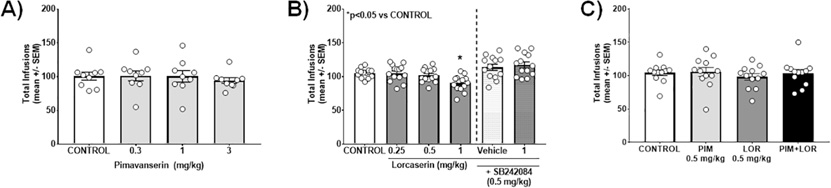
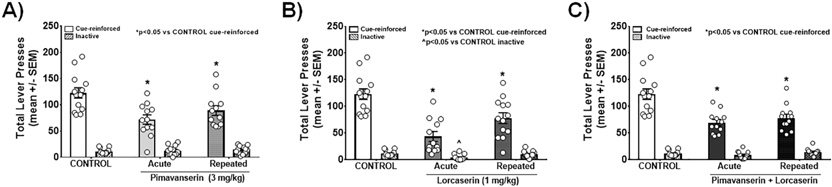
Cocaine use disorder (CUD) is a major public health challenge for which there are no pharmacotherapeutics approved by the United States Food and Drug Administration (FDA). The propensity to relapse in CUD involves several vulnerability factors including sensitivity to cues associated with cocaine-taking. Serotonin (5-hydroxytryptamine, 5-HT) neurotransmission, particularly through the 5-HT2A receptor (5-HT2AR) and 5-HT2C receptor (5-HT2CR), is mechanistically linked to cocaine-seeking in preclinical models. In the present experiments, we employed self-administration assays in male rats to investigate whether acute and/or repeated administration of the FDA-approved selective 5-HT2AR antagonist/inverse agonist pimavanserin, selective 5-HT2CR agonist lorcaserin or their combination would alter cocaine intake and/or cocaine-seeking behavior. We found that acute administration of lorcaserin, but not pimavanserin, attenuated cocaine intake while pimavanserin plus lorcaserin did not impact cocaine self-administration. In contrast, 10-days of repeated administration of pimavanserin, lorcaserin, or pimavanserin plus lorcaserin during forced abstinence from cocaine self-administration, blunted cocaine-seeking, similar to the acute administration of each ligand. Taken together, these data reveal the efficacy of repeated treatment with pimavanserin plus lorcaserin to attenuate factors important to relapse-like behaviors in rodent models of CUD. This article is part of the special issue entitled 'Serotonin Research: Crossing Scales and Boundaries'.
Keywords: 5-HT(2A) receptor; 5-HT(2C) receptor; Cocaine; Drug-seeking behavior; Lorcaserin; Pimavanserin.
Copyright © 2020 Elsevier Ltd. All rights reserved.
Figures
References
-
- Aloyo VJ, Berg KA, Spampinato U, Clarke WP, Harvey JA, 2009. Current status of inverse agonism at serotonin(2A) (5-HT(2A)) and 5-HT(2C) receptors. Pharmacol. Ther. 121, 160–173. - PubMed
-
- Anastasio NC, Stutz SJ, Fox RG, Sears RM, Emeson RB, DiLeone RJ, O'Neil RT, Fink LH, Li D, Green TA, Moeller FG, Cunningham KA, 2014b. Functional status of the serotonin 5-HT2C receptor (5-HT2CR) drives interlocked phenotypes that precipitate relapse-like behaviors in cocaine dependence. Neuropsychopharmacology 39, 370–382. - PMC - PubMed
Publication types
MeSH terms
Substances
Grants and funding
LinkOut - more resources
Full Text Sources
Other Literature Sources
Medical
