


Association of neighbourhood migrant density and risk of non-affective psychosis: a national, longitudinal cohort study
- PMID: 32145763
- PMCID: PMC7083220
- DOI: 10.1016/S2215-0366(20)30059-6
Association of neighbourhood migrant density and risk of non-affective psychosis: a national, longitudinal cohort study
Abstract
Background: Elevated risk of psychotic disorders in migrant groups is a public mental health priority. We investigated whether living in areas of high own-region migrant density was associated with reduced risk of psychotic disorders among migrants and their children, and whether generation status, probable visible minority status, or region-of-origin affected this relationship.
Methods: We used the Swedish registers to identify migrants and their children born between Jan 1, 1982, and Dec 31, 1996, and living in Sweden on or after their 15th birthday. We tracked all included participants from age 15 years or date of migration until emigration, death, or study end (Dec 31, 2016). The outcome was an ICD-10 diagnosis of non-affective psychosis (F20-29). We calculated own-region and generation-specific own-region density within the 9208 small areas for market statistics neighbourhoods in Sweden, and estimated the relationship between density and diagnosis of non-affective psychotic disorders using multilevel Cox proportional hazards models, adjusting for individual confounders (generation status, age, sex, calendar year, lone dwelling, and time since migration [migrants only]), family confounders (family income, family unemployment, and social welfare), and neighbourhood confounders (deprivation index, population density, and proportion of lone dwellings), and using the Akaike information criterion (AIC) to compare model fit.
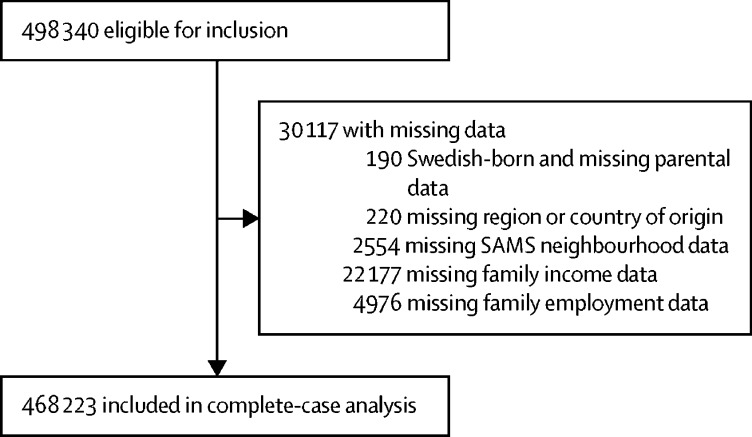
Findings: Of 468 223 individuals included in the final cohort, 4582 (1·0%) had non-affective psychotic disorder. Lower own-region migrant density was associated with increased risk of psychotic disorders among migrants (hazard ratio [HR] 1·05, 95% CI 1·02-1·07 per 5% decrease) and children of migrants (1·03, 1·01-1·06), after adjustment. These effects were stronger for probable visible minority migrants (1·07, 1·04-1·11), including migrants from Asia (1·42, 1·15-1·76) and sub-Saharan Africa (1·28, 1·15-1·44), but not migrants from probable non-visible minority backgrounds (0·99, 0·94-1·04). Among migrants, adding generation status to the measure of own-region density provided a better fit to the data than overall own-region migrant density (AIC 36 103 vs 36 106, respectively), with a 5% decrease in generation-specific migrant density corresponding to a HR of 1·07 (1·04-1·11).
Interpretation: Migrant density was associated with non-affective psychosis risk in migrants and their children. Stronger protective effects of migrant density were found for probable visible minority migrants and migrants from Asia and sub-Saharan Africa. For migrants, this risk intersected with generation status. Together, these results suggest that this health inequality is socially constructed.
Funding: Wellcome Trust, Royal Society, Mental Health Research UK, University College London, National Institute for Health Research, Swedish Research Council, and FORTE.
Copyright © 2020 The Author(s). Published by Elsevier Ltd. This is an Open Access article under the CC BY 4.0 license. Published by Elsevier Ltd.. All rights reserved.
Comment in
-
Advancing the study of local ethnic density and psychosis.Lancet Psychiatry. 2020 Apr;7(4):293-294. doi: 10.1016/S2215-0366(20)30101-2. Epub 2020 Mar 5. Lancet Psychiatry. 2020. PMID: 32145762 No abstract available.
References
-
- Cantor-Graae E, Selten J-P. Schizophrenia and migration: a meta-analysis and review. Am J Psychiatry. 2005;162:12–24. - PubMed
-
- Bourque F, Van Der Ven E, Malla A. A meta-analysis of the risk for psychotic disorders among first- and second-generation immigrants. Psychol Med. 2011;41:897–910. - PubMed
-
- Pedersen CB, Cantor-Graae E. Age at migration and risk of schizophrenia among immigrants in Denmark: a 25-year incidence study. Am J Psychiatry. 2012;169:1117–1118. - PubMed
Publication types
MeSH terms
Grants and funding
LinkOut - more resources
Full Text Sources
Medical
Research Materials
