


Enhanced Emission Induced by FRET from a Long-Lifetime, Low Quantum Yield Donor to a Long-Wavelength, High Quantum Yield Acceptor
- PMID: 32148386
- PMCID: PMC7059372
- DOI: 10.1023/A:1015375622992
Enhanced Emission Induced by FRET from a Long-Lifetime, Low Quantum Yield Donor to a Long-Wavelength, High Quantum Yield Acceptor
Abstract
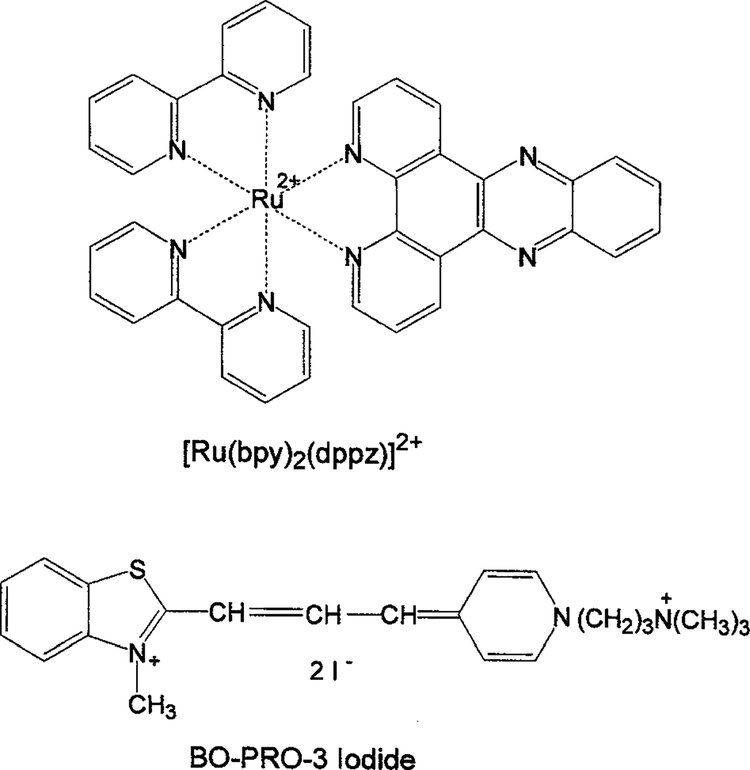
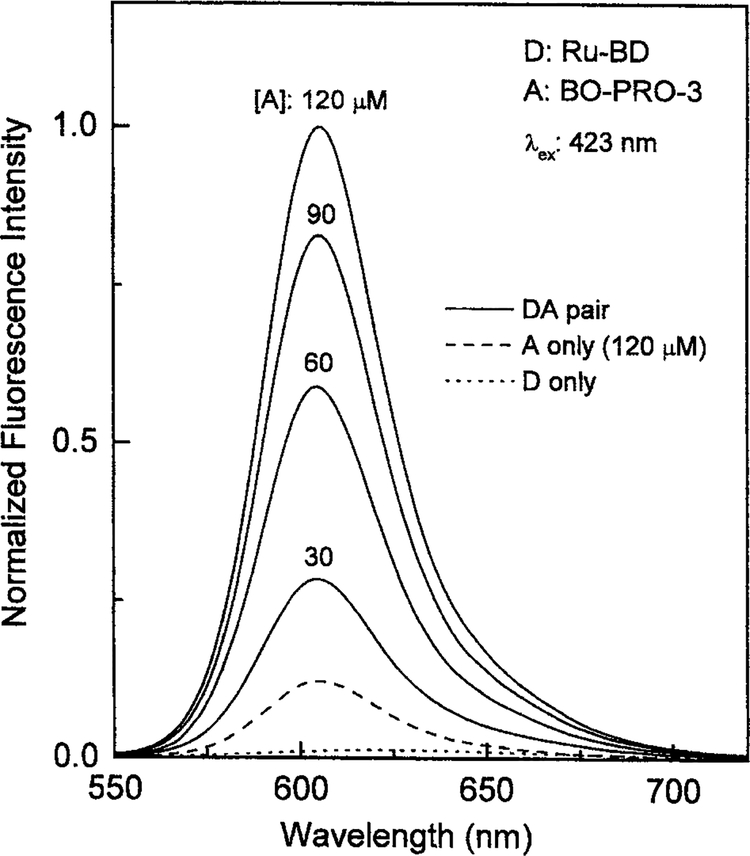
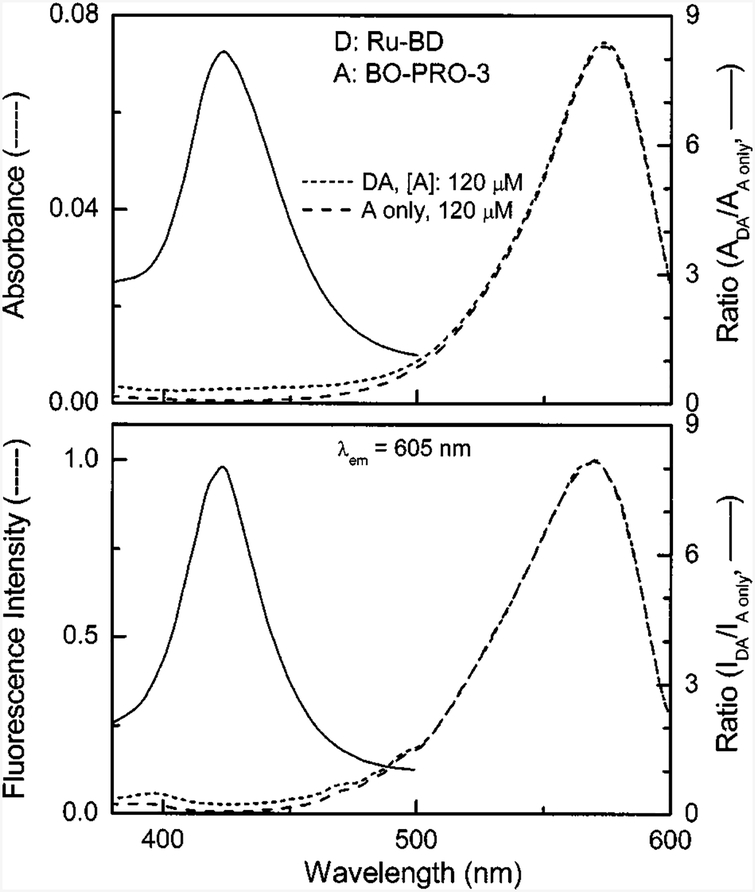
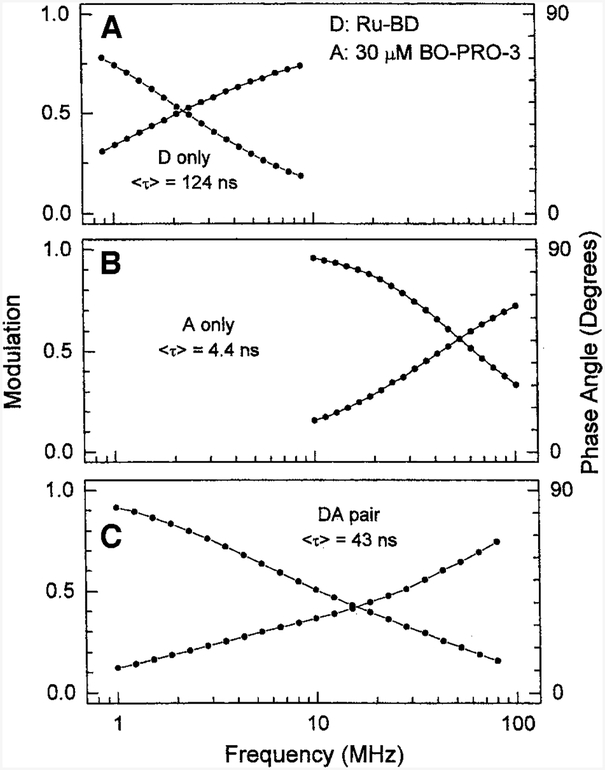
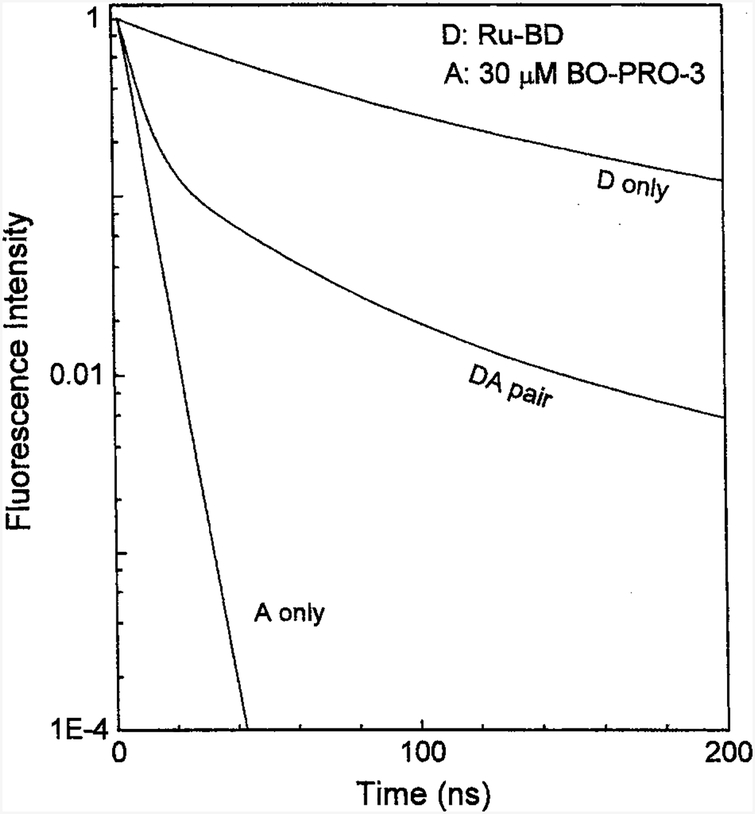
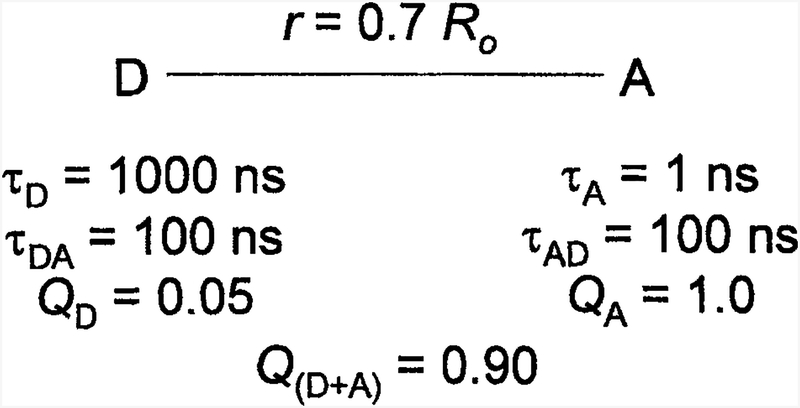
We report observation of high quantum yield, long-lifetime fluorescence from a red dye BO-PRO-3 excited by resonance energy transfer (RET). The acceptor fluorescence was highly enhanced upon binding to the donor-labeled DNA. A ruthenium complex (Ru) was chosen as a donor in this system because of its long fluorescence lifetime. Both donor and acceptor were non-covalently bound to DNA. Emission from the donor-acceptor system (DA) at wavelengths exceeding 600 nm still preserves the long-lifetime component of the Ru donor, retaining average fluorescence lifetimes in the range of 30-50 ns. Despite the low quantum yield of the Ru donor in the absence of acceptor, its overall quantum yield of the DA pair was increased by energy transfer to the higher quantum yield acceptor BO-PRO-3. The wavelength-integrated intensity of donor and acceptor bound to DNA was many-fold greater than the intensity of the donor and acceptor separately bound to DNA. The origin of this effect is due to an efficient energy transfer from the donor, competing with non-radiative depopulation of the donor excited state. The distinctive features of DA complexes can be used in the development of a new class of engineered luminophores that display both long lifetime and long-wavelength emission. Similar DA complexes can be applied as proximity indicators, exhibiting strong fluorescence of adjacently located donors and acceptors over the relatively weak fluorescence of separated donors and acceptors.
Keywords: BO-PRO-3; DNA; Enhanced emission; fluorescence resonance energy transfer; metal-ligand complex.
Figures
References
-
- Thompson RB (1994) In Lakowicz JR (Ed.) Topics in Fluorescence Spectroscopy, Vol. 4: Probe Design and Chemical Sensing, Plenum Press, New York, pp. 151–222.
-
- Daehne S, Resch-Genger U, and Wolfbeis OS (1998) NearInfrared Dyes for High Technology Applications, Kluwer Academic Publishers, Boston, pp. 458.
-
- Strickler SJ and Berg RA (1962) J. Chem. Phys 37, 814–822.
Grants and funding
LinkOut - more resources
Full Text Sources
Miscellaneous