Review
. 2020 Mar 27;40(3):BSR20200265.
doi: 10.1042/BSR20200265.

Colorectal cancer (CRC) as a multifactorial disease and its causal correlations with multiple signaling pathways

Affiliations
Review

Colorectal cancer (CRC) as a multifactorial disease and its causal correlations with multiple signaling pathways

Mao-Lin Wan et al. Biosci Rep. .

Abstract

Colorectal cancer (CRC) is the third most common malignancy and one of the leading causes of cancer-related death among men worldwide. CRC is a multifactor digestive pathology, which is a huge problem faced not only by clinicians but also by researchers. Importantly, a unique feature of CRC is the dysregulation of molecular signaling pathways. To date, a series of reviews have indicated that different signaling pathways are disordered and have potential as therapeutic targets in CRC. Nevertheless, an overview of the function and interaction of multiple signaling pathways in CRC is needed. Therefore, we summarized the pathways, biological functions and important interactions involved in CRC. First, we investigated the involvement of signaling pathways, including Wnt, PI3K/Akt, Hedgehog, ErbB, RHOA, Notch, BMP, Hippo, AMPK, NF-κB, MAPK and JNK. Subsequently, we discussed the biological function of these pathways in pathophysiological aspects of CRC, such as proliferation, apoptosis and metastasis. Finally, we summarized important interactions among these pathways in CRC. We believe that the interaction of these pathways could provide new strategies for the treatment of CRC.

Keywords: CRC; interaction; metastasis; proliferation; signaling pathway.


Conflict of interest statement

The authors declare that there are no competing interests associated with the manuscript.

Figures
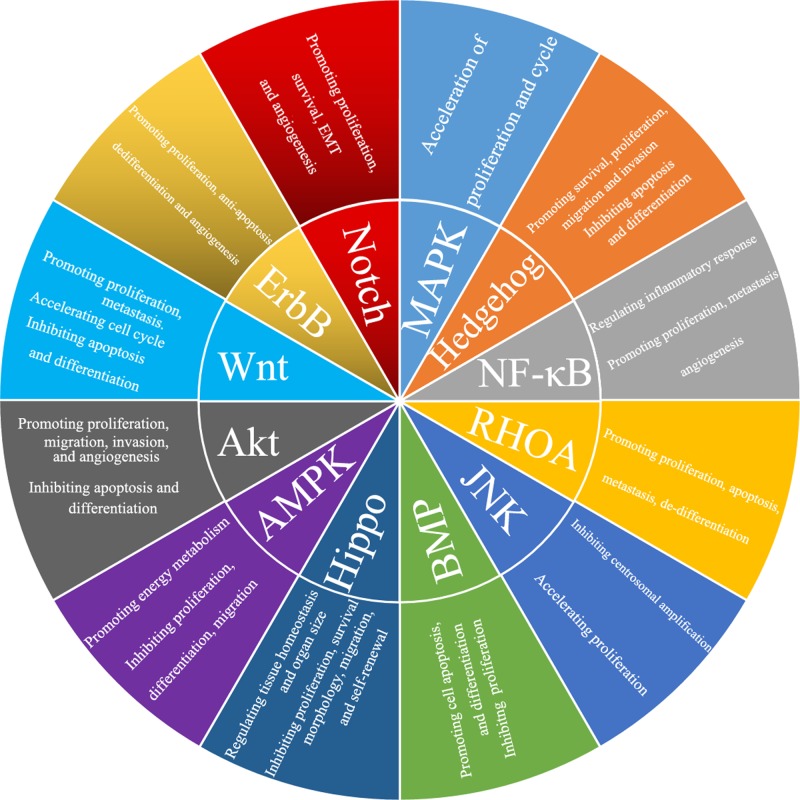
Figure 1
Figure 1. The function of these signaling pathways in CRC
Wnt, PI3K/Akt, Hedgehog, ErbB, Notch, NF-κB and MAPK can promote the carcinogenesis of CRC. BMP, AMPK and Hippo can inhibit the development and progression of CRC. However, RHOA and JNK may play dual roles in CRC.
Figure 2
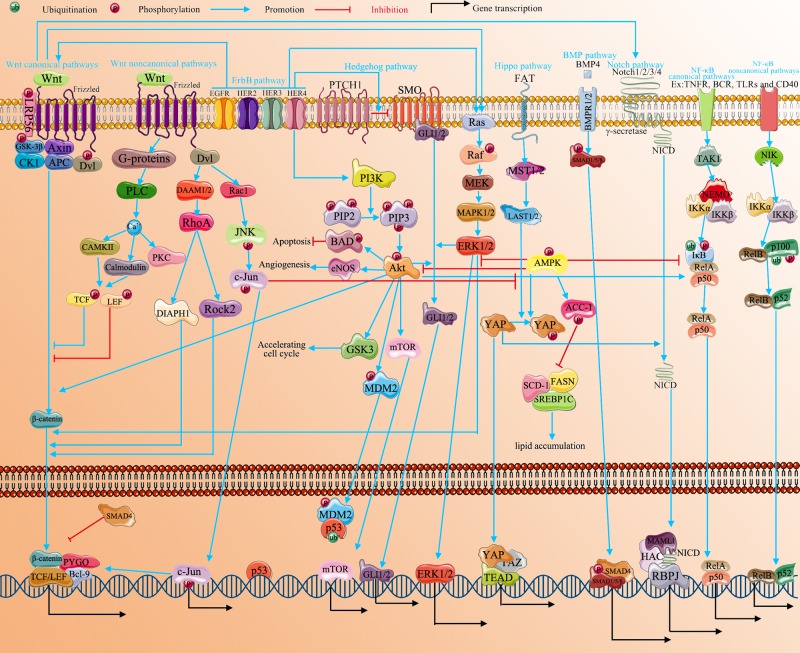
Figure 2. The correlation of multiple signaling pathways in CRC
The development and progression of CRC is mediated by multiple signaling pathways, including Wnt, PI3K/Akt, Hedgehog, ErbB, RHOA, Notch, BMP, AMPK, Hippo, NF-κB, MAPK and JNK. These signaling pathways do not function singly but interact with each other. AMPK, BMP and Hippo mainly play anticancer roles in CRC progression. Other pathways are involved in CRC as carcinogenic factors. These pathways interact not only in the cytoplasm but also in the nucleus. These interactions regulate the transcription of downstream genes leading to cancer cell proliferation, apoptosis inhibition, migration, invasion and dedifferentiation.

References

    1. Bray F., Ferlay J., Soerjomataram I., Siegel R.L., Torre L.A. and Jemal A. (2018) Global cancer statistics 2018: GLOBOCAN estimates of incidence and mortality worldwide for 36 cancers in 185 countries. CA Cancer J. Clin. 68, 394–424 10.3322/caac.21492 - DOI - PubMed
    1. Huang Y., Zhao M., Yin J. et al. (2019) Pulmonary metastasis in newly diagnosed colon-rectal cancer: a population-based nomogram study. Int. J. Colorectal Dis. 34, 867–878 10.1007/s00384-019-03270-w - DOI - PubMed
    1. Li K., Guo Q., Yang J. et al. (2017) FOXD3 is a tumor suppressor of colon cancer by inhibiting EGFR-Ras-Raf-MEK-ERK signal pathway. Oncotarget 8, 5048. - PMC - PubMed
    1. Eaden J.A., Abrams K.R. and Mayberry J.F. (2001) The risk of colorectal cancer in ulcerative colitis: a meta-analysis. Gut 48, 526–535 10.1136/gut.48.4.526 - DOI - PMC - PubMed
    1. Shahanavaj K., Gil-Bazo I., Castiglia M. et al. (2015) Cancer and the microbiome: potential applications as new tumor biomarker. Expert Rev. Anticancer Ther. 15, 317–330 10.1586/14737140.2015.992785 - DOI - PubMed