


Role of vaspin in porcine ovary: effect on signaling pathways and steroid synthesis via GRP78 receptor and protein kinase A†
- PMID: 32149334
- PMCID: PMC7703729
- DOI: 10.1093/biolre/ioaa027
Role of vaspin in porcine ovary: effect on signaling pathways and steroid synthesis via GRP78 receptor and protein kinase A†
Abstract
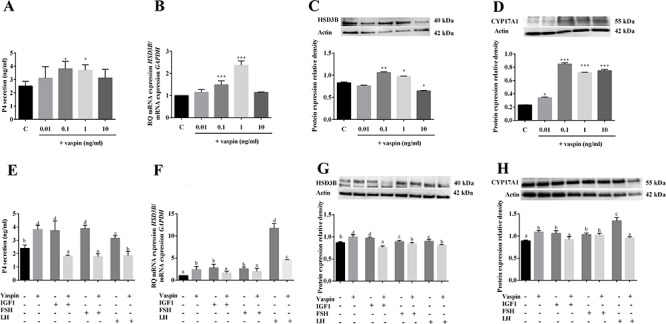
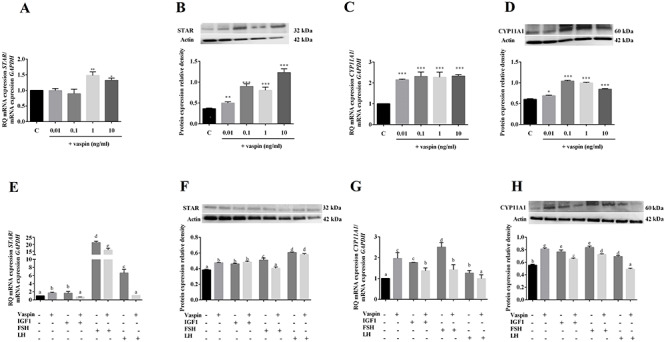
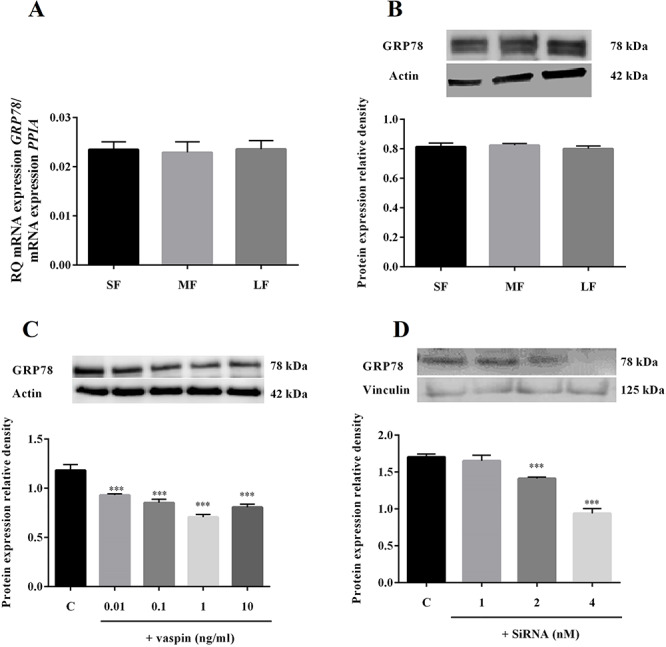
Vaspin, visceral-adipose-tissue-derived serine protease inhibitor, is involved in the development of obesity, insulin resistance, inflammation, and energy metabolism. Our previous study showed vaspin expression and its regulation in the ovary; however, the role of this adipokine in ovarian cells has never been studied. Here, we studied the in vitro effect of vaspin on various kinase-signaling pathways: mitogen-activated kinase (MAP3/1), serine/threonine kinase (AKT), signal transducer and activator of transcription 3 (STAT3) protein kinase AMP (PRKAA1), protein kinase A (PKA), and on expression of nuclear factor kappa B (NFKB2) as well as on steroid synthesis by porcine ovarian cells. By using western blot, we found that vaspin (1 ng/ml), in a time-dependent manner, increased phosphorylation of MAP3/1, AKT, STAT3, PRKAA1, and PKA, while it decreased the expression of NFKB2. We observed that vaspin, in a dose-dependent manner, increased the basal steroid hormone secretion (progesterone and estradiol), mRNA and protein expression of steroid enzymes using real-time PCR and western blot, respectively, and the mRNA of gonadotropins (FSHR, LHCGR) and steroids (PGR, ESR2) receptors. The stimulatory effect of vaspin on basal steroidogenesis was reversed when ovarian cells were cultured in the presence of a PKA pharmacological inhibitor (KT5720) and when GRP78 receptor was knocked down (siRNA). However, in the presence of insulin-like growth factor type 1 and gonadotropins, vaspin reduced steroidogenesis. Thus, vaspin, by activation of various signaling pathways and stimulation of basal steroid production via GRP78 receptor and PKA, could be a new regulator of porcine ovarian function.
Keywords: kinases; ovary; pig; steroid hormones; vaspin.
© The Author(s) 2020. Published by Oxford University Press on behalf of Society for the Study of Reproduction. All rights reserved. For permissions, please e-mail: journals.permissions@oup.com.
Figures





References
-
- Hida K, Wada J, Eguchi J, Zhang H, Baba M, Seida A, Hashimoto I, Okada T, Yasuhara A, Nakatsuka A, Shikata K, Hourai S et al. Visceral adipose tissue-derived serine protease inhibitor: a unique insulin-sensitizing adipocytokine in obesity. Proc Natl Acad Sci USA 2005; 102:10610–10615. - PMC - PubMed
-
- Li Q, Chen R, Moriya J, Yamakawa J, Sumino H, Kanda T, Takahashi T. A novel adipocytokine, visceral adipose tissue-derived serine protease inhibitor (vaspin), and obesity. J Int Med Res 2008; 36:625–629. - PubMed
-
- Klöting N, Kovacs P, Kern M, Heiker JT, Fasshauer M, Schön MR, Stumvoll M, Beck-Sickinger AG, Blüher M. Central vaspin administration acutely reduces food intake and has sustained blood glucose-lowering effects. Diabetologia 2011; 54:1819–1823. - PubMed
-
- Lai X, Zhang C, Wang J, Wang C, Lan X, Zhang C, Lei C, Chen H. mRNA expression pattern and association study with growth traits of bovine vaspin gene. Mol Biol Rep 2013; 40:4499–4505. - PubMed
-
- Youn BS, Klöting N, Kratzsch J, Lee N, Park JW, Song ES, Ruschke K, Oberbach A, Fasshauer M, Stumvoll M, Blüher M. Serum vaspin concentrations in human obesity and type 2 diabetes. Diabetes 2008; 57:372–377. - PubMed
Publication types
MeSH terms
Substances
LinkOut - more resources
Full Text Sources
Research Materials
Miscellaneous
