


Rapid regulation of photosynthetic light harvesting in the absence of minor antenna and reaction centre complexes
- PMID: 32149343
- PMCID: PMC7307847
- DOI: 10.1093/jxb/eraa126
Rapid regulation of photosynthetic light harvesting in the absence of minor antenna and reaction centre complexes
Abstract
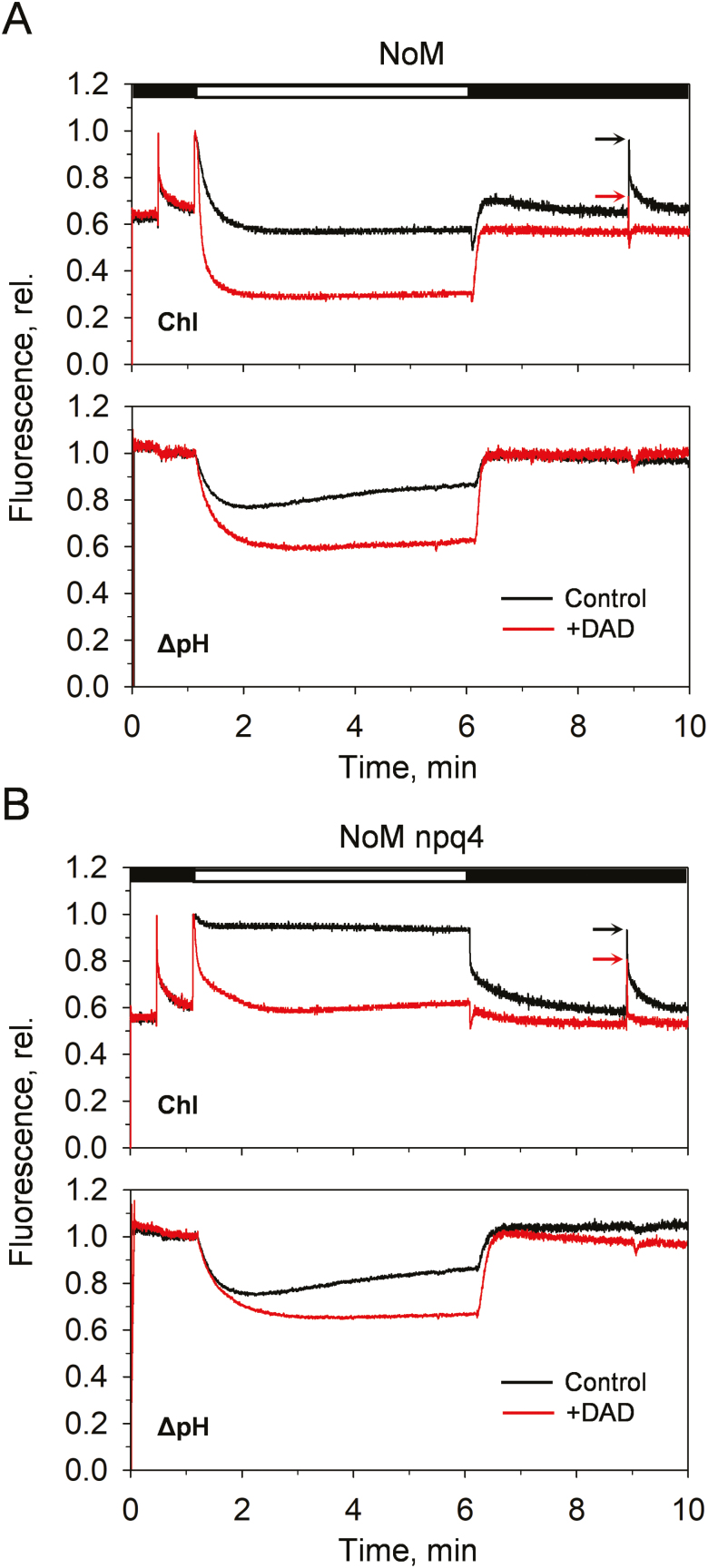
Plants are subject to dramatic fluctuations in the intensity of sunlight throughout the day. When the photosynthetic machinery is exposed to high light, photons are absorbed in excess, potentially leading to oxidative damage of its delicate membrane components. A photoprotective molecular process called non-photochemical quenching (NPQ) is the fastest response carried out in the thylakoid membranes to harmlessly dissipate excess light energy. Despite having been intensely studied, the site and mechanism of this essential regulatory process are still debated. Here, we show that the main NPQ component called energy-dependent quenching (qE) is present in plants with photosynthetic membranes largely enriched in the major trimeric light-harvesting complex (LHC) II, while being deprived of all minor LHCs and most photosystem core proteins. This fast and reversible quenching depends upon thylakoid lumen acidification (ΔpH). Enhancing ΔpH amplifies the extent of the quenching and restores qE in the membranes lacking PSII subunit S protein (PsbS), whereas the carotenoid zeaxanthin modulates the kinetics and amplitude of the quenching. These findings highlight the self-regulatory properties of the photosynthetic light-harvesting membranes in vivo, where the ability to switch reversibly between the harvesting and dissipative states is an intrinsic property of the major LHCII.
Keywords: Chlorophyll fluorescence; LHCII; NPQ; proton gradient; qE; zeaxanthin.
© The Author(s) 2020. Published by Oxford University Press on behalf of the Society for Experimental Biology.
Figures




Comment in
-
Just the essentials: photoprotective energy dissipation pared-down.J Exp Bot. 2020 Jun 22;71(12):3380-3382. doi: 10.1093/jxb/eraa164. J Exp Bot. 2020. PMID: 32569382 No abstract available.
References
-
- Akhtar P, Görföl F, Garab G, Lambrev PH. 2019. Dependence of chlorophyll fluorescence quenching on the lipid-to-protein ratio in reconstituted light-harvesting complex II membranes containing lipid labels. Chemical Physics 522, 242–248.
-
- Anderson J, Chow W, Goodchild D. 1988. Thylakoid membrane organisation in sun/shade acclimation. Functional Plant Biology 15, 11–26.
-
- Aro EM, Virgin I, Andersson B. 1993. Photoinhibition of Photosystem II. Inactivation, protein damage and turnover. Biochimica et Biophysica Acta 1143, 113–134. - PubMed
-
- Avenson TJ, Ahn TK, Zigmantas D, Niyogi KK, Li Z, Ballottari M, Bassi R, Fleming GR. 2008. Zeaxanthin radical cation formation in minor light-harvesting complexes of higher plant antenna. Journal of Biological Chemistry 283, 3550–3558. - PubMed
Publication types
MeSH terms
Substances
Grants and funding
LinkOut - more resources
Full Text Sources
