Association of Stress-Related Disorders With Subsequent Neurodegenerative Diseases
- PMID: 32150226
- PMCID: PMC7063561
- DOI: 10.1001/jamaneurol.2020.0117
Association of Stress-Related Disorders With Subsequent Neurodegenerative Diseases
Abstract
Importance: Posttraumatic stress disorder (PTSD) has been associated with increased risk for dementia. Less is known, however, about other stress-related disorders and their associations with neurodegenerative diseases.
Objective: To examine the association between stress-related disorders and risk for neurodegenerative diseases.
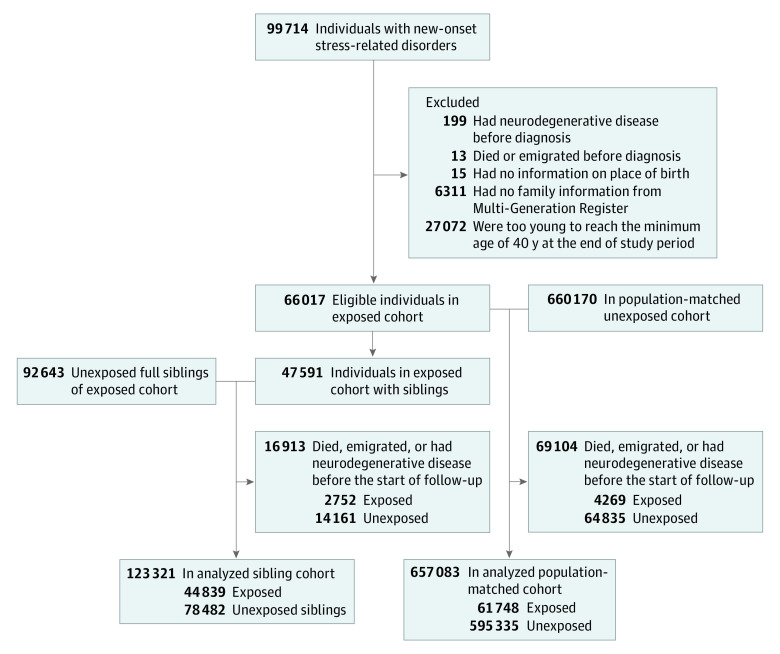
Design, setting, and participants: This population-matched and sibling cohort study was conducted in Sweden using data from nationwide health registers, including the Swedish National Patient Register. Individuals who received their first diagnosis of stress-related disorders between January 1, 1987, and December 31, 2008, were identified. Individuals who had a history of neurodegenerative diseases, had conflicting or missing information, had no data on family links, or were aged 40 years or younger at the end of the study were excluded. Individuals with stress-related disorders were compared with the general population in a matched cohort design; they were also compared with their siblings in a sibling cohort. Follow-up commenced from the age of 40 years or 5 years after the diagnosis of stress-related disorders, whichever came later, until the first diagnosis of a neurodegenerative disease, death, emigration, or the end of follow-up (December 31, 2013), whichever occurred first. Data analyses were performed from November 2018 to April 2019.
Exposures: Diagnosis of stress-related disorders (PTSD, acute stress reaction, adjustment disorder, and other stress reactions).
Main outcomes and measurements: Neurodegenerative diseases were identified through the National Patient Register and classified as primary or vascular. Alzheimer disease, Parkinson disease, and amyotrophic lateral sclerosis were evaluated separately. Cox proportional hazards regression models were used to estimate hazard ratios (HRs) with 95% CIs after controlling for multiple confounders.
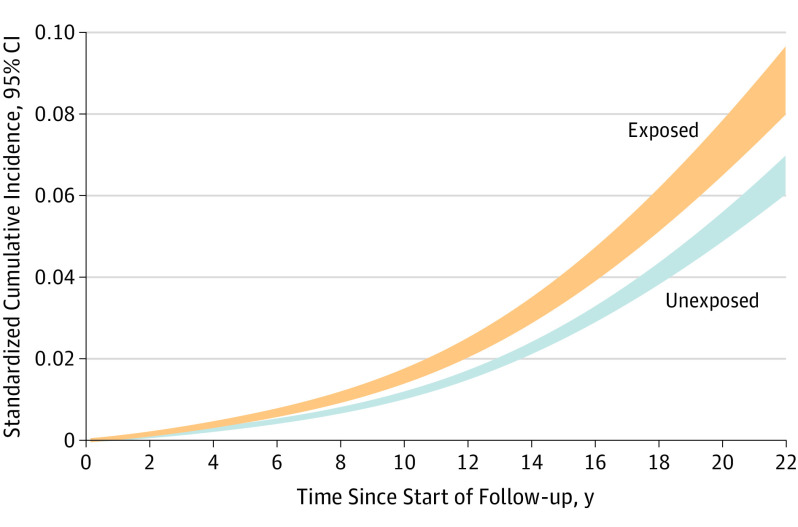
Results: The population-matched cohort included 61 748 exposed individuals and 595 335 matched unexposed individuals. A total of 44 839 exposed individuals and their 78 482 unaffected full siblings were included in the sibling cohort analysis. The median (interquartile range) age at the start of follow-up was 47 (41-56) years, and 24 323 (39.4%) of the exposed individuals were male. The median (interquartile range) follow-up was 4.7 (2.1-9.8) years. Compared with unexposed individuals, individuals with a stress-related disorder were at an increased risk of neurodegenerative diseases (HR, 1.57; 95% CI, 1.43-1.73). The risk increase was greater for vascular neurodegenerative diseases (HR, 1.80; 95% CI, 1.40-2.31) than for primary neurodegenerative diseases (HR, 1.31; 95% CI, 1.15-1.48). A statistically significant association was found for Alzheimer disease (HR, 1.36; 95% CI, 1.12-1.67) but not Parkinson disease (HR, 1.20; 95% CI, 0.98-1.47) or amyotrophic lateral sclerosis (HR, 1.20; 95% CI, 0.74-1.96). Results from the sibling cohort corroborated results from the population-matched cohort.
Conclusions and relevance: This study showed an association between stress-related disorders and an increased risk of neurodegenerative diseases. The relative strength of this association for vascular neurodegenerative diseases suggests a potential cerebrovascular pathway.
Conflict of interest statement
Figures
References
Publication types
MeSH terms
LinkOut - more resources
Full Text Sources
Medical
Miscellaneous