. 2020 May 1;318(5):F1074-F1085.
doi: 10.1152/ajprenal.00598.2019. Epub 2020 Mar 9.

Temporal hemodynamic changes in a female mouse model of systemic lupus erythematosus

Affiliations

Temporal hemodynamic changes in a female mouse model of systemic lupus erythematosus

Elena L Dent et al. Am J Physiol Renal Physiol. .

Abstract

Systemic lupus erythematosus (SLE) is a chronic multisystem autoimmune disease characterized by circulating autoantibodies, prevalent hypertension, renal injury, and cardiovascular disease. Onset of the disease often occurs in young women of childbearing age. Although kidney involvement is common to patients with SLE, little is known about temporal changes in renal hemodynamic function and its relationship to the pathogenesis of hypertension during autoimmune diseases. We hypothesized that the loss of immunological tolerance and subsequent production of autoantibodies in SLE leads to impaired renal hemodynamic function that precedes the development hypertension. Female NZBWF1 (SLE) mice and female NZW/LacJ (control) mice were instrumented with carotid artery and jugular vein catheters to determine mean arterial pressure (MAP) and glomerular filtration rate, respectively, at ages of 15, 20, 24, 28, 31, and 34 wk. In addition, urinary albumin excretion, blood urea nitrogen, circulating autoantibodies, and glomerulosclerosis were assessed at each age. Levels of circulating autoantibodies are increased between 24 and 28 wk of age in NZBWF1 mice and were significantly greater than in control mice. Glomerular filtration rate was significantly increased at 28 wk of age in NZBWF1 mice followed by a sharp decline at 34 wk of age. NZBWF1 mice had an increase in MAP that occurred by 34 wk of age. These data show that changes in circulating autoantibodies, renal hemodynamic function, and glomerular injury occur in NZBWF1 mice before changes in MAP, suggesting an important mechanistic role for autoimmunity to directly impair renal hemodynamic function and promote the development of hypertension.

Keywords: autoantibodies; autoimmunity; hypertension; renal hemodynamics; systemic lupus erythematosus.


Conflict of interest statement

No conflicts of interest, financial or otherwise, are declared by the author(s).

Figures
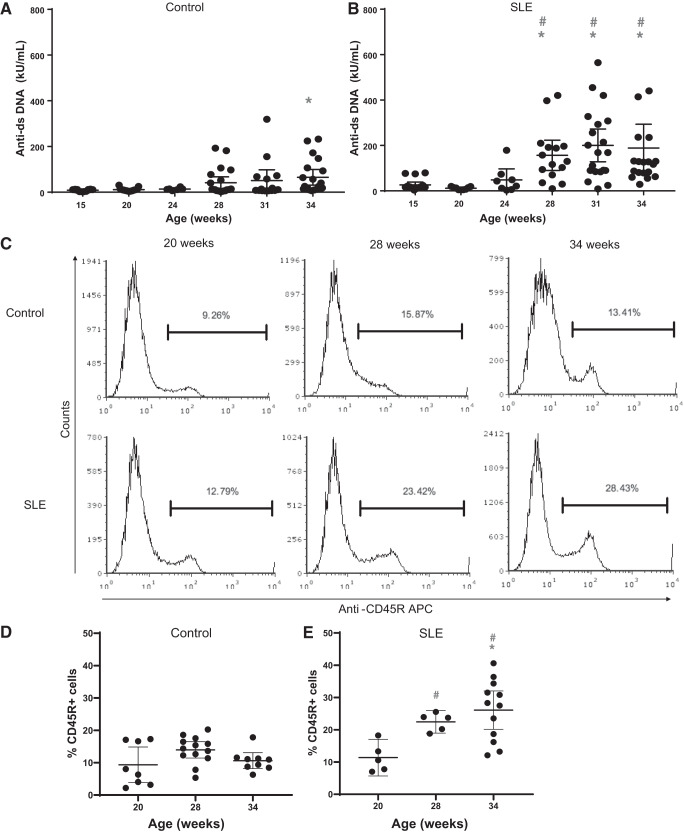
Fig. 1.
Fig. 1.
Anti-dsDNA IgG is increased by 28 wk of age in female mice with systemic lupus erythematosus (SLE). A: anti-dsDNA IgG was increased at 34 wk of age (*P = 0.0234) compared with 15 wk of age in female control mice. B: anti-dsDNA IgG was significantly increased by 28 wk of age (*P = 0.0436), 31 wk of age (*P = 0.0012), and 34 wk of age (*P = 0.0032) compared with 15 wk of age in female mice with SLE (95% confidence interval: −258.5 to −2.428, −293.1 to −54.64, and −283 to −41.67, respectively). Anti-dsDNA IgG was significantly increased by 28 wk of age (#P = 0.0072), 31 wk of age (#P = 0.0002), and 34 wk of age (#P = 0.0016) compared with age-matched control mice (95% confidence interval: −208.5 to −22.14, −243.2 to −54.9, and −211.6 to −35.01, respectively). C: representative histograms from control and SLE mice at 20, 28, and 34 wk of age. Peripheral blood leukocytes were isolated and stained with anti-mouse CD45R PE-Cy7. D and E: quantitative representation of CD45R+ B cells at 20, 28, and 34 wk of age in control (D) and SLE (E) mice. E: the percentage of circulating CD45R+ B cells was increased by 34 wk of age (*P = 0.0030) compared with 20 wk in SLE mice (95% CI: −24.24 to −5.204). The percentage of circulating CD45R+ B cells was increased by 28 wk of age (#P = 0.0310) and 34 wk of age (#P < 0.0001) in female mice with SLE compared with age-matched controls (95% confidence interval: −16.35 to −0.6109 and −22.07 to −8.883, respectively). The percentage of CD45R+ B cells did not change in female control mice.
Fig. 2.
Fig. 2.
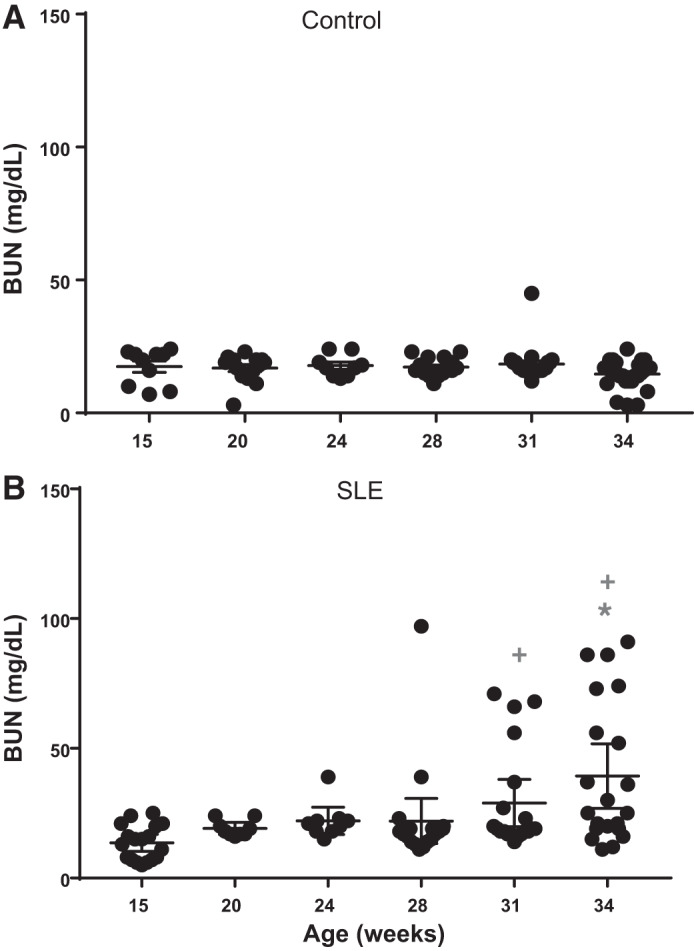
Plasma blood urea nitrogen (BUN) over time in female mice. A: BUN did not change in female control mice. B: BUN was significantly increased by 34 wk of age (; P = 0.0001) compared with 15 wk of age in female mice with systemic lupus erythematosus (SLE; 95% confidence interval: −41.03 to −10.43). BUN was significantly increased by 31 wk of age (+P = 0.0451) and 34 wk of age (+P < 0.0001) in mice with SLE compared with age-matched control mice (95% confidence interval: −21.46 to 0.1462 and −34.78 to −14.65, respectively).
Fig. 3.
Fig. 3.
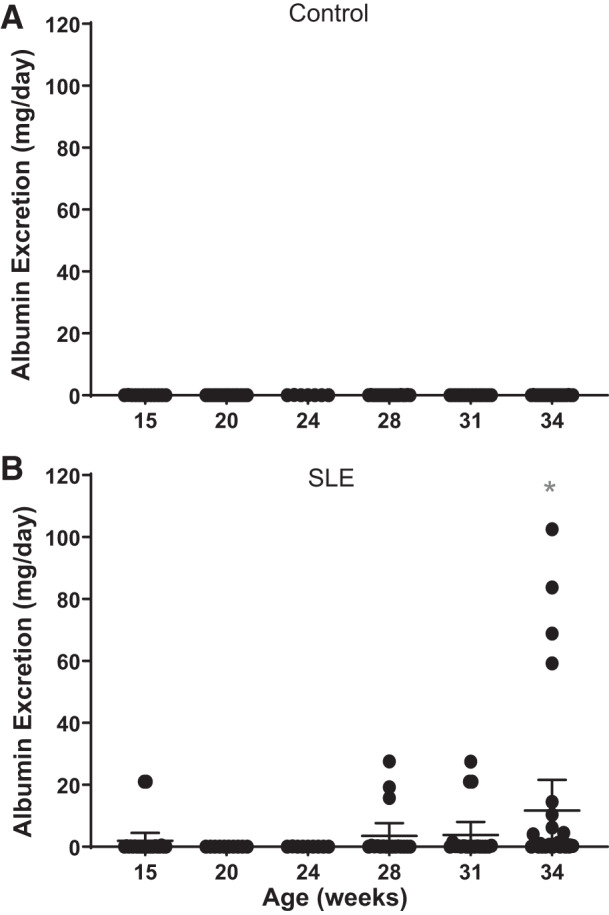
Urinary albumin excretion over time in female mice. A: albumin excretion did not change in female control mice. B: albumin excretion was increased by 34 wk of age compared with 15 wk of age in female mice with systemic lupus erythematosus (SLE). Albumin excretion was significantly increased by 34 wk of age (*P = 0.0263) in mice with SLE compared with age-matched control mice (95% confidence interval: −22.40 to −0.8994).
Fig. 4.
Fig. 4.
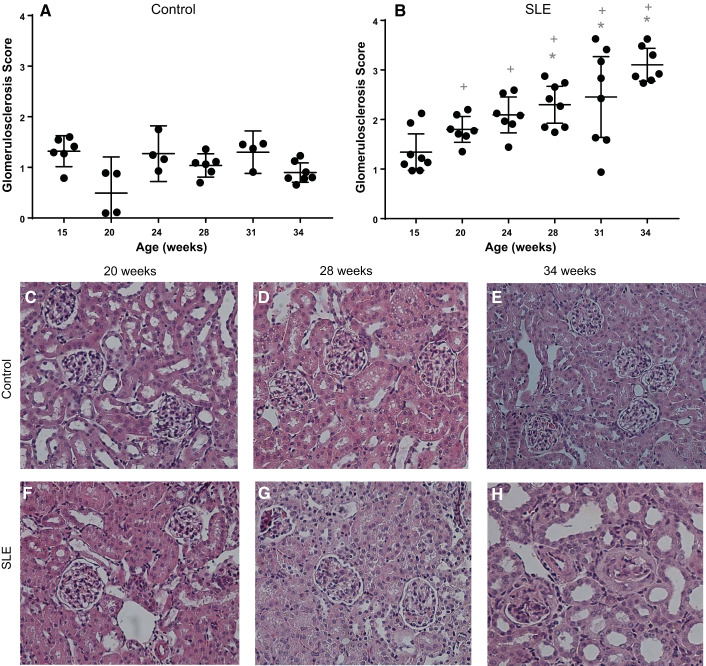
A and B: glomerulosclerosis was present in female mice with systemic lupus erythematosus (SLE) by 28 wk of age. A: glomerular scores did not increase in female control mice. B: glomerular scores were significantly increased by 28 wk of age (*P = 0.0058), 31 wk of age (*P = 0.0011), and 34 wk of age (*P < 0.0001) compared with 15 wk of age in female mice with SLE (95% confidene interval: −1.695 to −0.218, −1.849 to −0.3727, and −2.526 to −0.998, respectively). Glomerular scores were significantly increased at 20 wk of age (+P = 0.0002), 24 wk of age (+P = 0.0361), 28 wk of age (+P < 0.0001), 31 wk of age (+P = 0.0008), and 34 wk of age (+P < 0.0001) in mice with SLE compared with age-matched control mice (95% confidence interval: −2.095 to −0.5209, −1.609 to −0.03508, −1.938 to −0.5817, −1.923 to −0.3850, and −2.879 to −1.536, respectively). C−H: representative pictures of glomerulosclerosis (×40) from paraffin-embedded kidneys stained with hematoxylin and eosin.
Fig. 5.
Fig. 5.
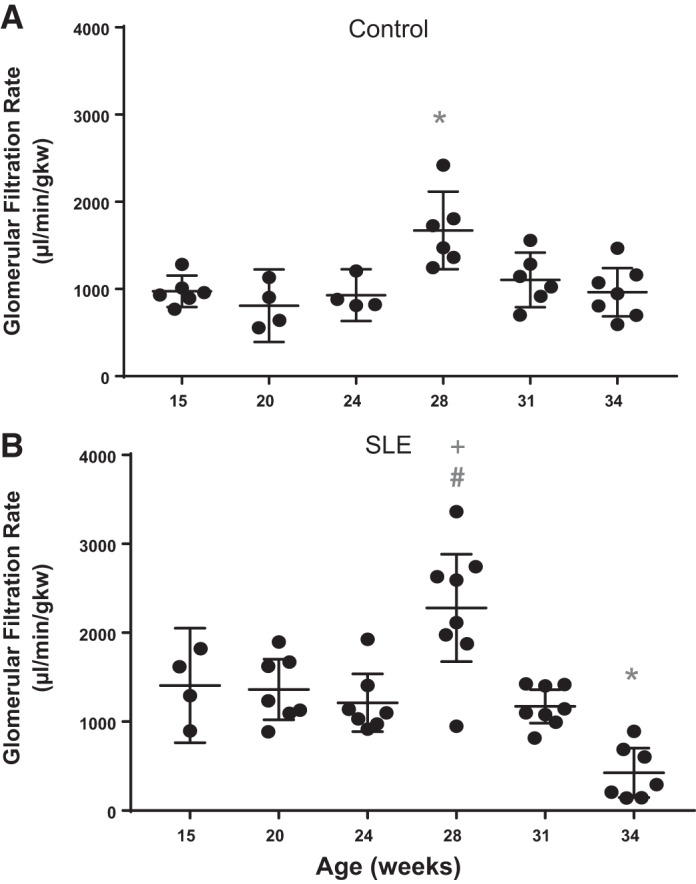
Glomerular filtration rate (GFR) is altered by 28 wk of age in female mice with systemic lupus erythematosus (SLE). A: GFR was increased in female control mice by 28 wk of age (*P = 0.0017) compared with 15 wk of age (95% confidence interval: −1169 to −226.3). B: GFR was significantly increased by 28 wk of age (#P = 0.0140) and significantly decreased by 34 wk of age (*P = 0.0057) compared with 15 wk of age in female mice with SLE (95% confidence interval: −1,615 to 131.5 and 223.6 to 1,742, respectively) and significantly increased at 28 wk (+P = 0.0254) in female mice with SLE compared with age-matched control mice (95% confidence interval: −1,133 to −50.97).
Fig. 6.
Fig. 6.
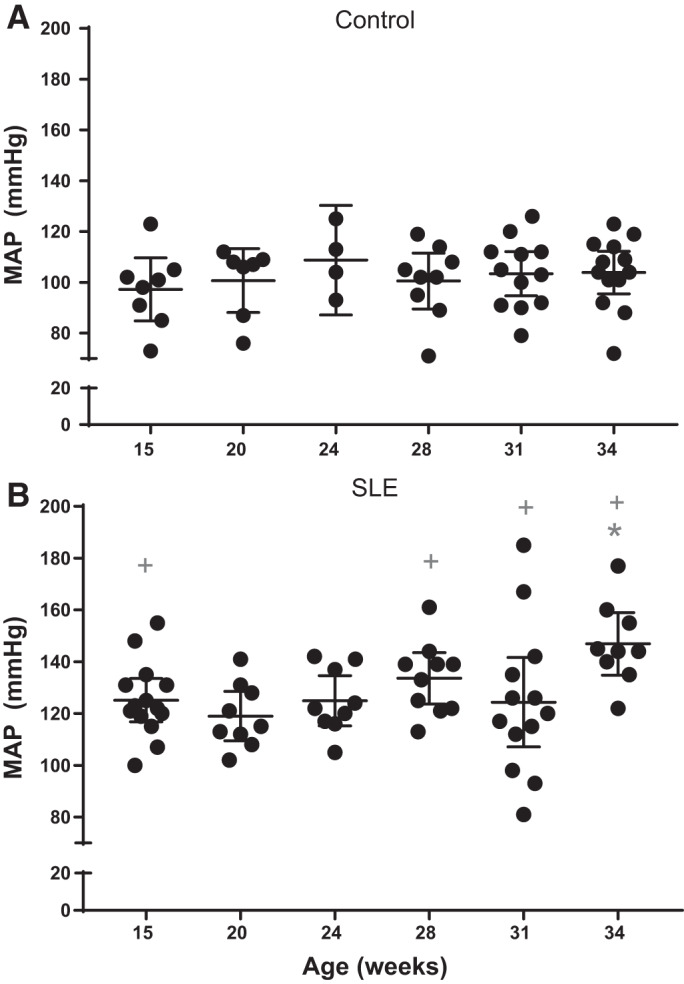
Mean arterial pressure (MAP) is increased by 34 wk of age in female mice with systemic lupus erythematosus (SLE). A: MAP remained unchanged in female control mice. B: MAP was significantly increased by 34 wk of age (*P = 0.0318) compared with 15 wk of age in female mice with SLE (95% confidence interval: −42.2 to −1.292). MAP was significantly increased by 15 wk of age (+P = 0.0012), 28 wk of age (+P = 0.0002), 31 wk of age (+P = 0.0105), and 34 wk (+P < 0.0001) compared with age-matched control mice (95% confidence interval: −47.28 to −8.506, −53.14 to −12.95, −38.48 to −3.457, and −62.01 to −24.07, respectively).
Fig. 7.
Fig. 7.
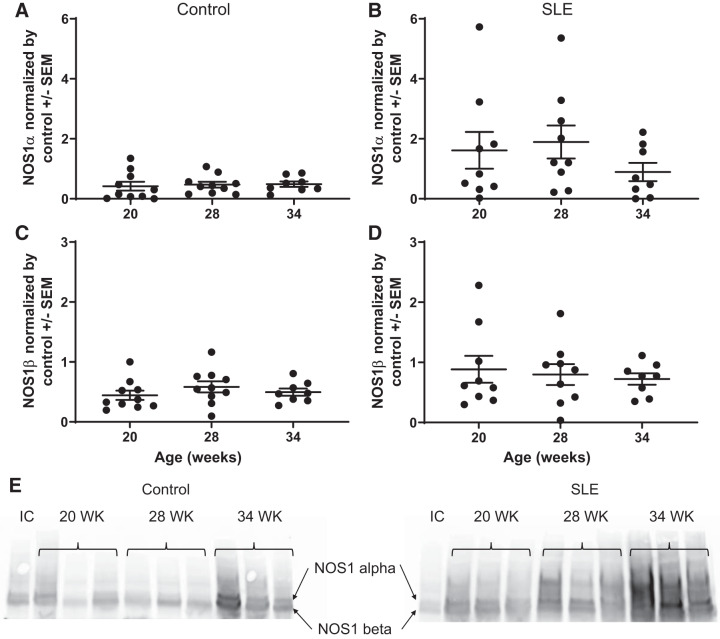
Nitric oxide synthase (NOS)1α and NOS1β over time in female mice. A: NOS1α was not changed in control mice. B: NOS1α was higher but not changed in female mice with systemic lupus erythematosus (SLE). C: NOS1β did not change in female control mice. D: NOS1β was higher but not changed in female mice with SLE. E: representative blots for NOS1α and NOS1β. IC, internal control.
Fig. 8.
Fig. 8.
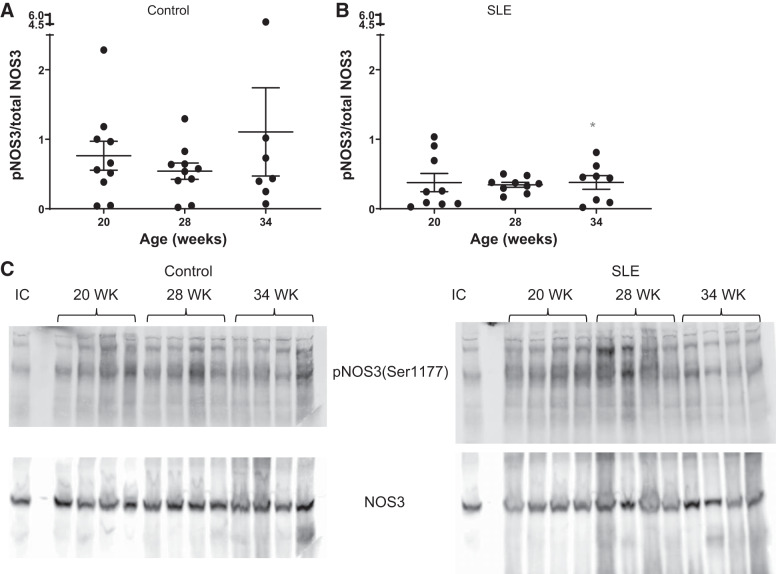
Phosphorylation of nitric oxide synthase (NOS3) at serine residue 1177 [pNOS3(Ser1177) to total NOS3] over time in female mice. A: phosphorylation of NOS3 at serine residue 1177 was not changed in control mice. B: phosphorylation of NOS3 at serine residue 1177 was lower in female mice with systemic lupus erythematosus (SLE). Phosphorylation of NOS3 at serine residue 1177 was significantly lower at 34 wk of age (*P = 0.0440) in female mice with SLE compared with age-matched control mice (95% confidence interval: 0.03876 to 3.489). C: representative blots for phosphorylation of NOS3 at serine residue 1177 and total NOS3. IC, internal control.
Fig. 9.
Fig. 9.
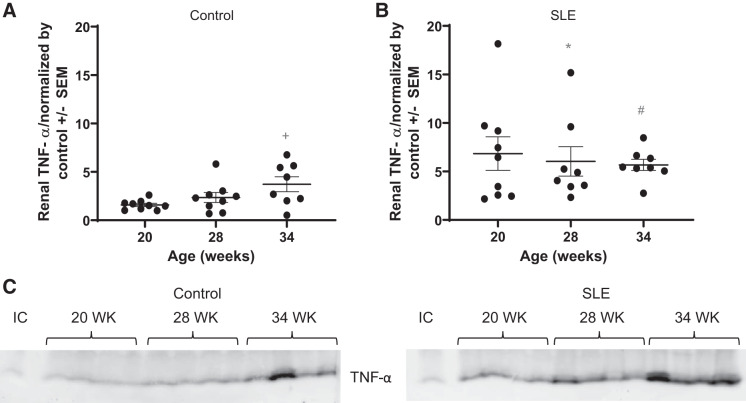
Whole kidney TNF-α expression is higher in mice with systemic lupus erythematosus (SLE). A: renal TNF-α was significantly increased by 34 wk of age (+P = 0.0158) compared with 20 wk of age in female control mice (SE of difference = 0.7419=). B: renal TNF-α expression was significantly higher at 20 wk of age (*P = 0.0019) and 28 wk of age (#P = 0.0476) in mice with SLE compared with age-matched control mice (SE of difference = 1.430 and 1.474, respectively). C: representative blots for TNF-α expression. IC, internal control.

References

    1. Al-Herz A, Ensworth S, Shojania K, Esdaile JM. Cardiovascular risk factor screening in systemic lupus erythematosus. J Rheumatol 30: 493–496, 2003. - PubMed
    1. Anders HJ, Weening JJ. Kidney disease in lupus is not always ‘lupus nephritis’. Arthritis Res Ther 15: 108, 2013. doi: 10.1186/ar4166. - DOI - PMC - PubMed
    1. Andrews BS, Eisenberg RA, Theofilopoulos AN, Izui S, Wilson CB, McConahey PJ, Murphy ED, Roths JB, Dixon FJ. Spontaneous murine lupus-like syndromes. Clinical and immunopathological manifestations in several strains. J Exp Med 148: 1198–1215, 1978. doi: 10.1084/jem.148.5.1198. - DOI - PMC - PubMed
    1. Arbuckle MR, McClain MT, Rubertone MV, Scofield RH, Dennis GJ, James JA, Harley JB. Development of autoantibodies before the clinical onset of systemic lupus erythematosus. N Engl J Med 349: 1526–1533, 2003. doi: 10.1056/NEJMoa021933. - DOI - PubMed
    1. Arellano-Mendoza MG, Vargas-Robles H, Del Valle-Mondragon L, Rios A, Escalante B. Prevention of renal injury and endothelial dysfunction by chronic l-arginine and antioxidant treatment. Ren Fail 33: 47–53, 2011. doi: 10.3109/0886022X.2010.541583. - DOI - PubMed

Publication types

MeSH terms