


A Possible Link of Genetic Variations in ER/IGF1R Pathway and Risk of Melanoma
- PMID: 32150843
- PMCID: PMC7084478
- DOI: 10.3390/ijms21051776
A Possible Link of Genetic Variations in ER/IGF1R Pathway and Risk of Melanoma
Abstract
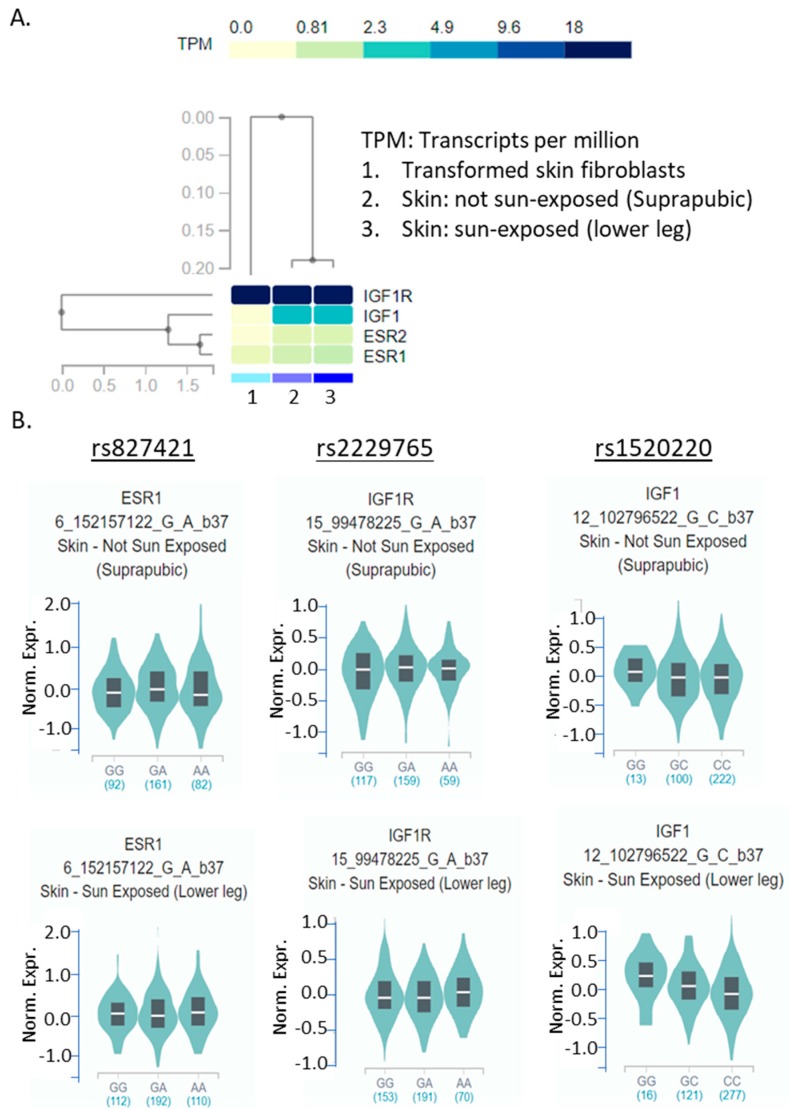
The mechanism of gender disparity in cutaneous melanoma incidence remains unclear. Steroid hormones including estrogens have long been implicated in the course of melanoma, but the conclusion is controversial. Estrogen receptors (ERs) and insulin-like growth factor 1 receptor (IGF1R) show extensive crosstalk in cancer development, but how the ER/IGF1R network impacts melanoma is currently unclear. Here we studied the melanoma associations of selected SNPs from the ER/IGF1R network. Part of the International Genes, Environment, and Melanoma (GEM) cohort was used as a discovery set, and the Gene Environment Association Studies Initiative (GENEVA) dataset served as a validation set. Based on the associations with other malignant disease conditions, thirteen single nucleotide polymorphism (SNP) variants in ESR1, ESR2, IGF1, and IGF1R were selected for candidate gene association analyses. The rs1520220 in IGF1 and rs2229765 in IGF1R variants were significantly associated with melanoma risk in the GEM dataset after Benjamini-Hochberg multiple comparison correction, although they were not validated in the GENEVA set. The discrepancy may be caused by the multiple melanoma characteristics in the GEM patients. Further analysis of gender disparity was carried out for IGF1 and IGF1R SNPs in the GEM dataset. The GG phenotype in IGF1 rs1520220 (recessive model) presented an increased risk of melanoma (OR = 8.11, 95% CI: 2.20, 52.5, p = 0.006) in men but a significant opposite effect in women (OR = 0.15, 95% CI: 0.018, 0.86, p = 0.045). The AA genotype in IGF1R rs2229765 (recessive model) showed a significant protective effect in men (OR = 0.24, 95% CI: 0.07, 0.64, p = 0.008) and no effect in women. Results from the current study are warranted for further validation.
Keywords: cutaneous melanoma; estrogen receptors; gender disparities; genetic variants; insulin-like growth factor 1; insulin-like growth factor 1 receptor.
Conflict of interest statement
The authors declare no conflicts of interest. The funders had no role in the design of the study; in the collection, analyses, or interpretation of data; in the writing of the manuscript, or in the decision to publish the results.
Figures
References
-
- SEER Annual Report to the Nation 2019: National Trends in Rates of New Cancer Cases. [(accessed on 28 June 2019)];2019 Available online: https://seer.cancer.gov/report_to_nation/infographics/incidence.html.
-
- Liu-Smith F., Farhat A.M., Arce A., Ziogas A., Taylor T., Wang Z., Yourk V., Liu J., Wu J., McEligot A.J., et al. Sex differences in the association of cutaneous melanoma incidence rates and geographic ultraviolet light exposure. J. Am. Acad. Dermatol. 2017;76:499–505. doi: 10.1016/j.jaad.2016.08.027. - DOI - PMC - PubMed
-
- Yuan T.A., Lu Y., Edwards K., Jakowatz J., Meyskens F.L., Liu-Smith F. Race-, Age-, and Anatomic Site-Specific Gender Differences in Cutaneous Melanoma Suggest Differential Mechanisms of Early-and Late-Onset Melanoma. Int. J. Environ. Res. Public Health. 2019;16:908. doi: 10.3390/ijerph16060908. - DOI - PMC - PubMed
MeSH terms
Substances
Grants and funding
LinkOut - more resources
Full Text Sources
Medical
Research Materials
Miscellaneous
