. 2020 Mar 5;17(5):1703.
doi: 10.3390/ijerph17051703.

A Systematic Literature Review of Factors Affecting the Timing of Menarche: The Potential for Climate Change to Impact Women's Health

Affiliations

A Systematic Literature Review of Factors Affecting the Timing of Menarche: The Potential for Climate Change to Impact Women's Health

Silvia P Canelón et al. Int J Environ Res Public Health. .

Abstract

Menarche is the first occurrence of a woman's menstruation, an event that symbolizes reproductive capacity and the transition from childhood into womanhood. The global average age for menarche is 12 years and this has been declining in recent years. Many factors that affect the timing menarche in girls could be affected by climate change. A systematic literature review was performed regarding the timing of menarche and four publication databases were interrogated: EMBASE, SCOPUS, PubMed, and Cochrane Reviews. Themes were identified from 112 articles and related to environmental causes of perturbations in menarche (either early or late), disease causes and consequences of perturbations, and social causes and consequences. Research from climatology was incorporated to describe how climate change events, including increased hurricanes, avalanches/mudslides/landslides, and extreme weather events could alter the age of menarche by disrupting food availability or via increased toxin/pollutant release. Overall, our review revealed that these perturbations in the timing of menarche are likely to increase the disease burden for women in four key areas: mental health, fertility-related conditions, cardiovascular disease, and bone health. In summary, the climate does have the potential to impact women's health through perturbation in the timing of menarche and this, in turn, will affect women's risk of disease in future.

Keywords: climate change; timing of menarche; women’s health.


Conflict of interest statement

The authors declare no conflict of interest.

Figures
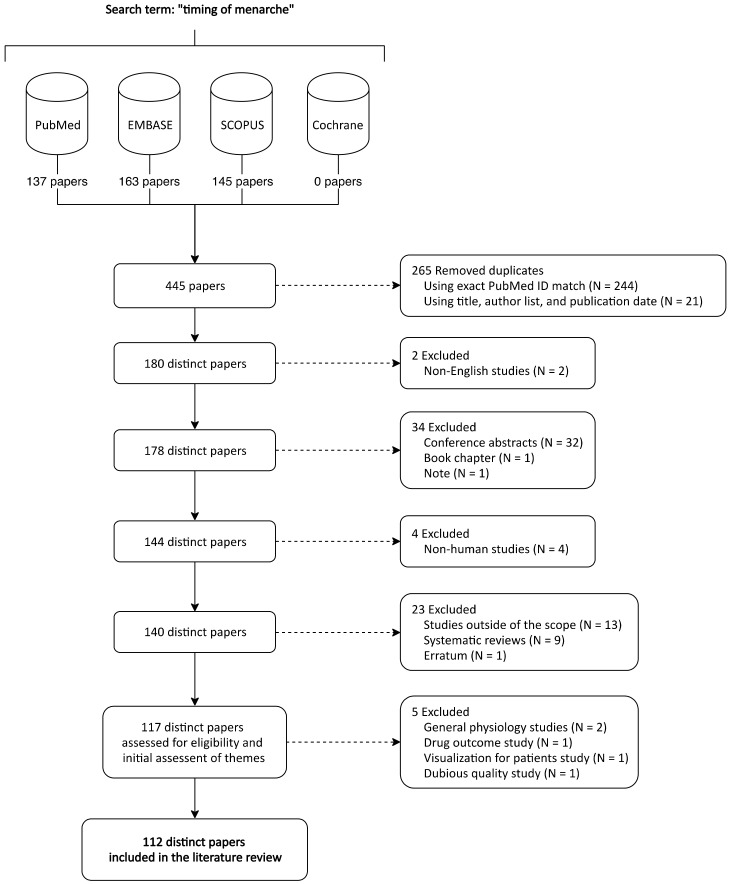
Figure 1
Figure 1
PRISMA flow diagram of study selection process. Initially 445 studies were identified. The review process resulted in 112 studies included in this systematic review.
Figure 2
Figure 2
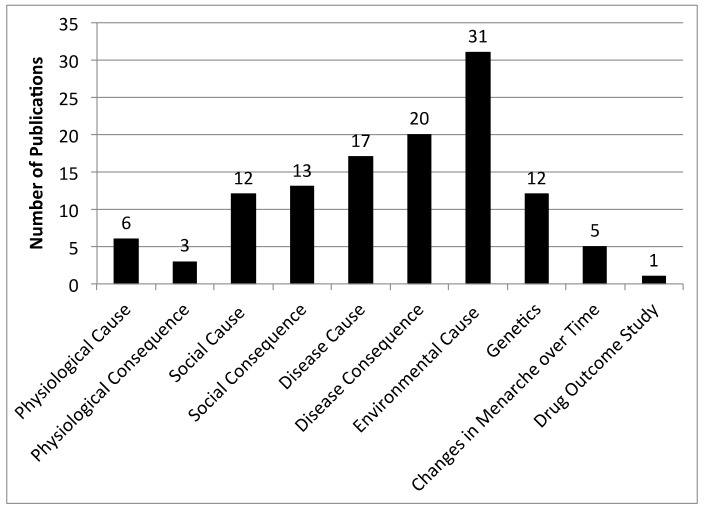
Breakdown of timing of menarche articles by themes identified. The 117 articles on timing of menarche were categorized into themes delineating articles on causes vs. consequences and other factors (e.g., genetics) described in the articles.
Figure 3
Figure 3
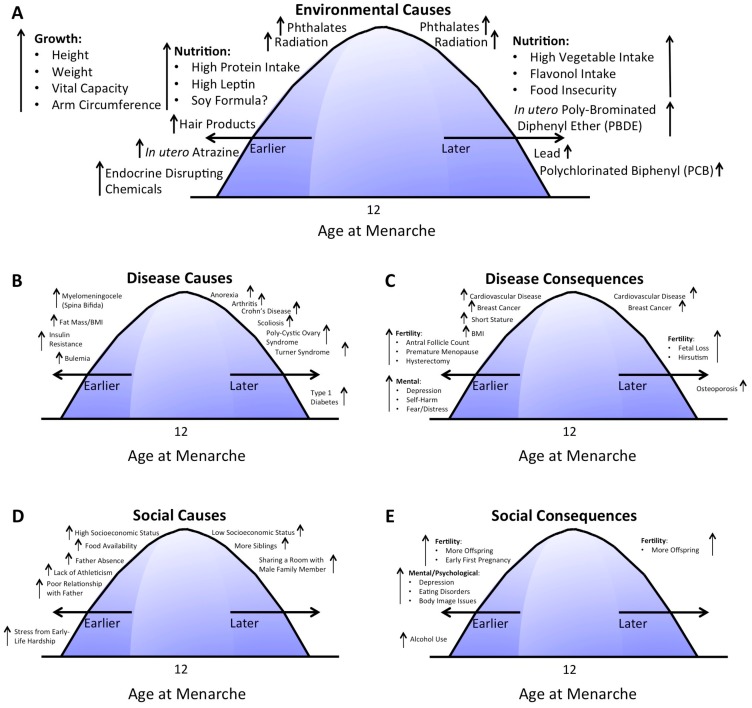
The causes and consequences of perturbations in timing of menarche. The environmental causes of either early or late menarche are shown in (A), followed by disease causes (B), and consequences (C), and social causes (D) and consequences (E). Mental health and psychological conditions were categorized as either diseases or social factors depending on the specific finding and research article. The arrows (↑) indicate that increases in that factor correspond to either early or late menarche (depending on the side of the bell distribution it is shown on). The question mark (?) that appears near “soy formula” indicates that there is conflicting evidence regarding whether or not soy formula has an effect on the timing of menarche.
Figure 4
Figure 4
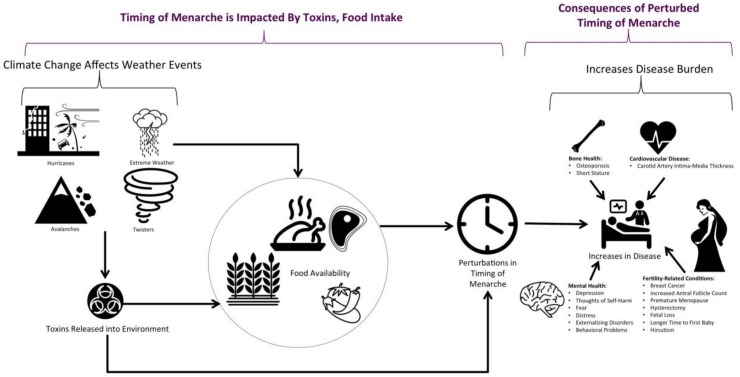
A conceptual schema illustrating how climate change could impact timing of menarche and increase disease burden. Climate change could impact weather events and thereby increase the toxins or toxicants released into the environment, affecting food and crops. This would impact crop availability and food intake and perturb timing of menarche. These perturbations in menarche could increase disease burden with regards to bone health, cardiovascular disease, mental health, and fertility-related conditions.

References

    1. Sommer M., Sutherland C., Chandra-Mouli V. Putting menarche and girls into the global population health agenda. Reprod. Health. 2015;12:24. doi: 10.1186/s12978-015-0009-8. - DOI - PMC - PubMed
    1. Natsuaki M.N., Leve L.D., Mendle J. Going through the rites of passage: Timing and transition of menarche, childhood sexual abuse, and anxiety symptoms in girls. J. Youth Adolesc. 2011;40:1357–1370. doi: 10.1007/s10964-010-9622-6. - DOI - PMC - PubMed
    1. Šaffa G., Kubicka A.M., Hromada M., Kramer K.L. Is the timing of menarche correlated with mortality and fertility rates? PLoS ONE. 2019;14:e0215462. doi: 10.1371/journal.pone.0215462. - DOI - PMC - PubMed
    1. Nagai N., Matsumoto K., Mino T., Takeuchi H., Takeda S. The secular trends in the menarcheal age and the maximum growth age in height for Japanese schoolgirls. Wakayama Med. Rep. 1980;23:41–45.
    1. Finlay F.O., Jones R., Coleman J. Is puberty getting earlier? The views of doctors and teachers. Child Care Health Dev. 2002;28:205–209. doi: 10.1046/j.1365-2214.2002.00263.x. - DOI - PubMed

Publication types