


Projections and Epidemiology of Revision Hip and Knee Arthroplasty in the United States to 2030
- PMID: 32151524
- PMCID: PMC7239745
- DOI: 10.1016/j.arth.2020.02.030
Projections and Epidemiology of Revision Hip and Knee Arthroplasty in the United States to 2030
Abstract
Background: As the incidence of primary total joint arthroplasty rises in the United States, it is important to investigate how this will impact rates of revision arthroplasty. The purpose of this study was to analyze the incidence and future projections of revision total hip arthroplasty (rTHA) and revision total knee arthroplasty (rTKA) to 2030. Anticipating surgical volume will aid surgeons in designing protocols to efficiently and effectively perform rTHA/rTKA.
Methods: The national inpatient sample was queried from 2002 to 2014 for all rTHA/rTKA. Using previously validated measures, Poisson and linear regression analyses were performed to project annual incidence of rTHA/rTKA to 2030, with subgroup analyses on modes of failure and age.
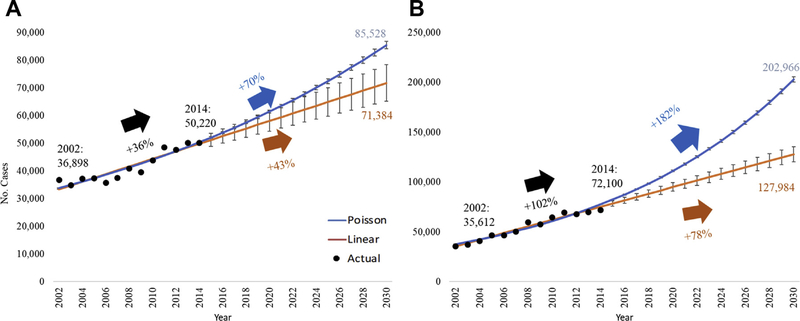
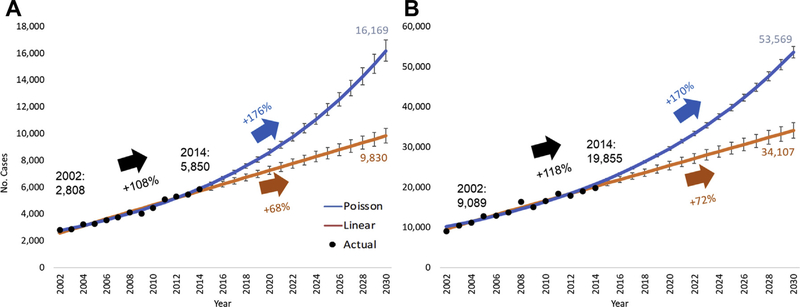
Results: In 2014, there were 50,220 rTHAs and 72,100 rTKAs. From 2014 to 2030, rTHA incidence is projected to increase by between 43% and 70%, whereas rTKA incidence is projected to increase by between 78% and 182%. The 55-64 and 65-74 age groups increased in revision incidence during the study period, whereas 75-84 age group decreased in incidence. For rTKA, infection and aseptic loosening are the 2 most common modes of failure, whereas periprosthetic fracture and infection are most common for rTHA.
Conclusion: The incidence of rTHA/rTKA is projected to increase, particularly in young patients and for infection. Given the known risk factor profiles and advanced costs associated with revision arthroplasty, our projections should encourage institutions to generate revision-specific protocols to promote safe pathways for cost-effective care that is commensurate with current value-based health care trends.
Level of evidence: IV.
Keywords: incidence; infection; projections; revision hip arthroplasty; revision knee arthroplasty.
Copyright © 2020 Elsevier Inc. All rights reserved.
Conflict of interest statement
One or more of the authors of this paper have disclosed potential or pertinent conflicts of interest, which may include receipt of payment, either direct or indirect, institutional support, or association with an entity in the biomedical field which may be perceived to have potential conflict of interest with this work. For full disclosure statements refer to
Figures
References
-
- Fingar KR, Stocks C, Weiss AJ, Steiner CA. Most Frequent Operating Room Procedures Performed in U.S. Hospitals, 2003–2012: Statistical Brief #186, in Healthcare Cost and Utilization Project (HCUP) Statistical Briefs. Rockville, MD: Agency for Healthcare Research and Quality (US); 2006. - PubMed
-
- Palsis JA, Brehmer TS, Pellegrini VD, Drew JM, Sachs BL. The cost of joint replacement: comparing two approaches to evaluating costs of total hip and knee arthroplasty. J Bone Joint Surg Am 2018;100:326–33. - PubMed
-
- Castagnini F, Sudanese A, Bordini B, Tassinari E, Stea S, Toni A. Total knee replacement in young patients: survival and causes of revision in a registry population. J Arthroplasty 2017;32:3368–72. - PubMed
Publication types
MeSH terms
Grants and funding
LinkOut - more resources
Full Text Sources
Medical
Research Materials
