. 2020 Jun;28(6):835-839.
doi: 10.1038/s41431-020-0595-y. Epub 2020 Mar 9.

Common genetic variation in the Angelman syndrome imprinting centre affects the imprinting of chromosome 15

Affiliations

Common genetic variation in the Angelman syndrome imprinting centre affects the imprinting of chromosome 15

Jasmin Beygo et al. Eur J Hum Genet. 2020 Jun.

Abstract

Angelman syndrome (AS) is a rare neurogenetic imprinting disorder caused by the loss of function of UBE3A. In ~3-5% of AS patients, the disease is due to an imprinting defect (ID). These patients lack DNA methylation of the maternal SNRPN promotor so that a large SNRPN sense/UBE3A antisense transcript (SNHG14) is expressed, which silences UBE3A. In very rare cases, the ID is caused by a deletion of the AS imprinting centre (AS-IC). To search for sequence alterations, we sequenced this region in 168 patients without an AS-IC deletion, but did not detect any sequence alteration. However, the AS-IC harbours six common variants (five single nucleotide variants and one TATG insertion/deletion variant), which constitute five common haplotypes. To determine if any of these haplotypes is associated with an increased risk for an ID, we investigated 119 informative AS-ID trios with the transmission disequilibrium test, which is a family-based association test that measures the over-transmission of an allele or haplotype from heterozygous parents to affected offspring. By this we observed maternal over-transmission of haplotype H-AS3 (p = 0.0073). Interestingly, H-AS3 is the only haplotype that includes the TATG deletion allele. We conclude that this haplotype and possibly the TATG deletion, which removes a SOX2 binding site, increases the risk for a maternal ID and AS. Our data strengthen the notion that the AS-IC is important for establishing and/or maintaining DNA methylation at the SNRPN promotor and show that common genetic variation can affect genomic imprinting.


Conflict of interest statement

The authors declare that they have no conflict of interest.

Figures
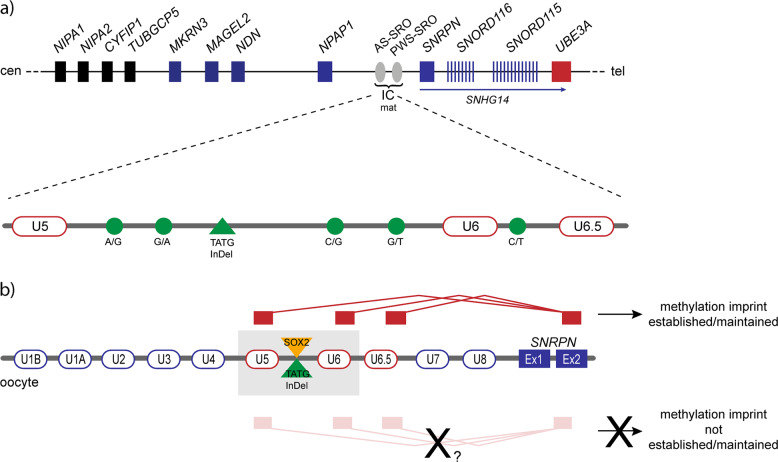
Fig. 1
Fig. 1. Overview of the imprinted gene cluster on chromosome 15q11q13 and the AS-IC and possible effect of the haplotype HAS-3.
a The figure gives an overview of the genes within the imprinted cluster on chromosome 15q11q13. Genes depicted in blue are paternally expressed, the UBE3A gene is depicted in red for maternal only expression (situation in neurons). The biallelically expressed genes are shown in black. The bipartite structure of the IC is shown with the light grey ovals indicating the AS- and the PWS-IC. The AS-IC region is shown expanded below including the oocyte-specific transcription start sites at the upstream exons U5, U6 and U6.5 (rounded rectangles) and the six common variants (green circles for single nucleotide substitutions, a green triangle for the 4 bp InDel). b The figure shows part of the SNRPN gene with some of its upstream exons (rounded rectangles). Upstream exons U5 and U6 are located within the AS-IC (grey region) and U6.5 is located directly 3′. All three upstream exons have been shown to be oocyte-specific transcription start sites indicated by their red colour [5]. The transcripts originating at these exons all splice onto exon 2 of the SNRPN gene (blue rectangle), indicated above. The 4 bp InDel variant (green triangle), that is only present in haplotype H-AS3, affects a SOX2 binding site (orange triangle; [18]). This variant might affect SOX2 binding and - possibly in conjunction with other factors - could have an effect that hinders establishment of the methylation imprint at the AS-IC. Not drawn to scale. cen centromeric, tel telomeric, IC imprinting centre, mat maternally methylated.

References

    1. Buiting K, Williams C, Horsthemke B. Angelman syndrome–insights into a rare neurogenetic disorder. Nat Rev Neurol. 2016;12:584–93. doi: 10.1038/nrneurol.2016.133. - DOI - PubMed
    1. Monk D, Morales J, den Dunnen JT, Russo S, Court F, Prawitt D, et al. Recommendations for a nomenclature system for reporting methylation aberrations in imprinted domains. Epigenetics. 2018;13:117–21. doi: 10.1080/15592294.2016.1264561. - DOI - PMC - PubMed
    1. Buiting K, Saitoh S, Gross S, Dittrich B, Schwartz S, Nicholls RD, et al. Inherited microdeletions in the Angelman and Prader-Willi syndromes define an imprinting centre on human chromosome 15. Nat Genet. 1995;9:395–400. doi: 10.1038/ng0495-395. - DOI - PubMed
    1. Buiting K, Lich C, Cottrell S, Barnicoat A, Horsthemke B. A 5-kb imprinting center deletion in a family with Angelman syndrome reduces the shortest region of deletion overlap to 880 bp. Hum Genet. 1999;105:665–6. - PubMed
    1. Lewis MW, Brant JO, Kramer JM, Moss JI, Yang TP, Hansen PJ, et al. Angelman syndrome imprinting center encodes a transcriptional promoter. Proc Natl Acad Sci USA. 2015;112:6871–5. doi: 10.1073/pnas.1411261111. - DOI - PMC - PubMed

Publication types
