Review
. 2020 Feb 21:11:253.
doi: 10.3389/fimmu.2020.00253. eCollection 2020.

The Impact of Dietary Components on Regulatory T Cells and Disease

Affiliations
Review

The Impact of Dietary Components on Regulatory T Cells and Disease

Rebeca Arroyo Hornero et al. Front Immunol. .

Abstract

The rise in the prevalence of autoimmune diseases in developed societies has been associated with a change in lifestyle patterns. Among other factors, increased consumption of certain dietary components, such as table salt and fatty acids and excessive caloric intake has been associated with defective immunological tolerance. Dietary nutrients have shown to modulate the immune response by a direct effect on the function of immune cells or, indirectly, by acting on the microbiome of the gastrointestinal tract. FOXP3+ regulatory T cells (Tregs) suppress immune responses and are critical for maintaining peripheral tolerance and immune homeostasis, modulating chronic tissue inflammation and autoimmune disease. It is now well-recognized that Tregs show certain degree of plasticity and can gain effector functions to adapt their regulatory function to different physiological situations during an immune response. However, plasticity of Tregs might also result in conversion into effector T cells that may contribute to autoimmune pathogenesis. Yet, which environmental cues regulate Treg plasticity and function is currently poorly understood, but it is of significant importance for therapeutic purposes. Here we review the current understanding on the effect of certain dietary nutrients that characterize Western diets in Treg metabolism, stability, and function. Moreover, we will discuss the role of Tregs linking diet and autoimmunity and the potential of dietary-based interventions to modulate Treg function in disease.

Keywords: Treg—regulatory T cell; autoimmunity; diet; environmental factors; microbiome.


Figures

Figure 1
Figure 1
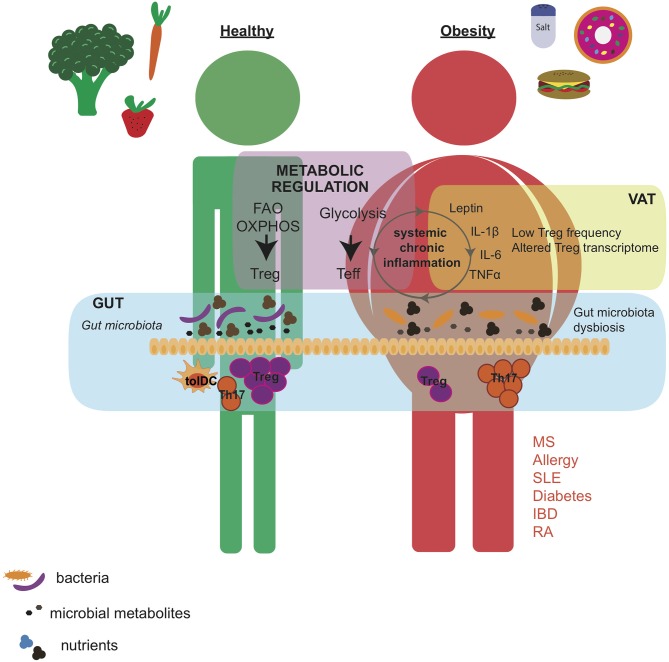
Western diet affects gut microbial composition and induces low-degree chronic inflammation that alters the metabolic status of the individual. Healthy diet supports the growth of bacterial species that, by the production of immunomodulatory metabolites, promotes Treg induction over Th17 cell development in the intestine. By contrast, western diet, characterized by high caloric intake, and high levels of salt and cholesterol, leads to obesity, increased secretion of pro-inflammatory adipokines and cytokines, and altered gut microbial composition. These changes are associated with an altered Treg phenotype and higher Th17 cell differentiation in the VAT and intestine. Importantly, Treg and Teff cells developed in the gut and VAT have a systemic effect and may contribute to exacerbation of autoimmune pathogenicity. Moreover, the frequency and function of Tregs may also be regulated by metabolic pathways such as FAO, OXPHOS, and glycolysis that depend on the nutritional state of the individual. VAT, visceral adipose tissue; Teff, effector T cell; FAO, fatty acid oxidation; OXPHOS, oxidative phosphorylation; MS, multiple sclerosis; SLE, systemic lupus erythematosus; IBD, inflammatory bowel disease; RA, rheumatoid arthritis.

References

    1. Bennett CL, Christie J, Ramsdell F, Brunkow ME, Ferguson PJ, Whitesell L, et al. The immune dysregulation, polyendocrinopathy, enteropathy, X-linked syndrome (IPEX) is caused by mutations of FOXP3. Nat Genet. (2001) 27:20–1. 10.1038/83713 - DOI - PubMed
    1. Wildin RS, Ramsdell F, Peake J, Faravelli F, Casanova JL, Buist N, et al. X-linked neonatal diabetes mellitus, enteropathy and endocrinopathy syndrome is the human equivalent of mouse scurfy. Nat Genet. (2001) 27:18–20. 10.1038/83707 - DOI - PubMed
    1. Brunkow ME, Jeffery EW, Hjerrild KA, Paeper B, Clark LB, Yasayko SA, et al. Disruption of a new forkhead/winged-helix protein, scurfin, results in the fatal lymphoproliferative disorder of the scurfy mouse. Nat Genet. (2001) 27:68–73. 10.1038/83784 - DOI - PubMed
    1. Qureshi OS, Zheng Y, Nakamura K, Attridge K, Manzotti C, Schmidt EM, et al. Trans-endocytosis of CD80 and CD86: a molecular basis for the cell-extrinsic function of CTLA-4. Science. (2011) 332:600–3. 10.1126/science.1202947 - DOI - PMC - PubMed
    1. Asseman C, Mauze S, Leach MW, Coffman RL, Powrie F. An essential role for interleukin 10 in the function of regulatory T cells that inhibit intestinal inflammation. J Exp Med. (1999) 190:995–1004. 10.1084/jem.190.7.995 - DOI - PMC - PubMed

Publication types

Substances

LinkOut - more resources