Review
. 2019 Sep 20;10(42):9640-9649.
doi: 10.1039/c9sc03766g. eCollection 2019 Nov 14.

Progress and prospects for accelerating materials science with automated and autonomous workflows

Affiliations
Review

Progress and prospects for accelerating materials science with automated and autonomous workflows

Helge S Stein et al. Chem Sci. .

Abstract

Accelerating materials research by integrating automation with artificial intelligence is increasingly recognized as a grand scientific challenge to discover and develop materials for emerging and future technologies. While the solid state materials science community has demonstrated a broad range of high throughput methods and effectively leveraged computational techniques to accelerate individual research tasks, revolutionary acceleration of materials discovery has yet to be fully realized. This perspective review presents a framework and ontology to outline a materials experiment lifecycle and visualize materials discovery workflows, providing a context for mapping the realized levels of automation and the next generation of autonomous loops in terms of scientific and automation complexity. Expanding autonomous loops to encompass larger portions of complex workflows will require integration of a range of experimental techniques as well as automation of expert decisions, including subtle reasoning about data quality, responses to unexpected data, and model design. Recent demonstrations of workflows that integrate multiple techniques and include autonomous loops, combined with emerging advancements in artificial intelligence and high throughput experimentation, signal the imminence of a revolution in materials discovery.


Figures

Fig. 1
Fig. 1. High level comparison of paradigms for materials/molecular sciences. Left: current paradigm exemplified with redox flow batteries. Right: closed-loop discovery utilizing inverse design and a tightly integrated workflow to enable faster identification, scale-up and manufacturing. Figure reproduced from Science, 361, 6400, 360–365 with permission from The American Association for the Advancement of Science.
Fig. 2
Fig. 2. (a) Overview of core research tasks with arrows indicating the cyclic execution of a traditional materials science experimental workflow. (b) Acceleration of each task in a workflow can be obtained by incorporating acceleration technique(s), as represented by these 6 types of accelerators.
Fig. 3
Fig. 3. Workflow diagrams of accelerated materials experimentation spanning a range of techniques, strategies and research goals. Based on (a) Nikolaev et al., (b) Yan et al., (c) Kusne et al., and (d) Li et al., each workflow involves accelerated tasks with various levels of automation and task-to-task integration. The productivity for a single pass through the workflow is noted, corresponding to the number of equivalent traditional experiments for (a)–(c) and duration of traditional experiments for (d). Feedback loops are each labelled with the approximate number of iterations per workflow execution (bold), and in (a) and (c) the percentage of iterations involving expert mediation is also approximated (italics).
Fig. 4
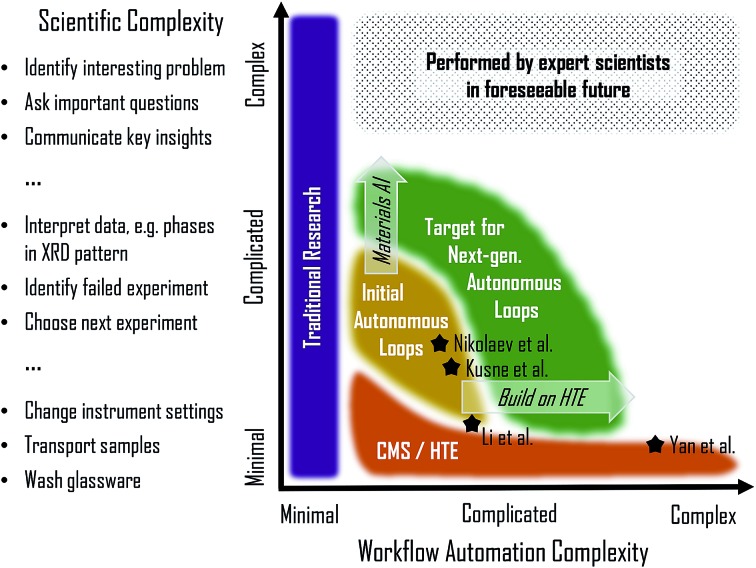
Fig. 4. Visualization of the landscape of materials experiment workflow in terms of the scientific complexity of automated tasks and the workflow automation complexity, which is based on the number, variety, speed, and difficulty of experimental steps in the workflow. The advancements in combinatorial materials science and high throughput experimentation (CMS/HTE) have been largely along this latter (horizontal) axis, and initial demonstrations of autonomous loops have made progress on the former (vertical) axis with automation of more intellectually challenging research tasks. The nominal location of the 4 workflows from Fig. 3 are noted by stars. While research will push the frontier of automated experiments along both axes (arrows with italics), the most complex scientific tasks will remain the responsibility of human experts for the foreseeable future.

References

    1. Alberi K. J. Phys. D: Appl. Phys. 2019;52:013001.
    1. Report of the Clean Energy Materials Innovation Challenge Expert Workshop January 2018, Mission Innovation, 2018, http://mission-innovation.net/wp-content/uploads/2018/01/Mission-Innovat....
    1. Xiang X.-D. and Takeuchi I., Combinatorial Materials Synthesis, CRC Press, 2003.
    1. Koinuma H., Takeuchi I. Nat. Mater. 2004;3:429–438. - PubMed
    1. Maier W. F., Stöwe K., Sieg S. Angew. Chem., Int. Ed. 2007;46:6016–6067. - PubMed