Self-reported and objectively measured physical activity in people with and without chronic heart failure: UK Biobank analysis
- PMID: 32153787
- PMCID: PMC7046950
- DOI: 10.1136/openhrt-2019-001099
Self-reported and objectively measured physical activity in people with and without chronic heart failure: UK Biobank analysis
Abstract
Objective: The impact of heart failure (HF) on perceived and objectively measured levels of physical activity (PA) can inform risk stratification and treatment recommendation. We aimed to compare self-reported and objectively measured PA levels in a large sample of participants with and without HF.
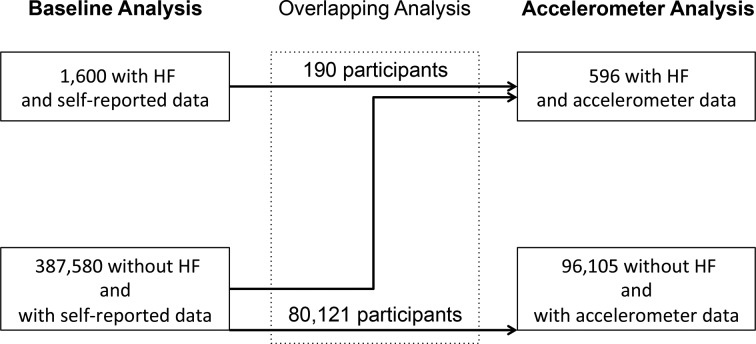
Methods: A validated PA questionnaire was used to estimate self-reported weekly PA among 1600 participants with HF and 387 580 participants without HF. Accelerometer data were studied in 596 participants with HF and 96 105 participants without HF for a period of 7 days. Using multivariable linear regression models, we compared the PA levels between participants with HF and without HF, focusing on both the average daily PA levels and the intensity of PAs throughout the day.
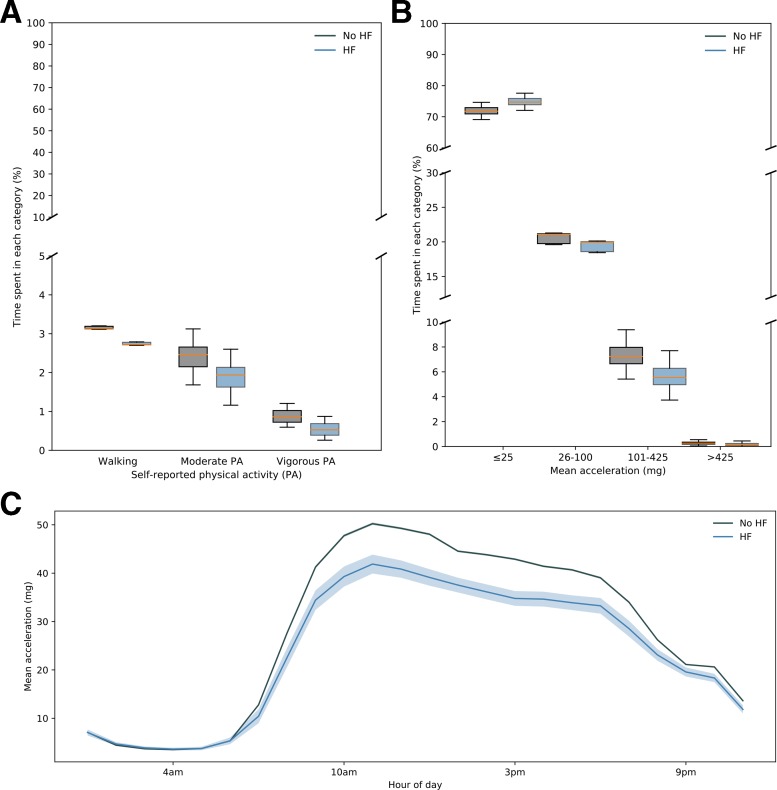
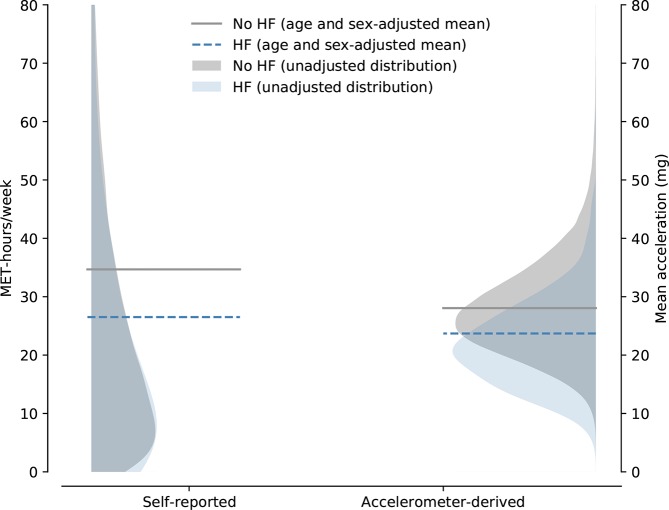
Results: PA levels were significantly lower in participants with HF using both self-report (excess metabolic equivalent of task hours per week of 26.5 (95% CI 24.7 to 28.4) vs 34.7 (95% CI 34.5 to 34.9), respectively (p<0.001)) and accelerometer measures (mean accelerations of 23.7 milligravity (95% CI 23.1 to 24.4) vs 28.1 milligravity (95% CI 28.0 to 28.1), respectively (p<0.001)). Findings were consistent across different PA intensities. Hour-by-hour comparisons showed that accelerometer-derived PA levels of patients with HF were reduced throughout the day.
Conclusion: Perceived and objectively recorded PA levels of patients with chronic HF are significantly lower than those of individuals without HF. This difference is continuous throughout the different hours of the day, with individuals with HF being on average 16% less active than individuals without HF. In patients with HF, increases in everyday activity may be a potential alternative to structured exercise programmes.
Keywords: epidemiology; heart failure; heart failure treatment; public health.
© Author(s) (or their employer(s)) 2020. Re-use permitted under CC BY. Published by BMJ.
Conflict of interest statement
Competing interests: None declared.
Figures
References
-
- Piepoli MF, Conraads V, Corrà U, et al. Exercise training in heart failure: from theory to practice. A consensus document of the heart failure association and the European association for cardiovascular prevention and rehabilitation. Eur J Heart Fail 2011;13:347–57. 10.1093/eurjhf/hfr017 - DOI - PubMed
-
- National Institute for Health and Care Excellence Chronic heart failure in adults: management | Guidance and guidelines. [Internet]. Available: https://www.nice.org.uk/guidance/cg108/chapter/1-guidance [Accessed 26 Jun 2017].
Publication types
MeSH terms
Grants and funding
LinkOut - more resources
Full Text Sources
Medical
Research Materials
Miscellaneous