


Outcomes of a randomized controlled trial of nutrition education to promote farmers' market fruit and vegetable purchases and consumption among women enrolled in the Special Supplemental Nutrition Program for Women, Infants, and Children (WIC)
- PMID: 32153828
- PMCID: PMC7050835
- DOI: 10.1186/s40795-017-0172-0
Outcomes of a randomized controlled trial of nutrition education to promote farmers' market fruit and vegetable purchases and consumption among women enrolled in the Special Supplemental Nutrition Program for Women, Infants, and Children (WIC)
Abstract
Background: The Special Supplemental Nutrition Program for Women, Infants, and Children (WIC) provides participants seasonal Farmers' Market Nutrition Program (FMNP) vouchers to purchase fruits and vegetables (FV) at farmers' markets and monthly cash value vouchers (CVV) redeemable at farmers' markets. Despite the promise of FMNP vouchers and CVV for improving FV access among WIC participants, voucher redemption rates are low. This study evaluated WIC Fresh Start (WFS), a theory-driven, web-based lesson to promote FV intake, the redemption of CVV at farmers' markets, FMNP voucher redemption, and farmers' market-related knowledge, attitudes, and skills among women enrolled in WIC.
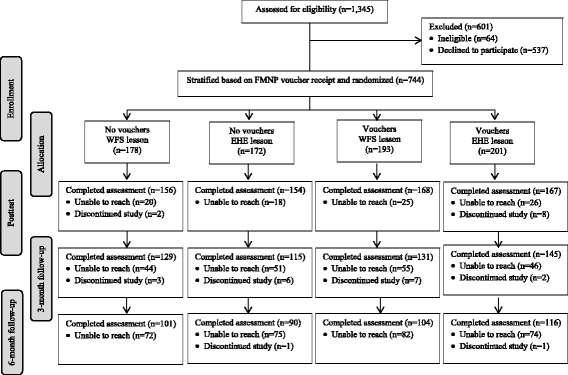
Methods: The lesson was evaluated in a four-arm randomized controlled trial. The setting was a large New Jersey-based WIC agency located in a densely populated, urban area. Participants (N = 744) were stratified based on FMNP voucher receipt and randomized to receive the WFS lesson or WIC online existing health education. Lesson effects on targeted outcomes were examined at posttest (2 weeks after the lesson) and 3 and 6 months after posttesting.
Results: Receipt of the WFS lesson was associated with FMNP voucher redemption (in the subset of participants preferring to speak Spanish); improvements in knowledge of the FMNP, locally grown seasonal items, seasonal items found at farmers' markets in July, WIC-authorized farmers' markets and food- and farmers' market-specific knowledge; ever having purchased and intentions to purchase FV at a farmers' market; FV food safety and preparation skills; and modest gains in the redemption of CVV at farmers' markets. FV intake did not differ over time by trial arm.
Conclusions: Findings aid understanding of effective approaches to promote farmers' market use and farmers' market-related knowledge and skills among WIC participants. Further research is needed to explore factors that may explain the lack of lesson effects on FV intake.
Trial registration: NCT02565706.
Keywords: Cash value voucher; Farmers’ market; Farmers’ market nutrition program; Fruits; Income; Internet; Randomized controlled trial; Vegetables; WIC program.
© The Author(s). 2017.
Conflict of interest statement
The authors declare that they have no competing interests.
Figures
References
-
- US Department of Agriculture, Food and Nutrition Service. Women, infants and children (WIC): about WIC. http://www.fns.usda.gov/wic/about-wic (2016). Accessed 5 May 2017.
-
- US Department of Agriculture, Food and Nutrition Service, Office of Research and Analysis . WIC food packages policy options study. Alexandria: FNS; 2011.
-
- Institute of Medicine. WIC Food Packages: Time for a Change. Washington, DC: The National Academies Press. 2006. 10.17226/11280. - DOI
-
- McDonnell L, Morris MN, Holland J. WIC participants’ perceived behavioral control, attitudes toward, and factors influencing behavioral intentions to redeeming cash-value vouchers at certified farmers markets. Calif J Health Promot. 2014;12(2):22–31.
-
- WIC Farmers’ Market Nutrition Program fact sheet. 2012. https://www.fns.usda.gov/sites/default/files/fmnp/WICFMNPFactSheet.pdf. Accessed June 2017.
Associated data
LinkOut - more resources
Full Text Sources
Medical