


An overview on medicinal perspective of thiazolidine-2,4-dione: A remarkable scaffold in the treatment of type 2 diabetes
- PMID: 32154036
- PMCID: PMC7052407
- DOI: 10.1016/j.jare.2020.01.008
An overview on medicinal perspective of thiazolidine-2,4-dione: A remarkable scaffold in the treatment of type 2 diabetes
Abstract
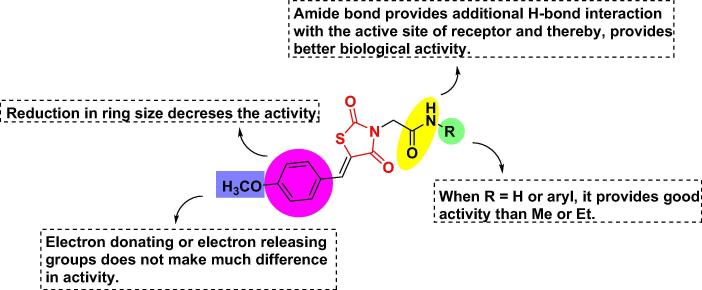
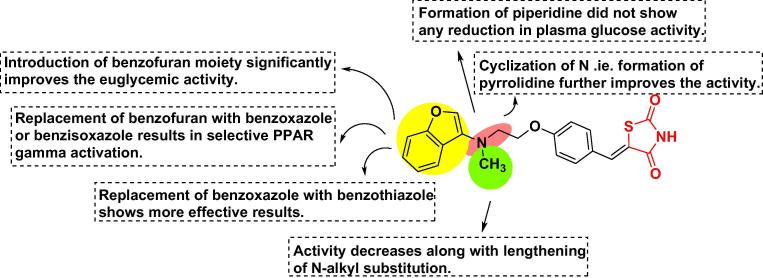
Diabetes or diabetes mellitus is a complex or polygenic disorder, which is characterized by increased levels of glucose (hyperglycemia) and deficiency in insulin secretion or resistance to insulin over an elongated period in the liver and peripheral tissues. Thiazolidine-2,4-dione (TZD) is a privileged scaffold and an outstanding heterocyclic moiety in the field of drug discovery, which provides various opportunities in exploring this moiety as an antidiabetic agent. In the past few years, various novel synthetic approaches had been undertaken to synthesize different derivatives to explore them as more potent antidiabetic agents with devoid of side effects (i.e., edema, weight gain, and bladder cancer) of clinically used TZD (pioglitazone and rosiglitazone). In this review, an effort has been made to summarize the up to date research work of various synthetic strategies for TZD derivatives as well as their biological significance and clinical studies of TZDs in combination with other category as antidiabetic agents. This review also highlights the structure-activity relationships and the molecular docking studies to convey the interaction of various synthesized novel derivatives with its receptor site.
Keywords: ADDP, 1,1′-(Azodicarbonyl)dipiperidine; AF, activation factor; ALP, alkaline phosphatase; ALT, alanine transaminase; AST, aspartate transaminase; Boc, Butyloxycarbonyl; DBD, DNA-binding domain; DCM, dichloromethane; DM, diabetes mellitus; DMF, dimethylformamide; DMSO, dimethyl sulfoxide; DNA, deoxyribonucleic acid; Diabetes; E, Entgegen; ECG, electrocardiogram; FDA, food and drug administration; FFA, free fatty acid; GAL4, Galactose transporter type; GLUT4, glucose transporter type 4; GPT, glutamic pyruvic transaminase; HCl, Hydrochloric Acid; HDL, high-density lipoprotein; HEK, human embryonic kidney; HEp-2, Human epithelial type 2; HFD, high-fat diet; IDF, international diabetes federation; IL-β, interlukin-beta; INS-1, insulin-secreting cells; K2CO3, Potassium carbonate; KOH, potassium hydroxide; LBD, ligand-binding domain; LDL, low-density lipoprotein; MDA, malondialdehyde; NA, nicotinamide; NBS, N-bromosuccinimide; NFκB, nuclear factor kappa-B; NO, nitric oxide; NaH, Sodium Hydride; OGTT, oral glucose tolerance test; PDB, protein data bank; PPAR, peroxisome-proliferator activated receptor; PPAR-γ; PPRE, peroxisome proliferator response element; PTP1B, protein-tyrosine phosphatase 1B; Pd, Palladium; Pioglitazone; QSAR, quantitative structure-activity relationship; RXR, retinoid X receptor; Rosiglitazone; SAR, structure-activity relationship; STZ, streptozotocin; T2DM, type 2 diabetes mellitus; TFA, trifluoroacetic acid; TFAA, trifluoroacetic anhydride; TG, triglycerides; THF, tetrahydrofuran; TNF-α, tumor necrosis factor-alpha; TZD, thiazolidine-2,4-dione; Thiazolidine-2,4-diones; WAT, white adipose tissue; Z, Zusammen; i.m, Intramuscular; mCPBA, meta-chloroperoxybenzoic acid.
© 2020 THE AUTHORS. Published by Elsevier BV on behalf of Cairo University.
Conflict of interest statement
The author has declared no conflict of interest.
Figures





References
-
- IDF diabetes atlas - Home 2017. http://www.diabetesatlas.org/ (accessed March 8, 2019).
-
- Rotella D.P. Novel “second-generation” approaches for the control of Type 2 diabetes. J Med Chem. 2004;47:4111–4112. - PubMed
-
- Pattan S.R., Kekare P., Patil A., Nikalje A., Kittur B.S. Studies on the synthesis of novel 2, 4-thiazolidinedione derivatives with antidiabetic activity. Iran J Pharm Sci. 2009;5:225–230.
-
- Diabetes control and complications trial research group. Nathan D.M., Genuth S., Lachin J., Cleary P., Crofford O., et al. The effect of intensive treatment of diabetes on the development and progression of long-term complications in insulin-dependent diabetes mellitus. N Engl J Med. 1993;329:977–986. - PubMed
Publication types
LinkOut - more resources
Full Text Sources
Research Materials
Miscellaneous
