


Classical and Delayed Orthostatic Hypotension in Patients With Unexplained Syncope and Severe Orthostatic Intolerance
- PMID: 32154270
- PMCID: PMC7046587
- DOI: 10.3389/fcvm.2020.00021
Classical and Delayed Orthostatic Hypotension in Patients With Unexplained Syncope and Severe Orthostatic Intolerance
Abstract
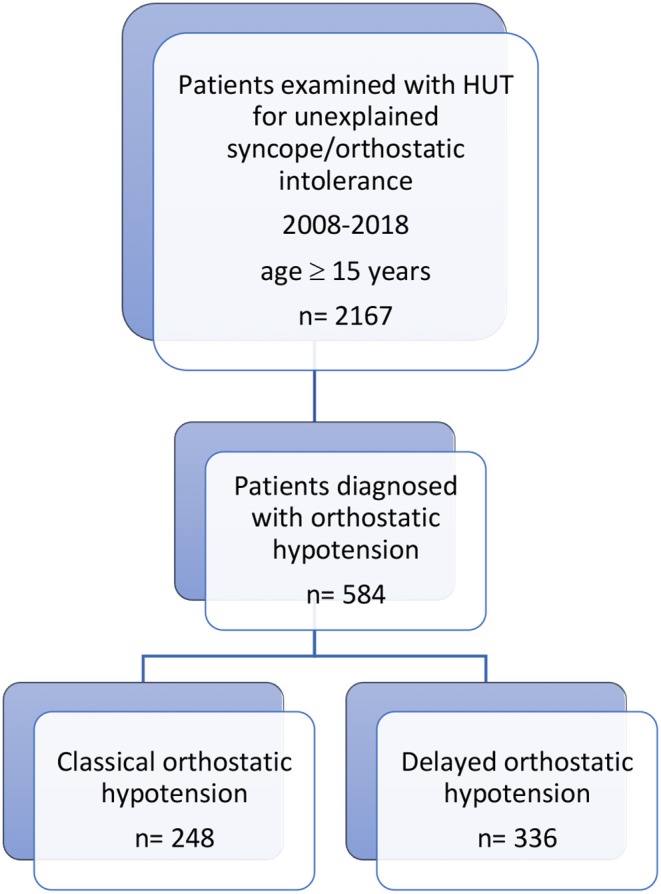
Background: Orthostatic hypotension (OH) is a major sign of cardiovascular autonomic failure leading to orthostatic intolerance and syncope. Orthostatic hypotension is traditionally divided into classical OH (cOH) and delayed OH (dOH), but the differences between the two variants are not well-studied. We performed a systematic clinical and neuroendocrine characterization of OH patients in a tertiary syncope unit. Methods: Among 2,167 consecutive patients (1,316 women, 60.7%; age, 52.6 ± 21.0 years) evaluated for unexplained syncope and severe orthostatic intolerance with standardized cardiovascular autonomic tests including head-up tilt (HUT), we identified those with a definitive diagnosis of cOH and dOH. We analyzed patients' history, clinical characteristics, hemodynamic variables, and plasma levels of epinephrine, norepinephrine, C-terminal-pro-arginine-vasopressin (CT-proAVP), C-terminal-endothelin-1, mid-regional-fragment of pro-atrial-natriuretic-peptide and pro-adrenomedullin in the supine position and at 3-min HUT. Results: We identified 248 cOH and 336 dOH patients (27% of the entire cohort); 111 cOH and 152 dOH had blood samples collected in the supine position and at 3-min HUT. Compared with dOH, cOH patients were older (68 vs. 60 years, p < 0.001), more often male (56.9 vs. 39.6%, p < 0.001), had higher systolic blood pressure (141 vs. 137 mmHg, p = 0.05), had lower estimated glomerular filtration rate (73 vs. 80 ml/min/1.73 m2, p = 0.003), more often pathologic Valsalva maneuver (86 vs. 49 patients, p < 0.001), pacemaker-treated arrhythmia (5 vs. 2%, p = 0.04), Parkinson's disease (5 vs. 1%, p = 0.008) and reported less palpitations before syncope (16 vs. 29%, p = 0.001). Supine and standing levels of CT-proAVP were higher in cOH (p = 0.022 and p < 0.001, respectively), whereas standing norepinephrine was higher in dOH (p = 0.001). After 3-min HUT, increases in epinephrine (p < 0.001) and CT-proAVP (p = 0.001) were greater in cOH, whereas norepinephrine increased more in dOH (p = 0.045). Conclusions: One-quarter of patients with unexplained syncope and severe orthostatic intolerance present orthostatic hypotension. Classical OH patients are older, more often have supine hypertension, pathologic Valsalva maneuver, Parkinson's disease, pacemaker-treated arrhythmia, and lower glomerular filtration rate. Classical OH is associated with increased vasopressin and epinephrine during HUT, but blunted increase in norepinephrine.
Keywords: arginine vasopressin; catecholamines; orthostatic hypotension; syncope; tilt-table test.
Copyright © 2020 Torabi, Ricci, Hamrefors, Sutton and Fedorowski.
Figures
References
LinkOut - more resources
Full Text Sources
