


"Association of Severity of Posttraumatic Stress Disorder With Inflammation: Using Total White Blood Cell Count as a Marker"
- PMID: 32154489
- PMCID: PMC7061332
- DOI: 10.1177/2470547019877651
"Association of Severity of Posttraumatic Stress Disorder With Inflammation: Using Total White Blood Cell Count as a Marker"
Abstract
Background: Inflammation is known to be associated with posttraumatic stress disorder (PTSD). It is not known if total white blood cell (WBC) count, a routinely checked inflammatory marker, is associated with PTSD symptom trajectories using medical record data.
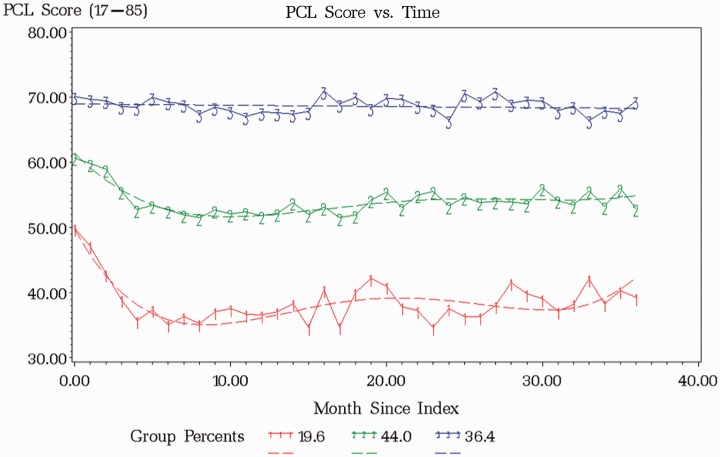
Methods: We used latent class growth analysis to identify three-year PTSD symptom trajectories using PTSD Checklist (PCL) scores. The outcome for each patient was maximum WBC count from index PTSD diagnosis to last PCL. Using linear regression analysis, we then calculated and compared the average WBC count for each trajectory before and after controlling for age, gender, race, obesity, smoking, diabetes, hypertension, cardiovascular disease, depression and other co-morbid inflammatory conditions.
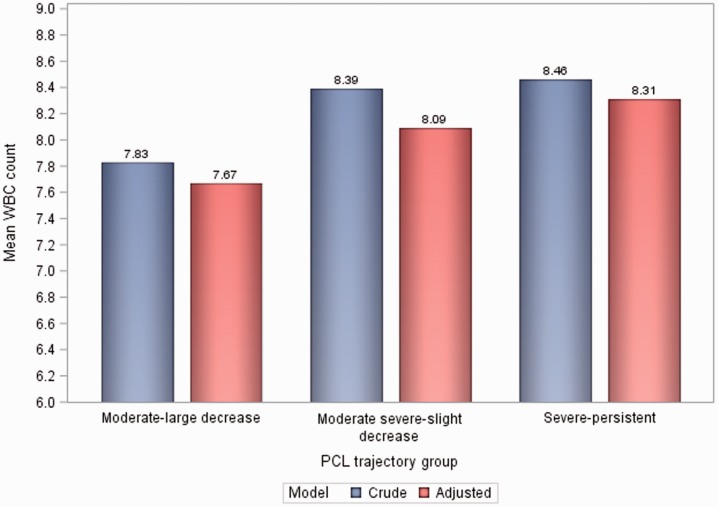
Results: Patients were 40.2 (SD±13.5) years of age, 83.7% male and 67.9% white. We identified three PCL trajectory groups based on symptom severity over time: 'moderate-large decrease', 'moderate severe-slight decrease', and 'severe-persistent'. In adjusted analyses, 'severe-persistent' vs. 'moderate-large decrease' had significantly higher WBC count (B=0.64; 95%CI=0.18, 1.09; p=.006). Although non-significant, 'moderate severe-slight decrease' vs. 'moderate-large decrease' also had a higher WBC count (B=0.42; 95% CI: -0.02, 0.86; p=.061).
Conclusion: Persistently severe PTSD is associated with a higher WBC count than improving PTSD. WBC appears to have utility for measuring the association between psychiatric disorders and inflammation in retrospective cohort studies involving large administrative medical record data bases.
Keywords: PTSD Checklist (PCL) scores; Posttraumatic stress disorder (PTSD); inflammation; symptom trajectories; white blood cell (WBC).
Conflict of interest statement
Conflict of interest: none
Figures
References
-
- Bersani FS, Wolkowitz OM, Milush JM, et al. A population of atypical CD56(−)CD16(+) natural killer cells is expanded in PTSD and is associated with symptom severity. Brain Behav Immun. 2016; 56: 264–270. - PubMed
-
- Lindqvist D, Dhabhar FS, Mellon SH, et al. Increased pro-inflammatory milieu in combat related PTSD—A new cohort replication study. Brain Behav Immun. 2017; 59: 260–264. - PubMed
