. 2020 Aug;20(8):2206-2215.
doi: 10.1111/ajt.15837. Epub 2020 Mar 24.

Memory T cell-mediated rejection is mitigated by FcγRIIB expression on CD8+ T cells

Affiliations

Memory T cell-mediated rejection is mitigated by FcγRIIB expression on CD8+ T cells

Anna B Morris et al. Am J Transplant. 2020 Aug.

Abstract

Donor-reactive memory T cells generated via heterologous immunity represent a potent barrier to long-term graft survival following transplantation because of their increased precursor frequency, rapid effector function, altered trafficking patterns, and reduced reliance on costimulation signals for activation. Thus, the identification of pathways that control memory T cell survival and secondary recall potential may provide new opportunities for therapeutic intervention. Here, we discovered that donor-specific effector/memory CD8+ T cell populations generated via exposure to acute vs latent vs chronic infections contain differential frequencies of CD8+ T cells expressing the inhibitory Fc receptor FcγRIIB. Results indicated that frequencies of FcγRIIB-expressing CD8+ donor-reactive memory T cells inversely correlated with allograft rejection. Furthermore, adoptive T cell transfer of Fcgr2b-/- CD8+ T cells resulted in an accumulation of donor-specific CD8+ memory T cells and enhanced recall responses, indicating that FcγRIIB functions intrinsically to limit T cell CD8+ survival in vivo. Lastly, we show that deletion of FcγRIIB on donor-specific CD8+ memory T cells precipitated costimulation blockade-resistant rejection. These data therefore identify a novel cell-intrinsic inhibitory pathway that functions to limit the risk of memory T cell-mediated rejection following transplantation and suggest that therapeutic manipulation of this pathway could improve outcomes in sensitized patients.

Keywords: animal models: murine; basic (laboratory) research/science; costimulation; immune regulation; immunobiology; infection and infectious agents; infectious disease; lymphocyte biology.


Conflict of interest statement

Disclosure

The authors of this manuscript have no conflicts to disclose as described by the American Journal of Transplantation.

Figures

Figure 1:
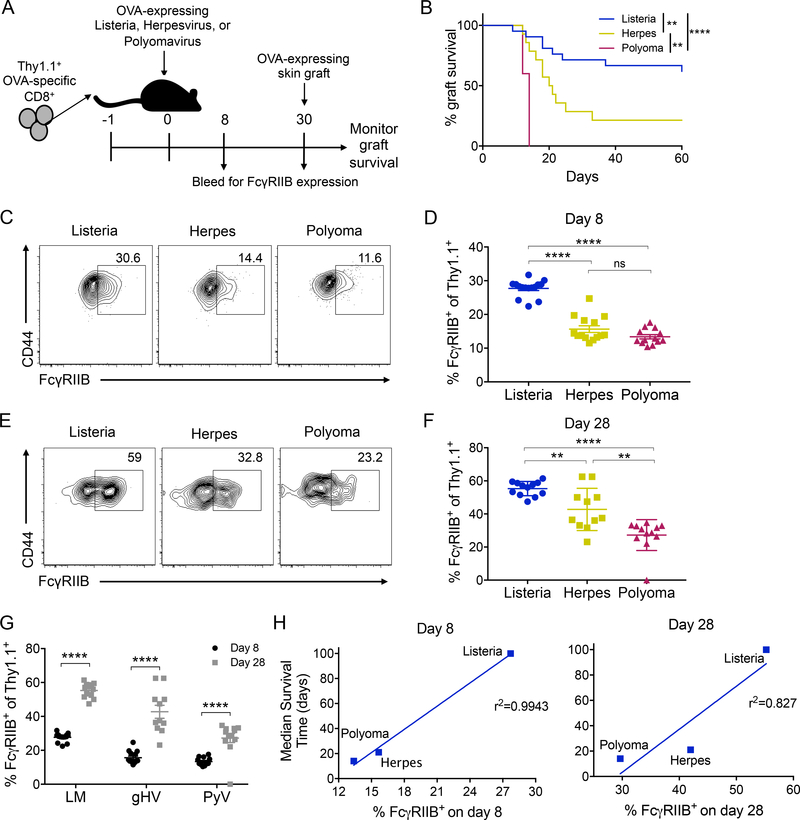
Figure 1:. Pathogen stimulation history modulates frequency of FcγRIIB-expressing cells and is correlated with prolonged graft survival.
OVA-specific Thy1.1+ CD8+ T cells (OT-I) were harvested from the spleen and adoptively transferred into WT B6 hosts that were then either infected with Listeria, Herpes, or Polyoma engineered to express OVA. Mice were bled on days 8 and 28. On day 30, mice were grafted with an OVA-expressing skin graft and treated with 250ug CTLA-4Ig, anti-CD154 (MR-1), and anti-VLA-4 on days 0, 2, 4 and 6 and graft survival was monitored. A) Schematic of experimental design. B) Graft survival, data from ref 13 Figure 3B–D, animals treated with CoB + anti- VLA4. Pooled data from two independent experiments, n=7 per group. A log-rank (Mantel-Cox) test was performed to compare groups **p<0.01, ****p<0.0001. C-D) Representative flow plots and summary data of the frequency of FcγRIIB-expressing cells on day 8 post infection in the peripheral blood. Pooled data from 2 independent experiments, n=7–8 mice per group. One-way ANOVA was performed with multiple comparisons, ****p<0.0001. E-F) Representative flow plots and summary data of the expression of FcγRIIB on day 28 post infection in the peripheral blood. Pooled data from 2 independent experiments, n=7–8 mice per group. One-way ANOVA was performed with multiple comparisons ****p<0.0001. G) Summary data of D and F comparing day 8 and 28 frequencies of FcγRIIB. Two-way ANOVA was performed with multiple comparisons, ****p<0.0001. H) Linear regression of the frequency of FcγRIIB-expressing OT-I T cells on day 8 and 28 post infection and the median survival time.
Figure 2:
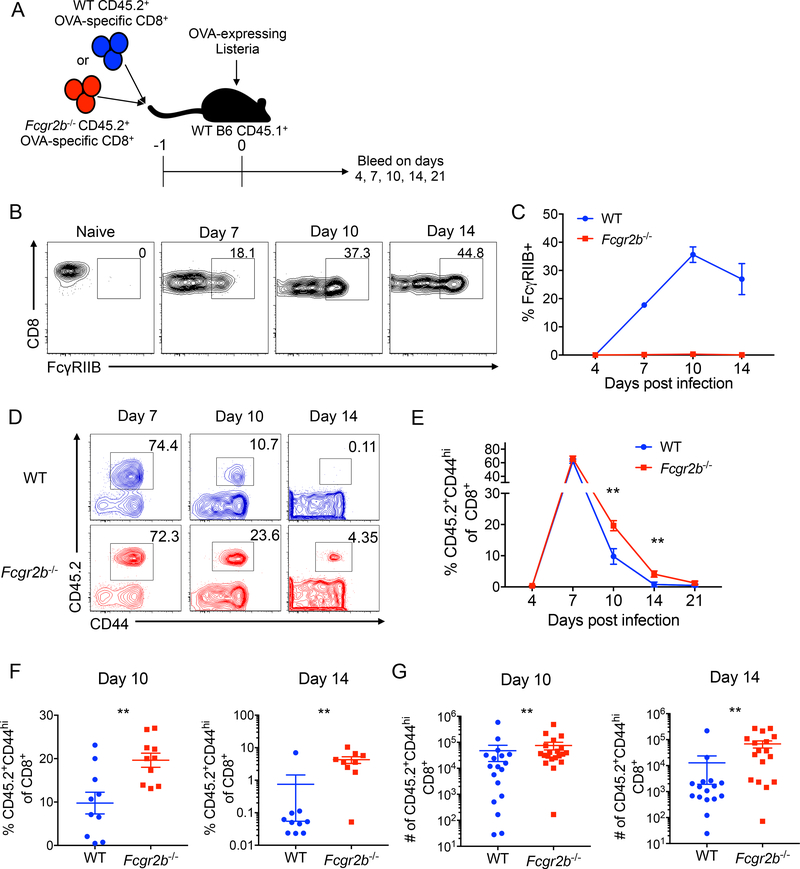
Figure 2:. FcγRIIB functions intrinsically to inhibit CD8+ T cell responses to Listeria.
WT OVA-specific CD45.2+ CD8+ T cells (WT OT-I) or Fcgr2b−/− OVA-specific CD45.2+ CD8+ T cells (Fcgr2b−/− OT-I) were harvested from the spleen and adoptively transferred into WT CD45.1+ C57BL/6 hosts that were then infected with Listeria and bled on days 4, 7, 10, 14, and 21. A) Schematic of experimental design. B-C) Representative flow plots and summary data of the frequency of FcγRIIB-expressing naïve and WT OT-I T cells on days 7, 10, and 14. Due to low cell number, FcγRIIB frequency could not be assessed on day 21. Representative data from two independent experiments, n=5 mice per group. D) Representative flow plots of the frequency of WT and Fcgr2b−/− OT-I T cells on days 7, 10, and 14. E) Summary data of the frequency of WT and FcγRIIB−/− OT-I T cells in the blood on days 4, 7, 10, 14 and 21. Representative data from two independent experiments, n=5 mice per group. Two-way ANOVA was performed, **p<0.01. F-G) Summary data of the frequency and absolute numbers of WT and Fcgr2b−/− OT-I T cells in the blood on days 10 and 14. Pooled data from 2–3 independent experiments, n=5 mice per group. Mann-Whitney t test was performed, **p<0.01.
Figure 3:
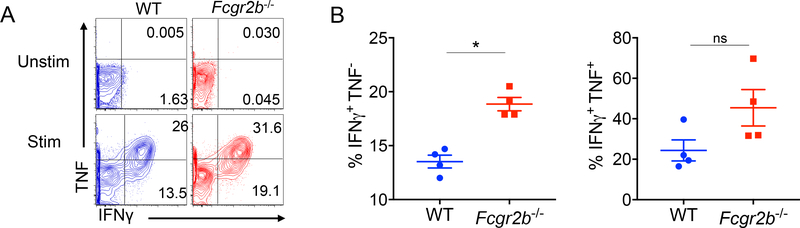
Figure 3:. Donor-specific T cells deficient of FcγRIIB maintain ability to produce effector cytokines.
WT OVA-specific CD45.2+ CD8+ T cells (WT OT-I) or Fcgr2b−/− OVA-specific CD45.2+ CD8+ T cells (Fcgr2b−/− OT-I) were harvested from the spleen and adoptively transferred into WT CD45.1+ C57BL/6 hosts that were then infected with Listeria. Animals were sacrificed and spleens were harvested on day 10 to assess cytokine response of the OT-I T cells. A) Representative flow plots of IFNγ- and TNF-producing OT-I T cells (splenocytes) on day 10 post adoptive transfer of either WT or Fcgr2b−/− OT-I T cells and subsequent infection with Listeria. B) Summary data of the frequency of IFNγ+TNF+ double-producing OT-I T cells and the frequency of single-producing IFNγ+TNF OT-I T cells. Representative data from two independent experiments, n=4–5 mice per group. Mann-Whitney t test was performed, *p<0.05, ns=nonsignficant.
Figure 4:
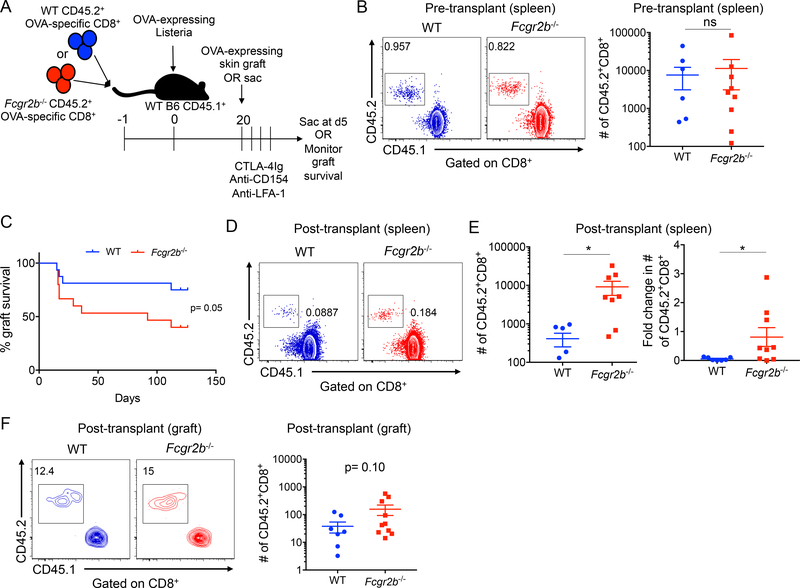
Figure 4:. FcγRIIB expression on memory CD8+ T cells modulates costimulation and integrin blockade resistance.
WT OVA-specific CD45.2+ CD8+ T cells (WT OT-I) or Fcgr2b−/− OVA-specific CD45.2+ CD8+ T cells (Fcgr2b−/− OT-I) were harvested from the spleen and adoptively transferred into WT CD45.1+ C57BL/6 hosts that were then infected with Listeria. A) Schematic of experimental design. B) Representative flow plots of WT and Fcgr2b−/− OT-I T cells (gated on CD8+) in the spleen on day 22 post infection. Summary data is also shown (due to logarithmic axis, zero values are not shown: 3 for WT, 1 for Fcgr2b−/−). Pooled data from two independent experiments, n=4–5 mice per group. Mann-Whitney T test was performed, ns=nonsignificant. C) On day 20, mice were grafted with OVA-expressing skin grafts and treated with 250ug CTLA-4Ig, anti-CD154 (MR-1), and anti-LFA-1 on days 0, 2, 4 and 6 and graft survival was monitored. Log-rank (Mantel-Cox) test was performed, p=0.05. D-F: On day 20, mice were grafted with OVA-expressing skin grafts and then sacrificed on day 5 and spleen and skin grafts were harvested. D) Representative flow plots of WT and Fcgr2b−/− CD45.2+ OT-I (gated on CD8+ T cells) from the spleen on day 5 post grafting. E) Summary data of the absolute cell number on day 5 and the fold change from day 22 in (B) to day 5 of WT and Fcgr2b−/− CD45.2+ OT-I from the spleen post grafting. Due to logarithmic axis, zero values are not shown: 2 for WT, 1 for Fcgr2b−/−. Pooled data from two independent experiments, n=4–5 mice per group. Mann-Whitney T test was performed, *p<0.05. F) Representative flow plots of WT and Fcgr2b−/− CD45.2+ OT-I (gated on CD8+ T cells) from the skin graft on day 5 post grafting. Summary data is also shown of the absolute cell number of WT and Fcgr2b−/− CD45.2+ OT-I from the skin graft on day 5 post grafting. Due to logarithmic axis, zero values are not shown: 1 for WT. Pooled data from two independent experiments, n=4–5 mice per group. Mann-Whitney t test was performed, p=0.10.

Comment in

References

    1. Heeger PS, Greenspan NS, Kuhlenschmidt S, Dejelo C, Hricik DE, Schulak JA, Tary-Lehmann M: Pretransplant frequency of donor-specific, IFN-gamma-producing lymphocytes is a manifestation of immunologic memory and correlates with the risk of posttransplant rejection episodes. J Immunol 1999, 163:2267–2275. - PubMed
    1. Nadazdin O, Boskovic S, Murakami T, Tocco G, Smith RN, Colvin RB, Sachs DH, Allan J, Madsen JC, Kawai T, et al. : Host alloreactive memory T cells influence tolerance to kidney allografts in nonhuman primates. Sci Transl Med 2011, 3:86ra51. - PMC - PubMed
    1. Krummey SM, Floyd TL, Liu D, Wagener ME, Song M, Ford ML: Candida-elicited murine Th17 cells express high Ctla-4 compared with Th1 cells and are resistant to costimulation blockade. J Immunol 2014, 192:2495–2504. - PMC - PubMed
    1. Cortes-Cerisuelo M, Laurie SJ, Mathews DV, Winterberg PD, Larsen CP, Adams AB, Ford ML: Increased Pretransplant Frequency of CD28(+) CD4(+) TEM Predicts Belatacept-Resistant Rejection in Human Renal Transplant Recipients. Am J Transplant 2017, 17:2350–2362. - PMC - PubMed
    1. Brehm MA, Markees TG, Daniels KA, Greiner DL, Rossini AA, Welsh RM: Direct visualization of cross-reactive effector and memory allo-specific CD8 T cells generated in response to viral infections. J Immunol 2003, 170:4077–4086. - PubMed

Publication types