Editorial
. 2019 Dec 27;5(3):252-254.
doi: 10.1016/j.ekir.2019.12.014. eCollection 2020 Mar.

Launching APOLLO: The Role of APOL1 Genetic Variants in Live- and Deceased-Donor Kidney Transplantation

Affiliations
Editorial

Launching APOLLO: The Role of APOL1 Genetic Variants in Live- and Deceased-Donor Kidney Transplantation

Federico Fuentes et al. Kidney Int Rep. .
No abstract available


Figures
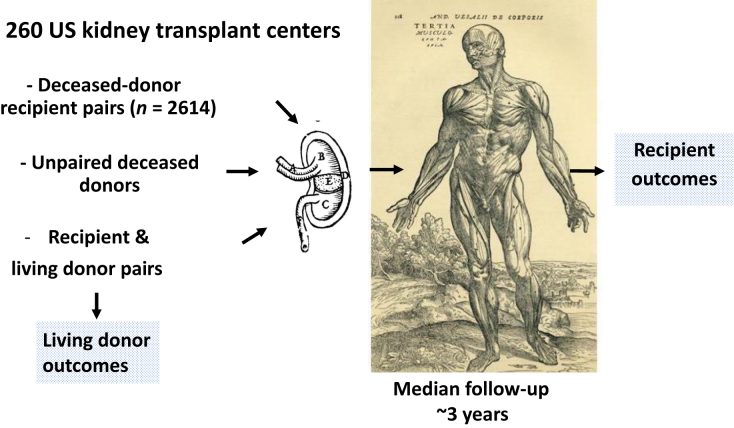
Figure 1
Figure 1
The 260 US transplant centers that are participating in the APOLLO study anticipate studying 2614 deceased-donor pairs (consisting of recipients and deceased donors) and additional numbers of unpaired deceased donors, as well as living donor and recipient pairs. Subjects will be studied at a median of 3 years after kidney transplantation, to evaluate renal outcomes among living donors and all recipients. Images are taken from woodcuts in De human corporis fabrica libri septum (1567, Basel, Switzerland) by Andries van Wesel (also known as Andreas Vesalius), the Flemish (Belgian) physician whose work on dissection of human cadavers and systematic and realistic textbooks revolutionized the field of anatomy.

Comment on

  • APOL1 Long-term Kidney Transplantation Outcomes Network (APOLLO): Design and Rationale.
    Freedman BI, Moxey-Mims MM, Alexander AA, Astor BC, Birdwell KA, Bowden DW, Bowen G, Bromberg J, Craven TE, Dadhania DM, Divers J, Doshi MD, Eidbo E, Fornoni A, Gautreaux MD, Gbadegesin RA, Gee PO, Guerra G, Hsu CY, Iltis AS, Jefferson N, Julian BA, Klassen DK, Koty PP, Langefeld CD, Lentine KL, Ma L, Mannon RB, Menon MC, Mohan S, Moore JB, Murphy B, Newell KA, Odim J, Ortigosa-Goggins M, Palmer ND, Park M, Parsa A, Pastan SO, Poggio ED, Rajapakse N, Reeves-Daniel AM, Rosas SE, Russell LP, Sawinski D, Smith SC, Spainhour M, Stratta RJ, Weir MR, Reboussin DM, Kimmel PL, Brennan DC. Freedman BI, et al. Kidney Int Rep. 2019 Dec 13;5(3):278-288. doi: 10.1016/j.ekir.2019.11.022. eCollection 2020 Mar. Kidney Int Rep. 2019. PMID: 32154449 Free PMC article.

References

    1. Freedman B.I., Moxey-Mims M.M., Alexander A.A. APOL1 Long-term Kidney Transplantation Outcomes Network (APOLLO): design and rationale. Kidney Int Rep. 2020;5:278–288. - PMC - PubMed
    1. Genovese G., Friedman D.J., Ross M.D. Association of trypanolytic ApoL1 variants with kidney disease in African Americans. Science. 2010;329:841–845. - PMC - PubMed
    1. Tzur S., Rosset S., Shemer R. Missense mutations in the APOL1 gene are highly associated with end stage kidney disease risk previously attributed to the MYH9 gene. Hum Genet. 2010;128:345–350. - PMC - PubMed
    1. Kopp J.B., Nelson G.W., Sampath K. APOL1 genetic variants in focal segmental glomerulosclerosis and HIV-associated nephropathy. J Am Soc Nephrol. 2011;22:2129–2137. - PMC - PubMed
    1. Lipkowitz M.S., Freedman B.I., Langefeld C.D. Apolipoprotein L1 gene variants associate with hypertension-attributed nephropathy and the rate of kidney function decline in African Americans. Kidney Int. 2013;83:114–120. - PMC - PubMed

LinkOut - more resources
