


immuneSIM: tunable multi-feature simulation of B- and T-cell receptor repertoires for immunoinformatics benchmarking
- PMID: 32154832
- PMCID: PMC7334888
- DOI: 10.1093/bioinformatics/btaa158
immuneSIM: tunable multi-feature simulation of B- and T-cell receptor repertoires for immunoinformatics benchmarking
Abstract
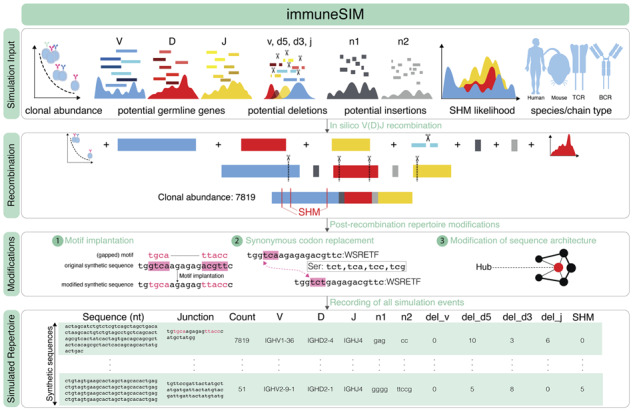
Summary: B- and T-cell receptor repertoires of the adaptive immune system have become a key target for diagnostics and therapeutics research. Consequently, there is a rapidly growing number of bioinformatics tools for immune repertoire analysis. Benchmarking of such tools is crucial for ensuring reproducible and generalizable computational analyses. Currently, however, it remains challenging to create standardized ground truth immune receptor repertoires for immunoinformatics tool benchmarking. Therefore, we developed immuneSIM, an R package that allows the simulation of native-like and aberrant synthetic full-length variable region immune receptor sequences by tuning the following immune receptor features: (i) species and chain type (BCR, TCR, single and paired), (ii) germline gene usage, (iii) occurrence of insertions and deletions, (iv) clonal abundance, (v) somatic hypermutation and (vi) sequence motifs. Each simulated sequence is annotated by the complete set of simulation events that contributed to its in silico generation. immuneSIM permits the benchmarking of key computational tools for immune receptor analysis, such as germline gene annotation, diversity and overlap estimation, sequence similarity, network architecture, clustering analysis and machine learning methods for motif detection.
Availability and implementation: The package is available via https://github.com/GreiffLab/immuneSIM and on CRAN at https://cran.r-project.org/web/packages/immuneSIM. The documentation is hosted at https://immuneSIM.readthedocs.io.
Contact: sai.reddy@ethz.ch or victor.greiff@medisin.uio.no.
Supplementary information: Supplementary data are available at Bioinformatics online.
© The Author(s) 2020. Published by Oxford University Press. All rights reserved. For permissions, please e-mail: journals.permissions@oup.com.
Figures
References
-
- Arora R. et al. (2019) Repertoire-based diagnostics using statistical biophysics. bioRxiv, doi: 10.1101/519108.
-
- Brown A.J. et al. (2019) Augmenting adaptive immunity: progress and challenges in the quantitative engineering and analysis of adaptive immune receptor repertoires. Mol. Syst. Des. Eng., 4, 701–736.
-
- Emerson R.O. et al. (2017) Immunosequencing identifies signatures of cytomegalovirus exposure history and HLA-mediated effects on the T cell repertoire. Nat. Genet., 49, 659–665. - PubMed
Publication types
MeSH terms
Substances
LinkOut - more resources
Full Text Sources
Other Literature Sources
