. 2020 May;8(5):e1205.
doi: 10.1002/mgg3.1205. Epub 2020 Mar 10.

Diagnostic value of whole-exome sequencing in Chinese pediatric-onset neuromuscular patients

Affiliations

Diagnostic value of whole-exome sequencing in Chinese pediatric-onset neuromuscular patients

Mandy H Y Tsang et al. Mol Genet Genomic Med. 2020 May.

Abstract

Background: Neuromuscular disorders (NMDs) comprise a group of heterogeneous genetic diseases with a broad spectrum of overlapping the clinical presentations that makes diagnosis challenging. Notably, the recent introduction of whole-exome sequencing (WES) is introducing rapid changes on the genetic diagnosis of NMDs. We aimed to investigate the diagnostic value of WES for pediatric-onset NMDs.

Methods: We applied integrated diagnostic approach and performed WES in 50 Chinese subjects (30 males, 20 females) with undiagnosed pediatric-onset NMDs despite previous specific tests. The patients were categorized in four subgroups according to phenotyping and investigation findings. Variants on NMDs gene list and open exome analysis for those with initial negative findings were identified.

Results: WES identified causative variants in ACTA1 (n = 2), POMT1, COL6A1 (n = 2), MTMR2, LMNA, SELENON, DNM2, TGFB1, MPZ, IGHMBP2, and LAMA2 in 13 patients. Two subjects have variants of uncertain significance (VUSs) in TTN and SCN11A, unlikely to be pathogenic due to incompatible phenotypes. The mean interval time from symptom onset to genetic diagnosis was 10.4 years (range from 1 month to 33 years). The overall diagnostic yield of WES in our cohort was 26%. Open exome analysis was necessary to identify the pathogenic variant in TGFB1 that caused skeletal dysplasia with neuromuscular presentation.

Conclusion: Our study shows a clear role of WES in the pathway of integrated diagnostic approach to shorten the diagnostic odyssey in patients with rare NMDs.

Keywords: integrated approach; neuromuscular disorders; pediatric-onset; whole-exome sequencing.


Conflict of interest statement

All authors have no conflict of interest to declare.

Figures
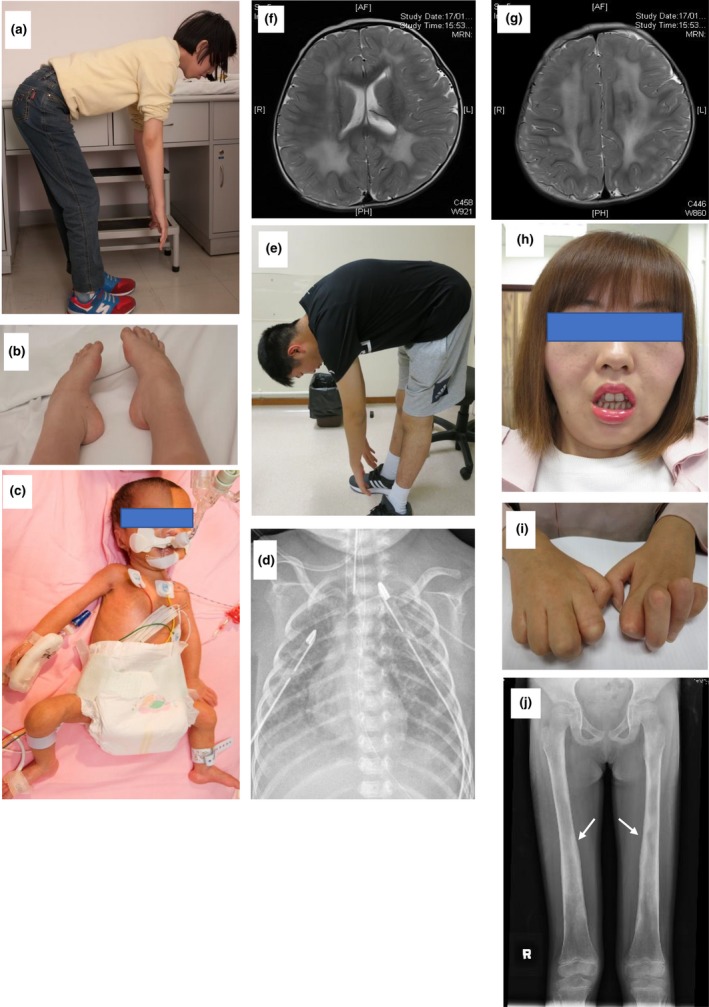
Figure 1
Figure 1
(a, b) Patient with heterozygous novel variant in ACTA1 has rigid spine and pes cavus. (c, d) Patient with heterozygous reported variant in ACTA1 had flaccid posture with minimal skin creases. Chest X‐ray demonstrated bilateral chest drains with residual chylothorax on the right side. (e) Patient with compound heterozygous variants in SELENON has rigid spine. (f, g) Patient with compound heterozygous variants in LAMA2 has the axial view of her T2 weighted MRI brain images shown diffuse cerebral white matter signal changes compatible to merosin‐deficient congenital muscular dystrophy. (h, i) Patient with compound heterozygous loss‐of‐function variants in the MTMR2, with facial weakness and marked finger contractures with distal hand wasting. (j) Patient with heterozygous reported pathogenic variant in TGFB1 with thickening of the diaphyseal bones (white arrows) on her X‐ray of bilateral femurs
Figure 2
Figure 2
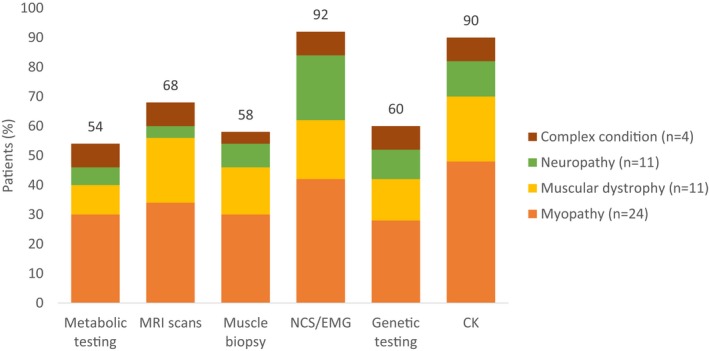
Summary of patients in each phenotypic category with prior neuromuscular investigations including metabolic testing, MRI scan, muscle biopsy, nerve conduction study/electromyography, genetic testing, and creatine kinase testing. CK, creatine kinase; EMG, electromyography; MRI, magnetic Resonance Imaging; NCS, nerve conduction study
Figure 3
Figure 3
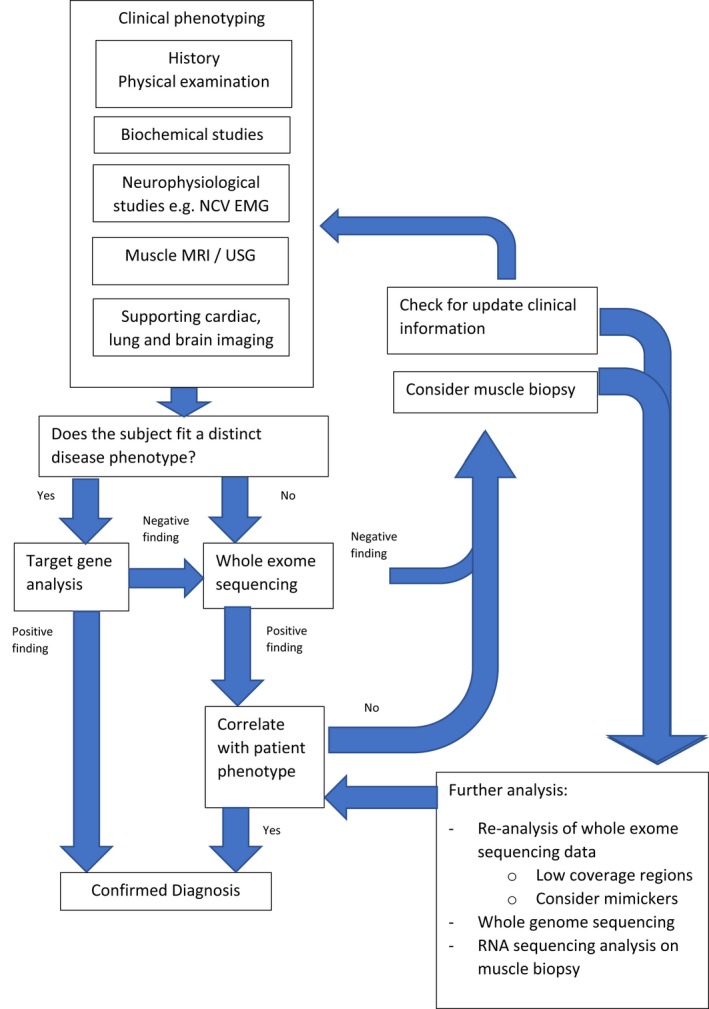
Proposed integrated diagnostic approach of neuromuscular disorders

References

    1. Ankala, A. , da Silva, C. , Gualandi, F. , Ferlini, A. , Bean, L. J. H. , Collins, C. , … Hegde, M. R. (2015). A comprehensive genomic approach for neuromuscular diseases gives a high diagnostic yield. Annals of Neurology, 77(2), 206–214. 10.1002/ana.24303 - DOI - PubMed
    1. Bertier, G. , Hétu, M. , & Joly, Y. (2016). Unsolved challenges of clinical whole‐exome sequencing: A systematic literature review of end‐users' views. BMC Medical Genomics, 9(1), 52–52. 10.1186/s12920-016-0213-6 - DOI - PMC - PubMed
    1. Bitoun, M. , Bevilacqua, J. A. , Prudhon, B. , Maugenre, S. , Taratuto, A. L. , Monges, S. , … Guicheney, P. (2007). Dynamin 2 mutations cause sporadic centronuclear myopathy with neonatal onset. Annals of Neurology, 62(6), 666–670. 10.1002/ana.21235 - DOI - PubMed
    1. Bolino, A. , Bolis, A. , Previtali, S. C. , Dina, G. , Bussini, S. , Dati, G. , … Wrabetz, L. (2004). Disruption of Mtmr2 produces CMT4B1‐like neuropathy with myelin outfolding and impaired spermatogenesis. The Journal of Cell Biology., 167(4), 711–721. 10.1083/jcb.200407010 - DOI - PMC - PubMed
    1. Bonne, G. , Barletta, M. R. D. , Varnous, S. , Bécane, H.‐M. , Hammouda, E.‐H. , Merlini, L. , … Schwartz, K. (1999). Mutations in the gene encoding lamin A/C cause autosomal dominant Emery‐Dreifuss muscular dystrophy. Nature Genetics, 21(3), 285 10.1038/6799 - DOI - PubMed

Publication types